How to Optimize Vector Database Costs for LLM Apps
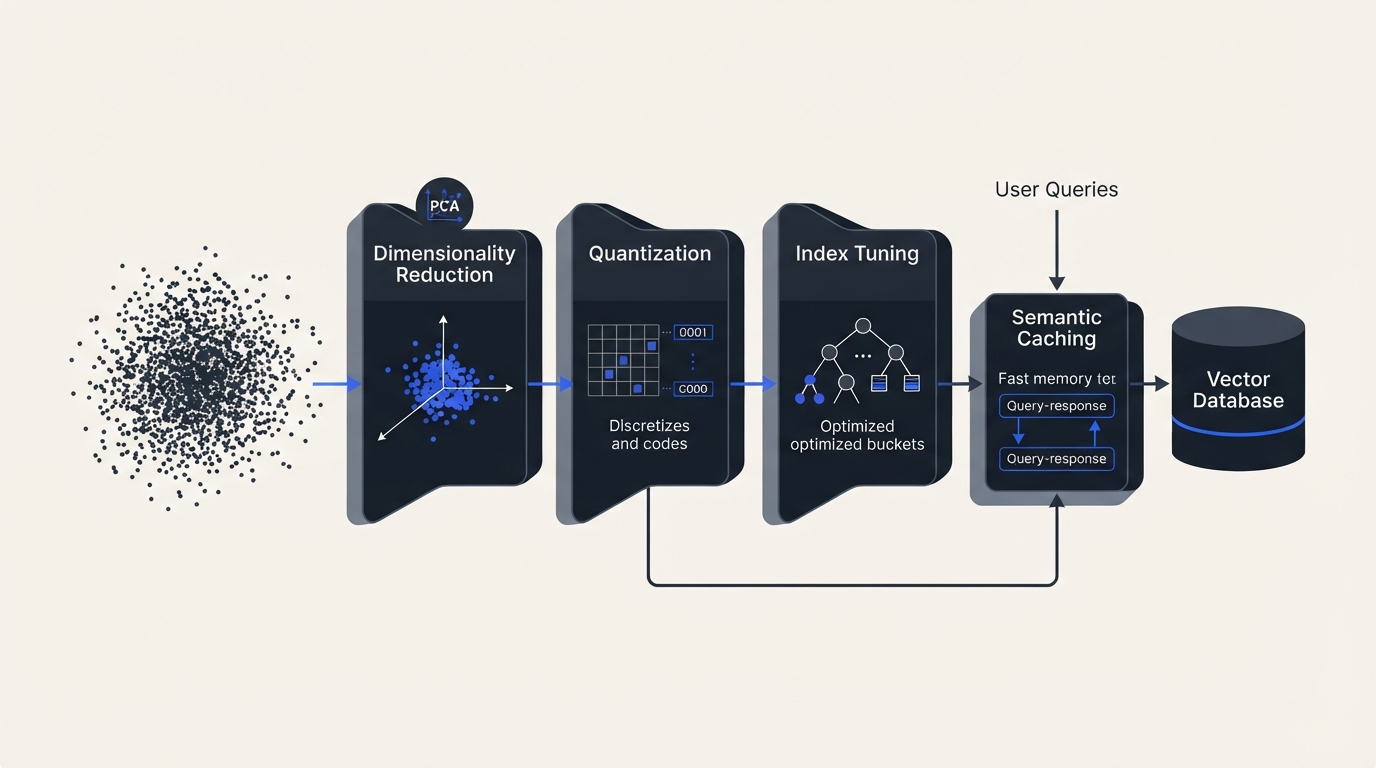
What Are the Primary Cost Drivers in Production Vector Databases?
Scaling production artificial intelligence systems introduces unique financial burdens across cloud infrastructure. While API token consumption for foundational models often commands initial budget discussions, vector database operations rapidly emerge as one of the largest recurring line items. Industry analyses demonstrate that vector storage and retrieval can account for 40 to 50 percent of total production expenses in retrieval-augmented generation architectures, ranking second only to direct model inference fees.
Understanding where this capital goes requires examining how vector stores operate differently from traditional relational systems. Conventional databases rely heavily on disk-based B-trees for exact record lookups. In contrast, high-performance vector search relies on specialized approximate nearest neighbor indexes. These indexes require massive amounts of random access memory to maintain low-latency similarity retrieval, making resource provisioning expensive as document corpuses expand.
When engineering teams deploy uncompressed float32 embeddings across millions of chunks, memory allocations compound quickly. A standard 1536-dimension embedding model generates substantial numeric arrays that must remain readily accessible to satisfy real-time user requests. Without deliberate architectural intervention, memory footprint expansion directly triggers aggressive horizontal node scaling, resulting in unsustainable cloud expenditures.
- Memory dominance accounts for 85 to 90 percent of operational database spend in high-throughput vector clusters.
- High-dimensional vectors scale linearly and non-linearly with multi-tenant document chunking and ingestion pipelines.
- Continuous approximate nearest neighbor graph traversals demand sustained multi-core CPU and GPU processing power.
The Challenge of RAM Dominance
High-performance vector indexes must reside primarily in active physical memory to satisfy strict latency service-level agreements below one hundred milliseconds. When an index outgrows available physical memory, the operating system is forced into disk paging, which degrades query throughput and introduces catastrophic latency spikes for end users.
Provisioning massive memory-optimized server instances just to host raw, uncompressed floating-point vectors quickly strains infrastructure budgets. Engineering leaders evaluating long-term technical roadmaps on the SnapKodex home portal frequently discover that unmanaged RAM growth is the single greatest inhibitor of sustainable margin expansion in AI software.
High-Dimensional Footprint Bloat
Standard embedding configurations generate wide numeric vectors for every chunk of enterprise data ingested into the system. Multiplying thousands of float32 values across hundreds of thousands of multi-tenant knowledge base documents leads to exponential storage consumption.
As organizations scale document ingestion to support complex retrieval workflows, storing raw representations without pre-filtering or dimensionality controls leads to rapid resource waste. Capping this raw footprint is an immediate technical prerequisite for long-term viability.
How Does Vector Quantization Reduce Memory and Infrastructure Costs?
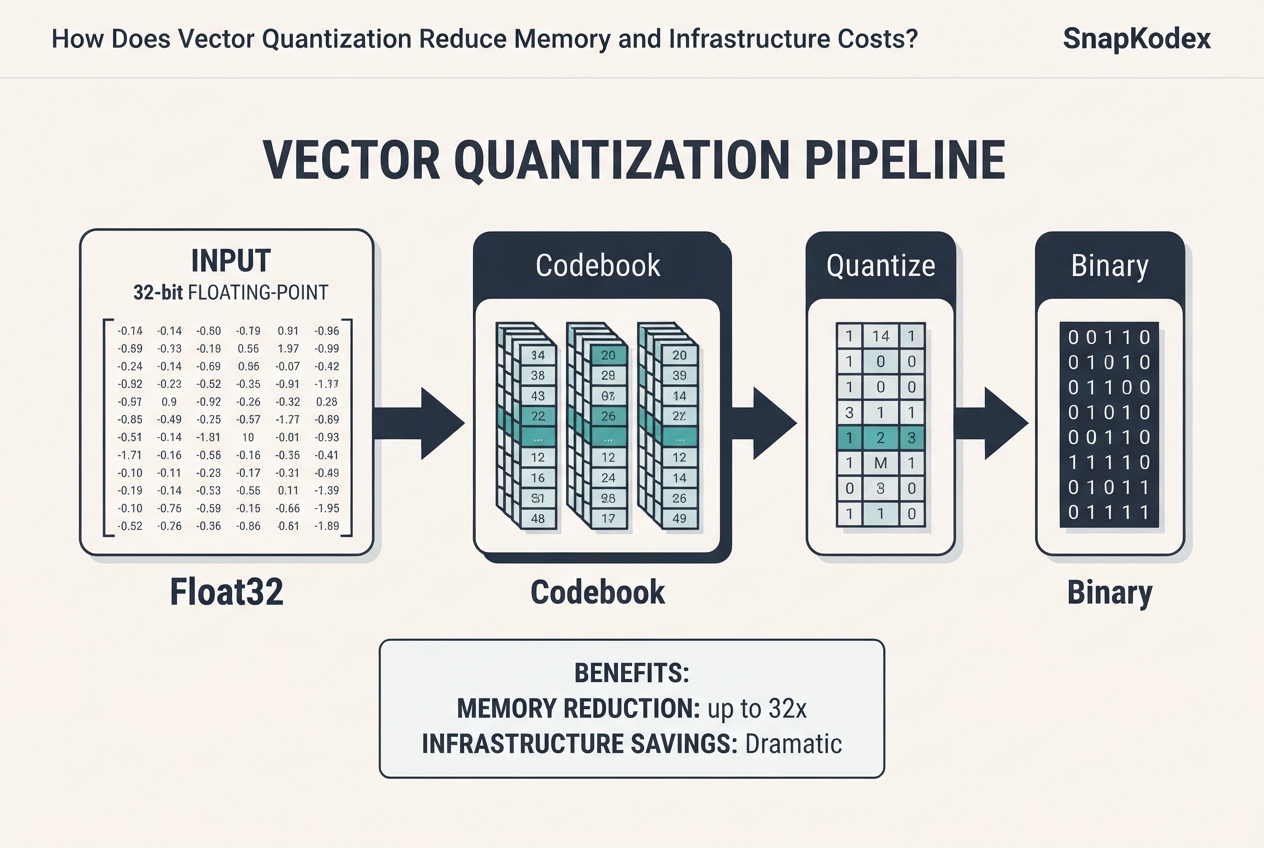
Vector quantization is one of the most effective engineering interventions for reducing physical memory pressure in production pipelines. By compressing high-precision 32-bit floating-point numbers into compact numeric representations or binary sequences, engineering teams can dramatically shrink index footprints without rebuilding their fundamental data pipelines.
Modern vector retrieval engines implement diverse quantization strategies that yield massive infrastructure cost savings. Industry benchmarks confirm that adopting product quantization or binary quantization can reduce memory consumption by four to thirty-two times. These compression techniques preserve critical geometric distances between vectors, allowing systems to maintain high recall accuracy while operating on significantly smaller hardware footprints.
Quantization also provides immediate throughput advantages. Smaller vectors reduce CPU cache misses and accelerate distance calculation loops during similarity evaluations. By lowering hardware resource requirements, engineering teams can deploy larger vector collections on compact node clusters, unlocking predictable operating expenditures.
- Scalar quantization compresses 32-bit floating-point values into 8-bit integers, yielding an instant fourfold memory reduction.
- Product quantization splits vectors into smaller sub-vectors and encodes them using discrete centroid codebooks.
- Binary quantization converts continuous float values into single-bit representations, delivering up to thirty-two times compression.
Implementing Product Quantization
Product quantization divides high-dimensional vectors into distinct lower-dimensional sub-vectors and clusters each subspace into representative centroids. During query execution, the vector engine computes asymmetric distance approximations against these precomputed centroids rather than full vectors.
This architectural mechanism eliminates the need to hold full floating-point arrays in active RAM. Production teams managing extensive enterprise documentation find that product quantization achieves between fourfold and eightfold memory reductions with virtually imperceptible degradation in top-k retrieval precision.
Unlocking Extreme Gains with Binary Quantization
For large-scale vector search workloads handling tens of millions of documents, binary quantization provides maximum compression. It maps each floating-point dimension to a single bit based on whether the value is positive or negative, transforming floating-point operations into rapid Hamming distance calculations.
While binary quantization requires validating domain-specific evaluation sets to confirm that semantic relevance remains within strict operational tolerances, it reduces index sizes by up to thirty-two times. This breakthrough makes multi-million vector datasets manageable on standard, cost-effective compute instances.
Can Dimensionality Reduction Lower High-Dimensional Storage Overhead?
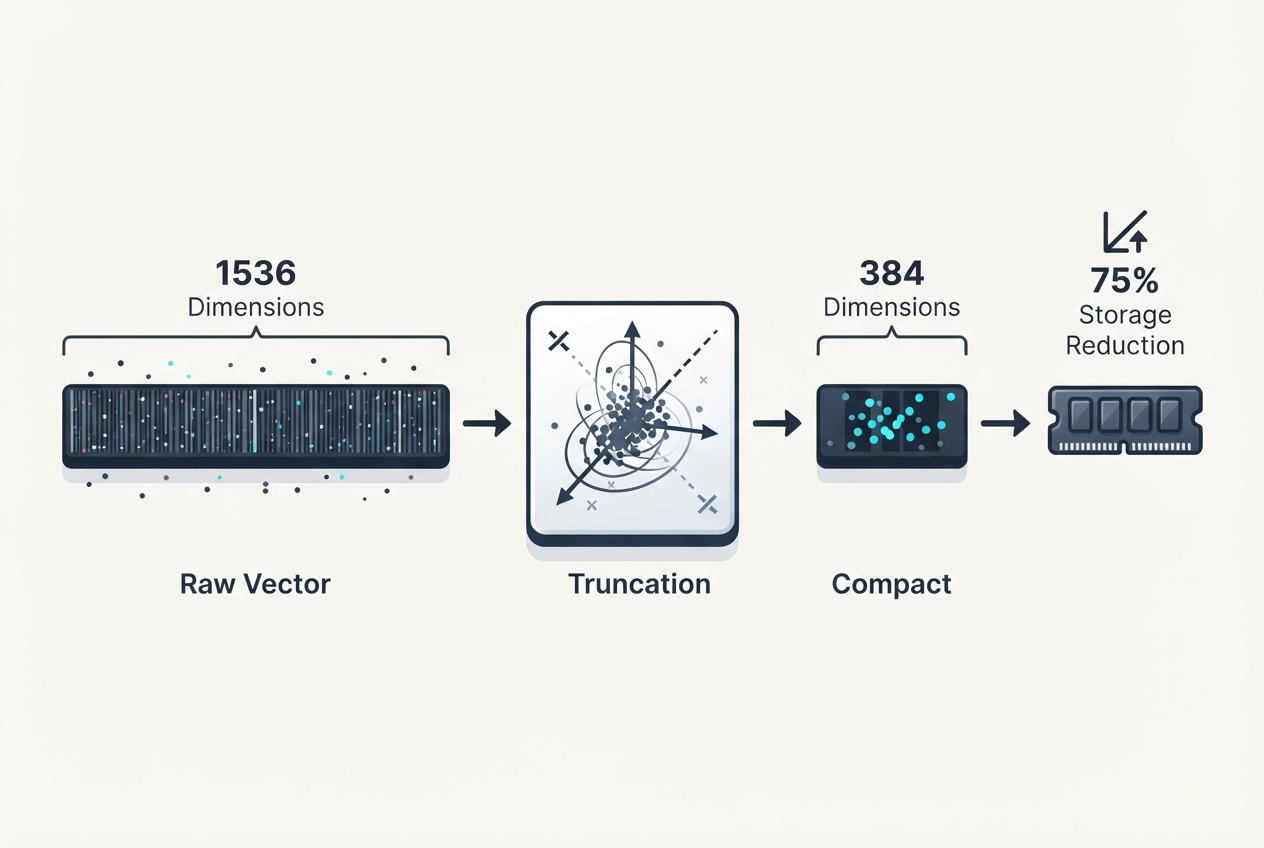
Beyond post-generation compression techniques like quantization, engineering teams can minimize vector database footprints by addressing vector dimensionality directly during model ingestion. Truncating unnecessary vector dimensions before index insertion prevents redundant data from ever entering your production memory pool.
Techniques such as Principal Component Analysis, Singular Value Decomposition, and modern Matryoshka embedding models allow developers to truncate embedding vectors while preserving over 95 percent of semantic information. For example, reducing an embedding configuration from 1536 dimensions down to 384 dimensions immediately slashes raw storage and memory requirements by 75 percent across the entire cluster.
Engineering organizations optimizing multi-stage retrieval pipelines can review specialized SnapKodex services to systematically evaluate their data ingestion architectures and maintain optimal throughput without exceeding cloud infrastructure allowances.
- Dimension truncation reduces linear memory and storage consumption by up to seventy-five percent.
- Matryoshka representation learning allows dynamic length adjustments tailored to distinct performance tiers.
- Linear projection methods remove redundant mathematical noise across high-dimensional feature spaces.
Principal Component Analysis and Truncation
Linear dimensionality reduction projects high-dimensional embedding spaces into lower-dimensional subspaces while retaining maximal variance across the corpus. Applying Principal Component Analysis identifies dimensions that contribute little semantic differentiation, enabling safe mathematical pruning.
Executing this transformation within the data preparation pipeline ensures that downstream databases only store dense, high-signal vector representations. This architectural discipline prevents cluster bloating and reduces baseline storage billing across all multi-tenant environments.
Matryoshka Embedding Architectures
Modern embedding architectures trained with Matryoshka representation learning structure semantic information hierarchically within vector outputs. The early dimensions encapsulate broad conceptual signals, while subsequent dimensions capture granular semantic details.
This hierarchical design allows applications to store compact vector prefixes for rapid, low-cost initial retrieval filtering. Teams can drop trailing vector dimensions entirely when operating under strict infrastructure budgets without sacrificing the core retrieval relevance of their search pipelines.
How Do Index Architecture Tuning and Disk Offloading Optimize TCO?
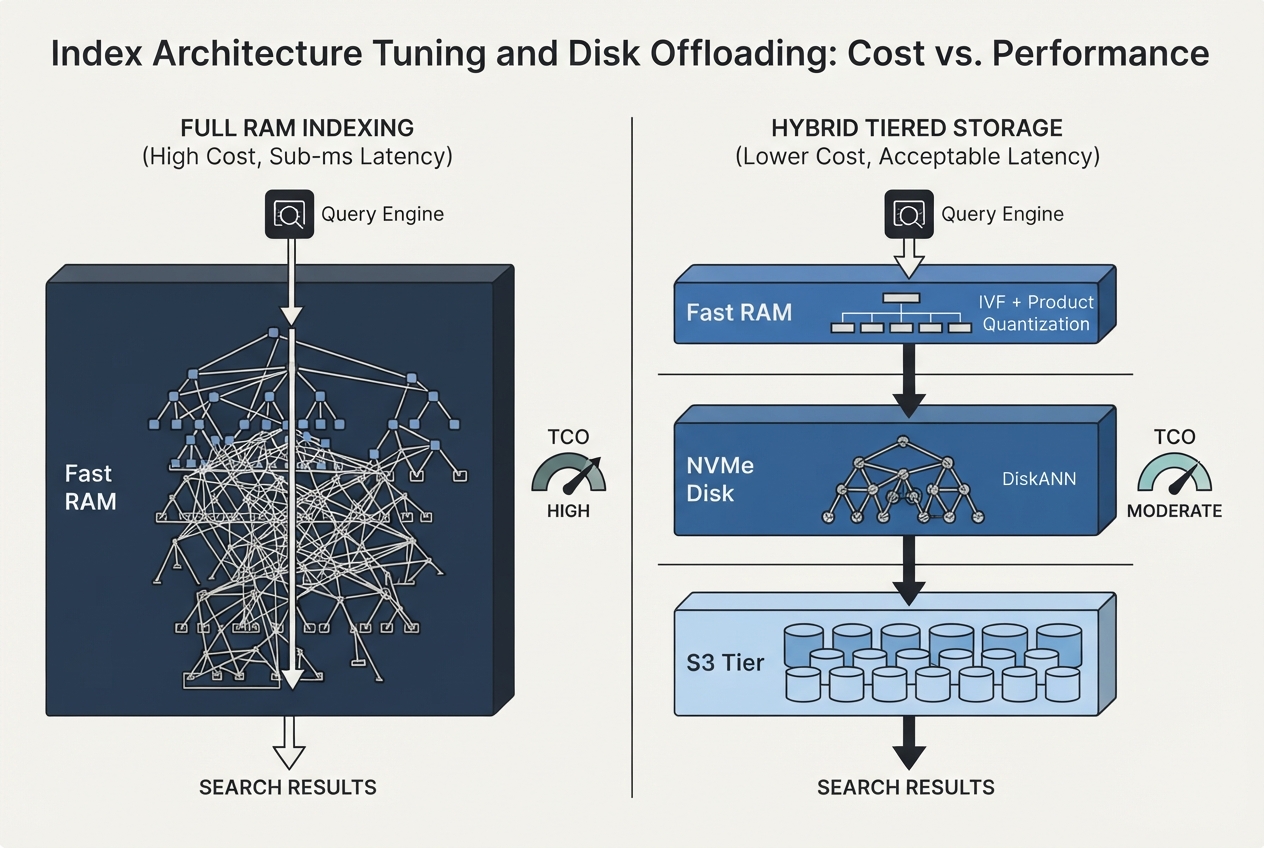
Index configuration choices directly dictate memory overhead and query execution costs. While Hierarchical Navigable Small World graphs deliver rapid sub-millisecond retrieval, they carry substantial memory overhead due to complex multi-layer graph structures and proximity links.
Engineering teams can re-evaluate index structures based on empirical latency requirements rather than default configurations. Trading memory-intensive graph indexes for Inverted File indexes combined with product quantization significantly lowers RAM consumption while maintaining acceptable recall latency for enterprise business workflows.
Furthermore, decoupled architectures that offload static vector segments to cost-effective object storage tiers allow teams to keep only active query indexes in memory. Organizations seeking tailored architectural transformations can Contact SnapKodex to audit existing index topologies and establish cost-efficient retrieval clusters.
- Inverted File indexes drastically reduce index graph construction overhead compared to raw HNSW.
- Disk-backed index implementations such as DiskANN leverage solid-state drives to lower active RAM demand.
- Decoupled storage patterns separate high-cost search compute from scalable long-term vector persistence.
Evaluating HNSW Versus IVF Indexes
Hierarchical Navigable Small World graphs maintain multiple layers of interconnected nodes, requiring continuous memory to hold node references alongside raw vectors. In high-concurrency environments, this index graph overhead alone can double total memory requirements.
By switching to Inverted File indexes, systems cluster vector spaces into Voronoi partitions and inspect only relevant centroid lists during queries. This approach eliminates graph memory overhead, allowing teams to trade minor latency margins for massive cloud infrastructure cost reductions.
Leveraging DiskANN and Tiered Storage
Modern high-density vector engines increasingly incorporate disk-backed indexing strategies like DiskANN. By storing quantized routing vectors in active memory and keeping full vectors on high-speed solid-state drives, disk-backed indexes preserve query precision while minimizing RAM overhead.
Implementing tiered storage patterns ensures that historical document chunks remain parked in inexpensive object storage until accessed. This hybrid pattern allows enterprise RAG systems to scale into millions of indexed documents without precipitating exponential hardware costs.
Why Is Semantic Caching Essential for Retrieval-Augmented Generation?
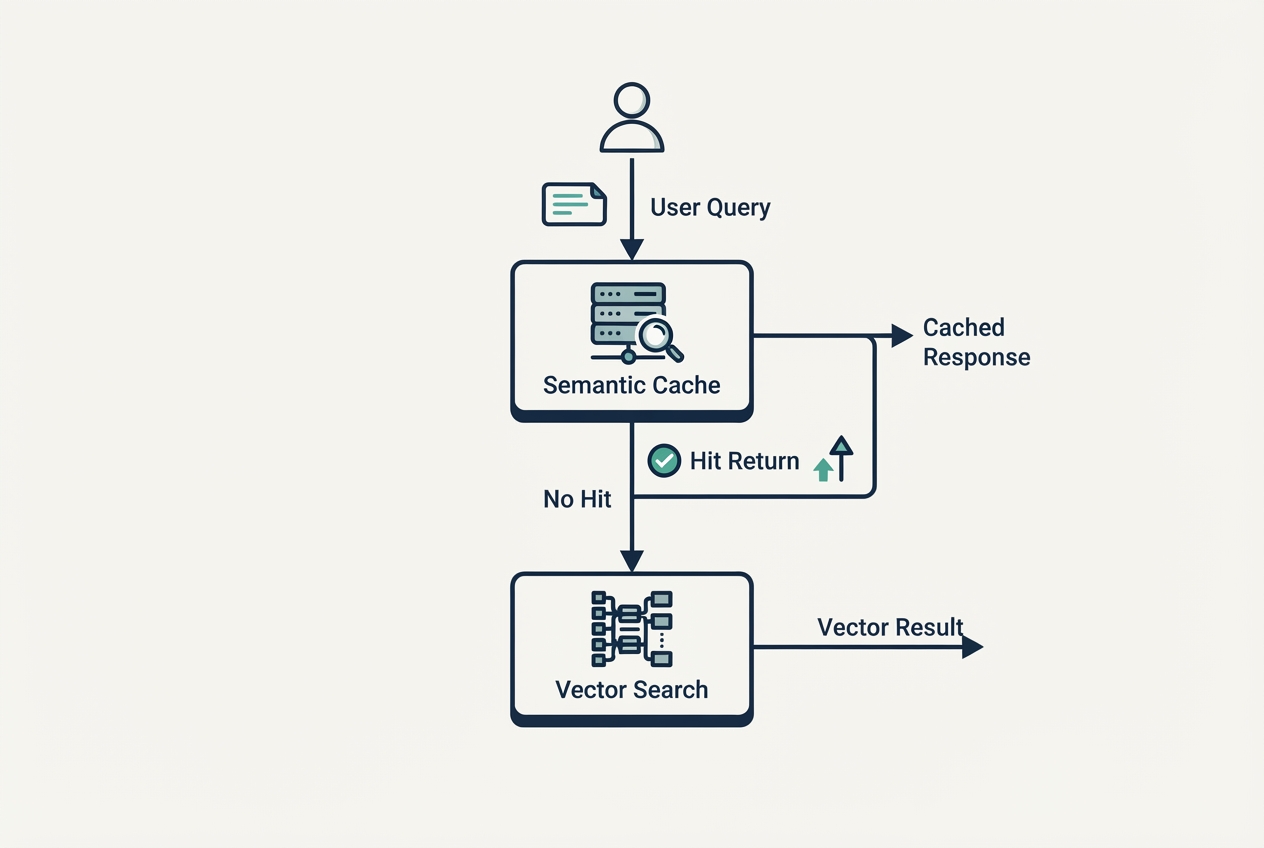
Optimizing storage representations and tuning vector indexes solves the persistence footprint challenge, but query processing patterns remain a major operational expense driver. Every raw vector search query consumes compute cycles, traversals, and potential database read units.
Implementing an intelligent semantic caching layer intercepts user queries before they reach the vector database. User traffic in customer support and search applications frequently exhibits high topic clustering, with diverse users posing identical or closely related questions throughout the day.
A semantic cache stores previously resolved vector queries and their associated retrieval contexts or generated model responses in a fast, in-memory key-value database. Engineering teams investing in structured documentation pipelines can explore https://snapkodex.com/services/seo-content to discover how streamlined technical content frameworks reduce repetitive user query overhead across digital touchpoints.
- Semantic caching prevents redundant vector searches by serving cached responses for similar queries.
- Fast key-value stores provide sub-millisecond retrieval checks, lowering vector database query loads.
- Caching reduces downstream language model token consumption by returning validated generation outputs.
Operating Mechanics of Semantic Caching
When an incoming query arrives, the semantic cache generates a lightweight query embedding and checks for near-identical vectors within a localized, compact index. If similarity exceeds a predefined threshold, the system immediately returns the cached context.
This bypass pattern eliminates repetitive vector database lookups and avoids invoking expensive generative foundation models. By serving recurring user queries directly from the cache, engineering teams achieve dramatic compute savings across their production pipelines.
Setting Cache Eviction and Similarity Thresholds
Operating a reliable semantic cache requires balancing similarity thresholds against semantic drift. Setting similarity requirements too loosely causes inaccurate cache hits, while overly strict thresholds reduce cache hit rates and diminish cost savings.
Teams should establish automated cache invalidation policies tied to knowledge base updates. When underlying documentation changes, corresponding semantic cache entries must clear instantly to prevent delivering outdated context to production language models.
Vector Database Optimization Strategy Comparison
Evaluating memory reduction factors, implementation complexity, and accuracy trade-offs across common vector database cost reduction techniques.
| Optimization Strategy | Memory Reduction | Implementation Complexity | Accuracy Impact |
|---|---|---|---|
| Product Quantization | 4x to 8x reduction | Moderate | Negligible loss in semantic recall |
| Binary Quantization | 16x to 32x reduction | High | Minor degradation; requires domain validation |
| Dimensionality Reduction (PCA) | 2x to 4x reduction | Moderate | Low semantic loss when preserving top variance |
| Disk-Backed Indexes (DiskANN) | 5x to 10x RAM reduction | High | No precision loss; slight read latency increase |
| Semantic Caching | Reduces query compute by 20–50% | Low | Zero degradation for verified cache hits |
Frequently asked questions
What drives up vector database costs in production LLM applications?
Vector database costs are primarily driven by RAM dominance, as high-performance approximate nearest neighbor indexes must reside in physical memory to maintain sub-100ms query latencies. High-dimensional embeddings and continuous compute overhead for graph traversals further inflate infrastructure bills.
How much can quantization reduce vector storage expenses?
Quantization techniques such as product quantization and binary quantization can compress vector memory footprints by four to thirty-two times. This dramatically lowers cluster memory requirements and associated server node costs while preserving high retrieval recall.
Does dimensionality reduction degrade retrieval relevance in RAG systems?
Truncating dimensions using PCA or Matryoshka embeddings can reduce raw footprints by up to 75 percent with minimal recall loss. However, engineering teams must evaluate compressed vectors against domain-specific test suites to ensure subtle contextual distinctions are maintained.
How does semantic caching help lower overall database expenses?
Semantic caching intercepts repeated or semantically equivalent user queries in a fast key-value store, returning verified responses instantly without invoking the vector database or foundation model inference APIs, significantly reducing compute and read unit charges.