How to Measure Developer Productivity with AI Tools
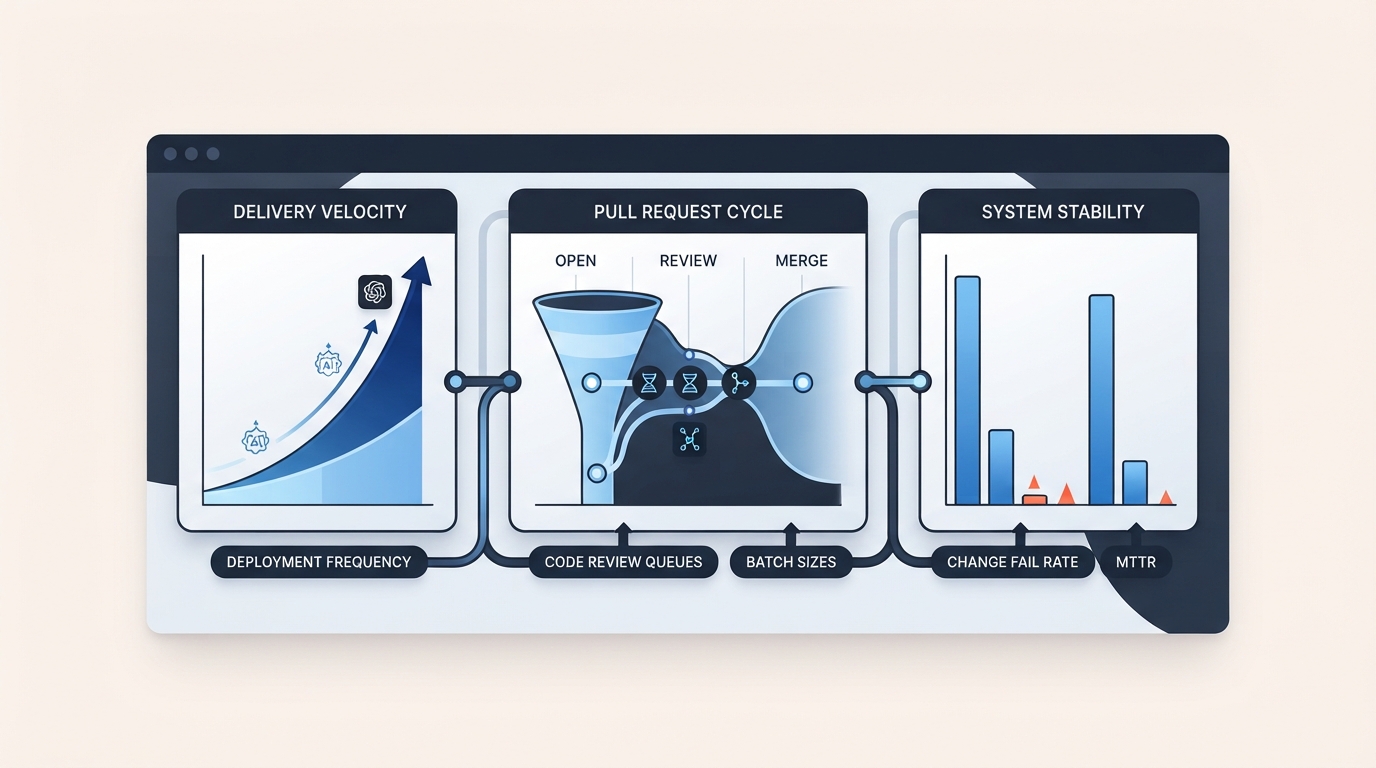
Why Do Traditional Metrics Fail When Evaluating AI Coding Assistants?
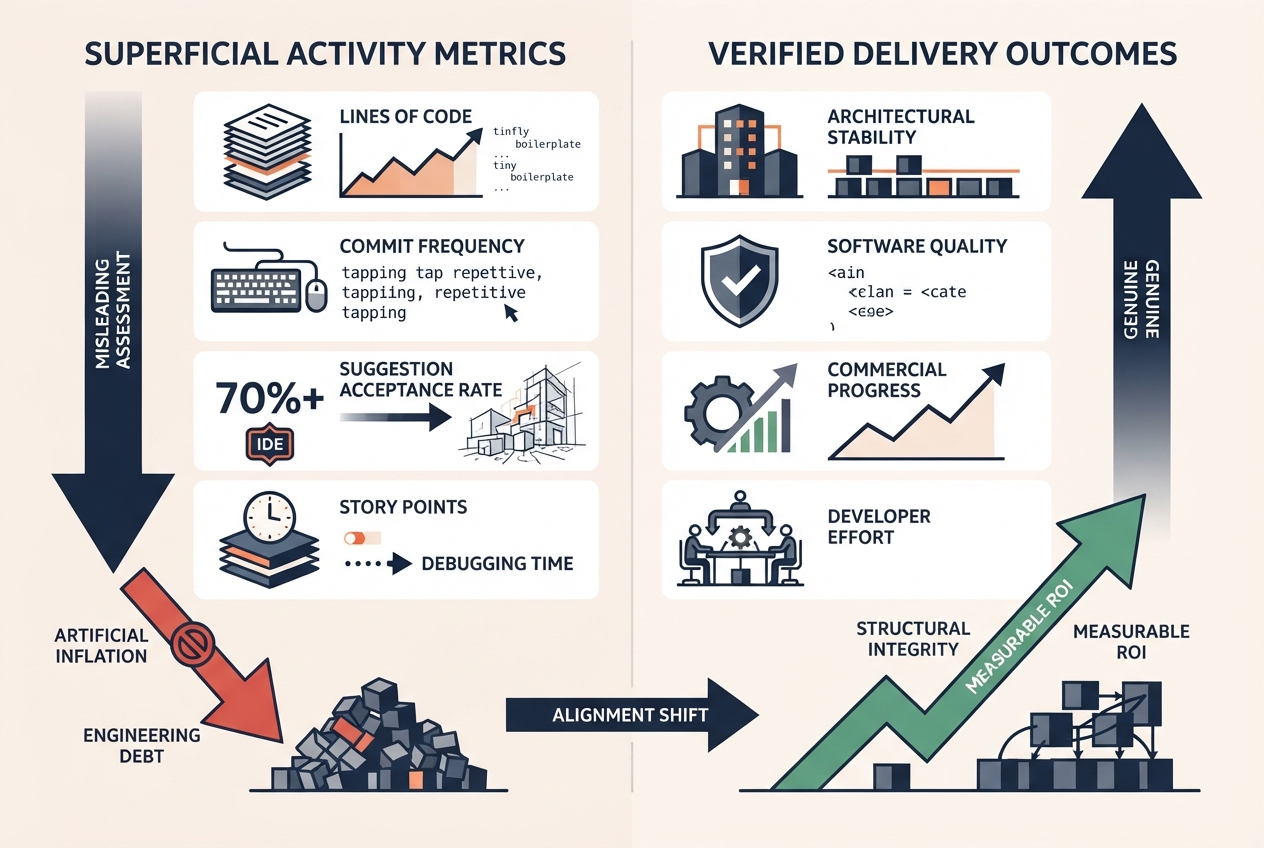
The integration of artificial intelligence coding assistants into software engineering workflows has dismantled conventional productivity evaluation. Historically, engineering managers relied on volume-centric measurements such as lines of code, commit frequency, and story points to track velocity. However, research indicates that roughly half of professional code in automated environments is now AI-assisted or generated. These automated tools produce boilerplate configurations, repetitive functions, and unit test skeletons within seconds. Consequently, measuring raw text generation no longer reflects developer effort, intellectual problem-solving, or commercial progress. Emphasizing output volume simply encourages developers to commit larger volumes of synthetic code without improving overall application architecture.
Similarly, relying on vendor-provided telemetry such as integrated development environment suggestion acceptance rates or active seat counts produces misleading assessments. An engineer with an acceptance rate exceeding seventy percent may merely be accepting complex, unvetted snippets that introduce architectural drift and require extensive debugging later. Engineering teams evaluating their organizational foundations can visit the SnapKodex home platform to review structured engineering models, ensuring development processes align with verifiable delivery outcomes rather than superficial repository activity. Leaders must recognize that vendor engagement metrics evaluate user adoption rather than organizational return on investment.
- Lines of code inflate artificially through automated boilerplate generation.
- Commit counts capture keyboard activity rather than architectural stability.
- Vendor acceptance rates monitor feature interaction instead of software quality.
- Velocity points fail to reflect downstream debugging and maintenance costs.
The Inflation of Pull Request Batch Sizes
Empirical industry studies across software organizations show that median pull request batch sizes, measured by lines of code changed per request, roughly doubled between early 2025 and 2026 as generative tooling expanded. When individual contributors generate large blocks of automated code rapidly, individual typing speed increases. However, bundling hundreds of generated lines into single pull requests strains the development pipeline. Instead of shipping concise, atomic increments, developers submit extensive drafts that congest review systems.
Distinguishing Surface Activity from True Outcomes
A critical milestone for technology leaders is separating activity metrics from outcome indicators. Activity metrics monitor the mechanical execution of tasks, such as automated completions accepted or branches generated. In contrast, outcome metrics evaluate business value delivery, deployment stability, and customer responsiveness. Focusing on mechanical output obscures whether engineering teams are delivering reliable software faster or simply spending their time reviewing synthetic contributions.
How Can Engineering Leaders Implement Multi-Dimensional Frameworks?
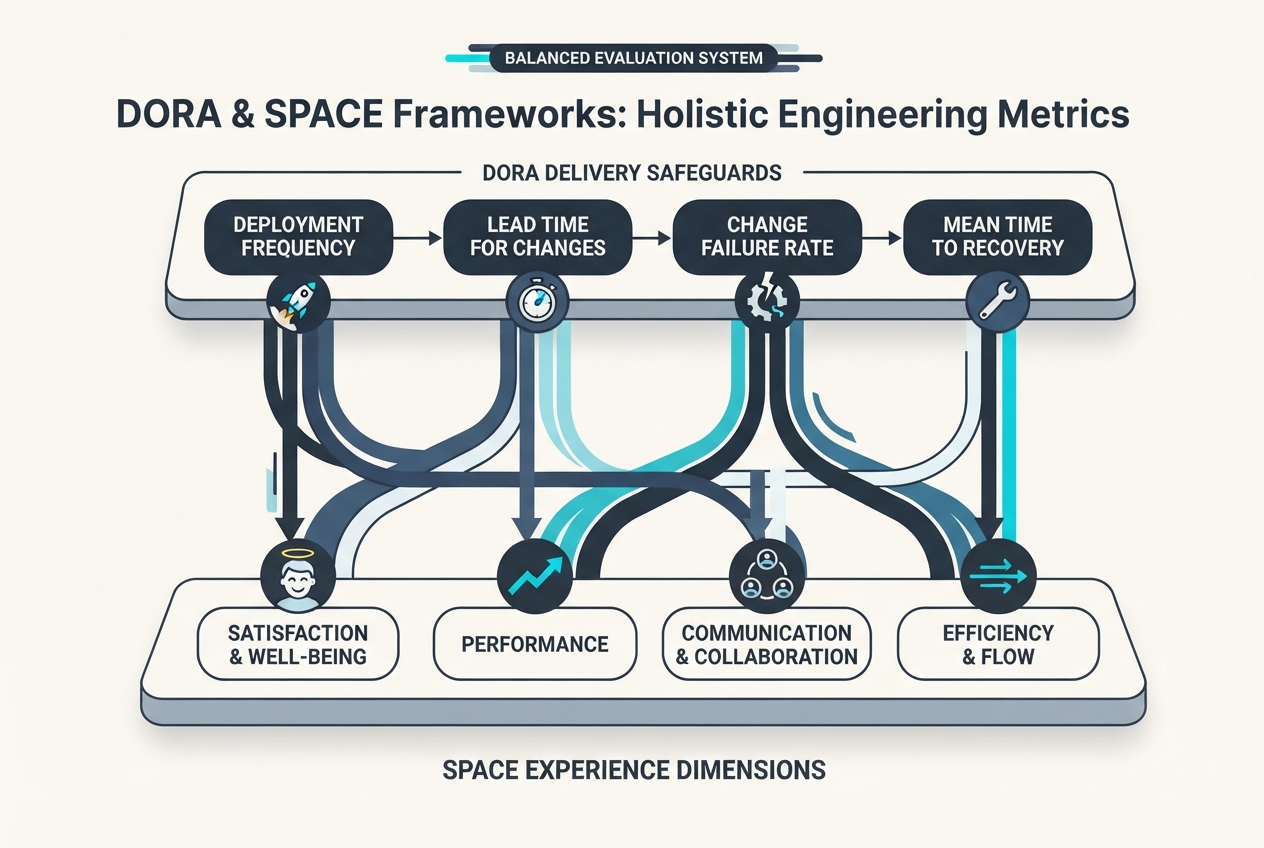
Modern engineering organizations evaluate AI tooling impact by adopting multi-dimensional measurement systems rather than isolated operational scores. Frameworks like DORA establish essential delivery safeguards by tracking deployment frequency, lead time for changes, change failure rate, and mean time to recovery. DORA metrics function as lagging indicators that show whether rapid initial coding translates into stable production releases. If code generation velocity accelerates while deployment frequency stalls or change failure rates climb, automated tools are creating unstable upstream churn.
To build customized evaluation structures, leaders often engage professional SnapKodex services to configure workflow monitoring systems that balance speed with continuous integration governance. Supplementing DORA with the SPACE framework provides a holistic perspective on team performance. SPACE assesses satisfaction and well-being, performance, communication and collaboration, and efficiency and flow. This balance prevents teams from optimizing code throughput while degrading developer satisfaction or causing cognitive exhaustion from relentless code reviews.
- DORA metrics evaluate deployment cadence and post-release system stability.
- The SPACE framework measures engineer satisfaction, collaboration, and cognitive flow.
- Token usage and seat licensing provide visibility into total operating expense.
- Integrated pipeline telemetry prevents localized speed from masking systemic lag.
Combining DORA and the SPACE Framework
Integrating DORA operational metrics with SPACE qualitative dimensions ensures teams maintain delivery velocity without sacrificing engineer well-being. While DORA verifies that deployment intervals remain steady and change failure rates stay low, SPACE tracks whether developers experience uninterrupted focus time or struggle under administrative overhead. Measuring both aspects prevents organizations from pushing high deployment numbers through unsustainable working conditions.
Tracking Operational and Compute Costs
A comprehensive measurement strategy must also quantify financial and compute expenditure. Enterprise licensing, model fine-tuning, and API token consumption represent ongoing operational expenses that offset theoretical productivity gains. Engineering managers must track total tool expenditure against measurable cycle time reductions to determine whether automated assistants produce genuine net savings.
What Are the Primary Downstream Bottlenecks Caused by AI Coding Tools?
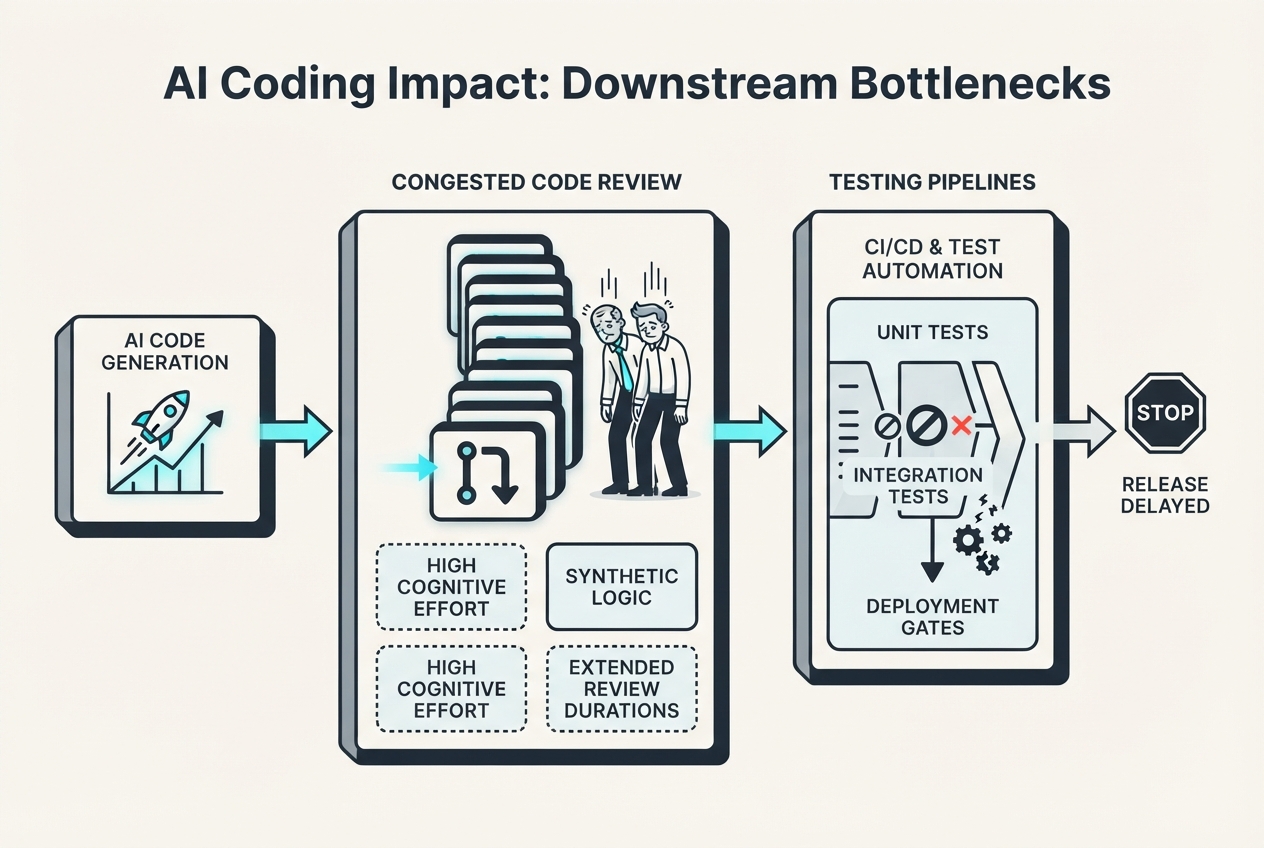
While AI coding assistants accelerate initial logic drafting, they frequently shift friction downstream into testing, continuous integration, and peer review. Code review queues in particular experience acute congestion when pull requests balloon in size. Reading, verifying, and evaluating synthetically generated logic requires significant mental effort from senior engineers. Reviewers must trace architectural assumptions and verify edge cases without the context of having written the implementation themselves.
When pull request review durations stretch from hours into days, the initial velocity achieved through AI assistance is neutralized. The software delivery process remains bound by the slowest constraint in the lifecycle. If organizations fail to expand automated testing or maintain disciplined pull request sizes, synthetic code piles up in review queues, delaying overall release timelines and increasing integration conflicts.
- Inflated code volume causes significant delays in peer review queues.
- Senior maintainers face increased cognitive fatigue inspecting synthetic logic.
- Extended merge cycle times negate initial code drafting time savings.
- Inadequate test automation amplifies downstream integration regressions.
Code Review Fatigue and Queue Delays
Reviewing synthetically generated code introduces unique psychological fatigue. Human reviewers must scrutinize code that appears syntactically polished but may contain subtle logic errors, incorrect API usages, or hidden security vulnerabilities. Restricting maximum pull request sizes and encouraging modular micro-reviews helps prevent reviewer burnout and keeps delivery pipelines fluid.
Defect Arrival Rates and Rework Cycles
Accelerated drafting can produce higher defect arrival rates if continuous integration environments lack automated static analysis. When unverified automated logic passes into pre-production stages, downstream rework cycles expand. Teams must track the volume of post-merge bug fixes and code churn to verify whether accelerated writing creates costly maintenance debt.
How Can Organizations Maintain Long-Term Code Health and Accountability?
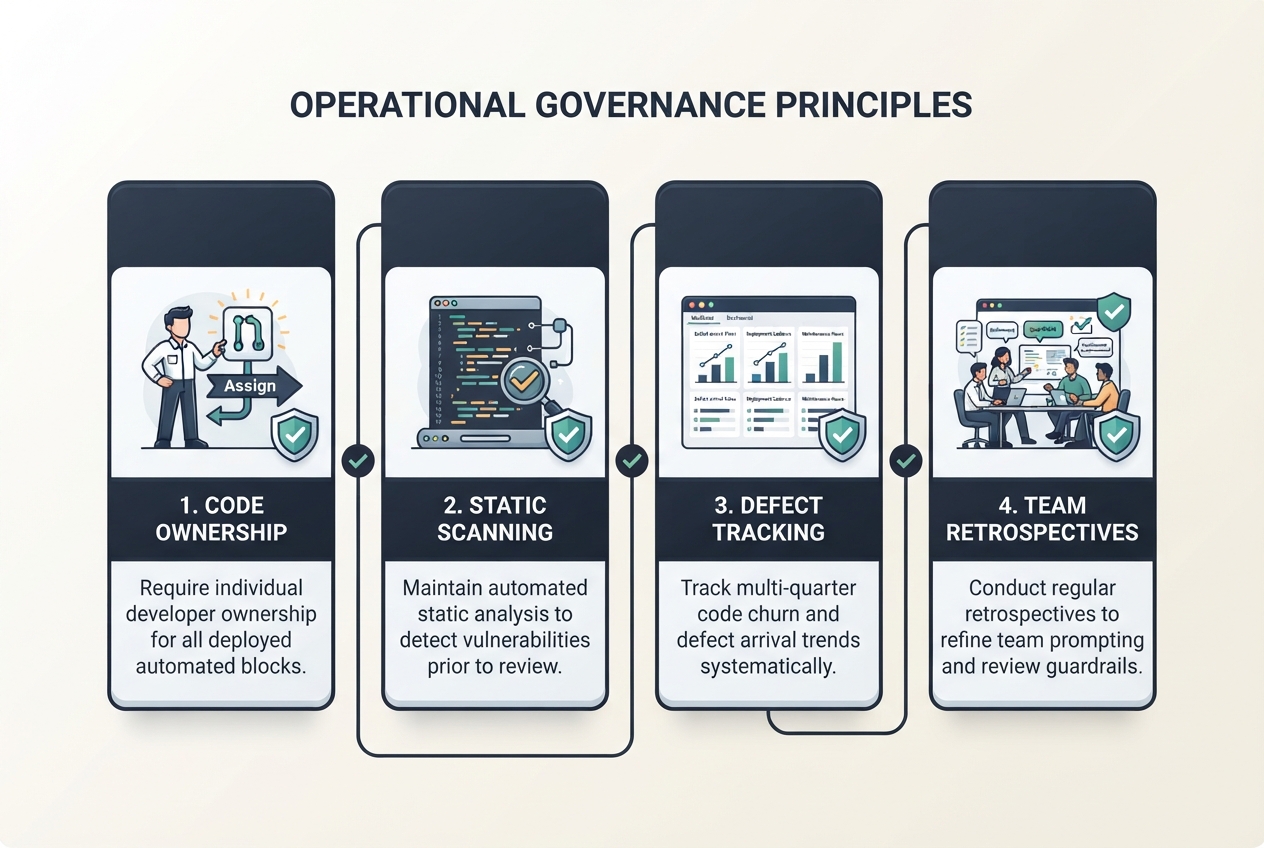
Sustaining software reliability across automated pipelines requires establishing clear engineering accountability. Synthetic coding tools cannot assume responsibility for production downtime, security regressions, or compliance violations. Technology leadership must mandate that every pull request has a designated human engineer who thoroughly understands the logic and assumes complete ownership over its operational behavior in production.
Organizations seeking objective benchmarking can reach out via Contact SnapKodex to audit their delivery pipelines, refine telemetry metrics, and establish sustainable developer governance frameworks. Engineering organizations should also establish regular retrospectives to compare defect arrival rates, deployment cadence, and maintenance hours across AI-assisted modules versus manually authored systems. Tracking these trends across multiple quarters prevents technical debt from quietly undermining enterprise systems.
- Require individual developer ownership for all deployed automated blocks.
- Maintain automated static analysis to detect vulnerabilities prior to review.
- Track multi-quarter code churn and defect arrival trends systematically.
- Conduct regular retrospectives to refine team prompting and review guardrails.
Enforcing Developer Ownership and Verification
Accountability must remain human-centric. When developers submit AI-assisted contributions, engineering guidelines should require them to document design rationale and demonstrate comprehensive automated test coverage. This explicit validation step ensures developers remain actively engaged authors rather than passive recipients of automated suggestions.
Iterative Telemetry and Retrospectives
Evaluating AI impact requires ongoing calibration rather than a one-time assessment. Development teams should hold quarterly reviews to assess whether automated tools have reduced cognitive toil or simply created more maintenance work. Adjusting policies based on empirical pipeline data ensures teams leverage automation responsibly.
Engineering Metric Comparison for AI Workflows
Understanding how traditional output measurements compare with modern outcome-focused indicators when assessing AI-assisted software engineering teams.
| Metric Type | Primary Focus | Limitations with AI | Recommended Alternative |
|---|---|---|---|
| Lines of Code (LOC) | Raw volume of generated code | Severely inflated by automated boilerplate and stubs | DORA Lead Time for Changes |
| Commit Frequency | Number of repository commits | Measures interaction activity rather than actual progress | Deployment Frequency |
| Tool Suggestion Acceptance | IDE auto-completion acceptance rate | Tracks vendor feature adoption without validating logic | PR Review Cycle Duration |
| Story Points Completed | Estimated planning units delivered | Distorted by synthetic task acceleration and rework | Customer Value Delivery Rate |
Frequently asked questions
Why are lines of code an ineffective productivity metric with AI tools?
Lines of code fail because AI assistants quickly generate large volumes of boilerplate, test stubs, and syntax scaffolds. High volume reflects model generation capacity rather than intellectual problem-solving or business value.
What is the SPACE framework in developer productivity?
The SPACE framework evaluates Satisfaction and well-being, Performance, Communication and collaboration, and Efficiency and flow, providing a balanced perspective beyond simple code throughput.
How do AI tools create downstream bottlenecks in development pipelines?
AI tools accelerate local code drafting, which often doubles pull request batch sizes. This surge creates congestion in peer review queues, stretches review times, and increases cognitive fatigue for senior engineers.
How can engineering teams verify that AI tools provide genuine ROI?
Teams verify ROI by comparing total operational costs—including software subscriptions and compute tokens—against end-to-end delivery speed improvements, reduction in defect rates, and steady deployment frequency.