How to Design Multi-Tenant Data Isolation for SaaS Apps
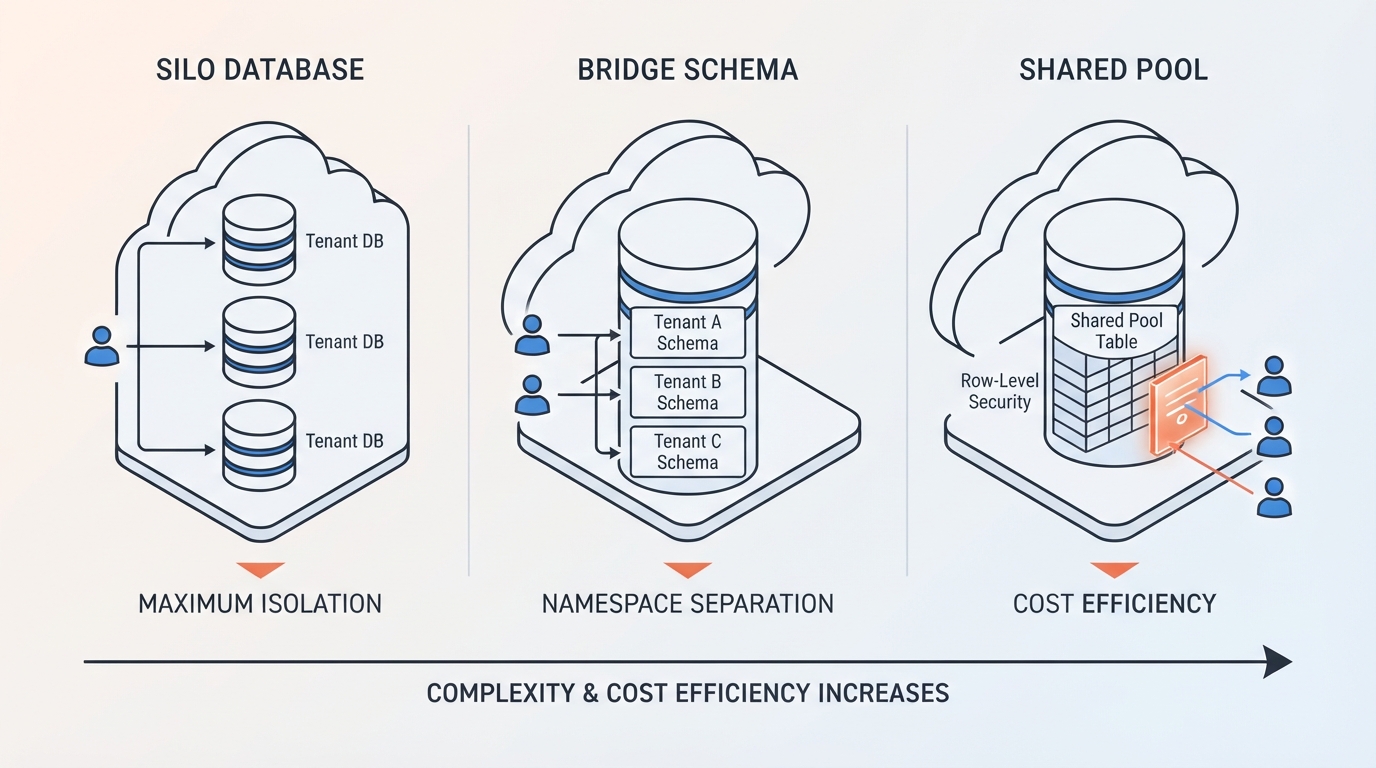
What are the core multi-tenant data isolation models?
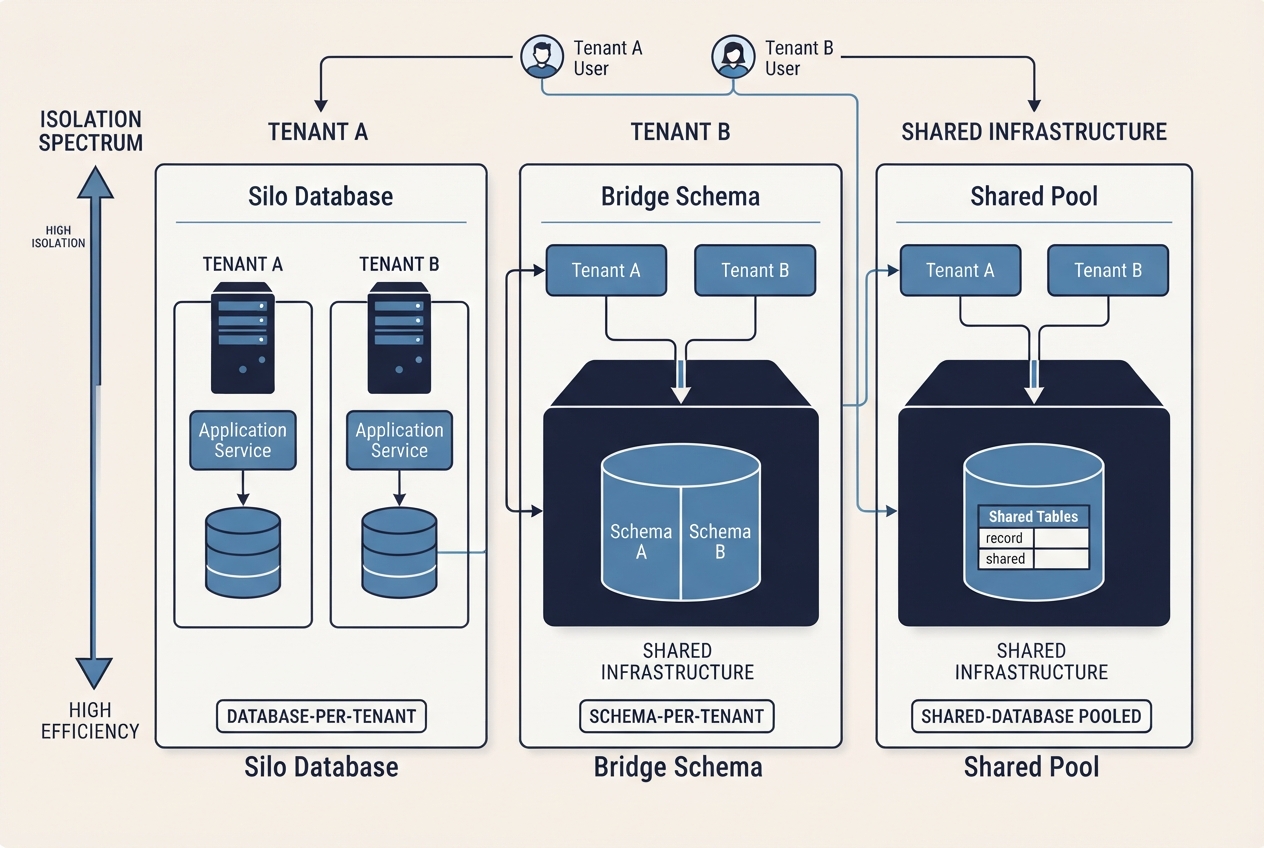
Selecting an isolation model represents one of the most consequential decisions when engineering modern cloud software. Multi-tenancy allows multiple client organizations to share application services and computing resources while keeping corporate records strictly partitioned. Modern isolation architectures exist along a continuous spectrum ranging from total physical separation to unified shared infrastructure. Choosing an approach requires evaluating trade-offs between hosting expenses, development velocity, database migration complexity, and customer compliance mandates.
Engineering teams must distinguish between user authentication and tenant data isolation. Authentication merely verifies the identity of an incoming user session. Isolation guarantees that authenticated users are programmatically restricted to data assets owned by their verified organization. When security enforcement is inadequate, application-layer defects or corrupted query parameters can expose proprietary records across organizational boundaries, violating regulatory standards and destroying customer trust.
Architectural strategy must also account for future company growth. Startups often launch with simple shared databases to conserve runway, only to face expensive refactoring initiatives when enterprise prospects demand dedicated infrastructure. Exploring resources on the SnapKodex home platform helps engineering leaders benchmark development patterns early in product planning cycles.
- Database-per-tenant silo configurations provide physical boundaries and straightforward data residency audits.
- Schema-per-tenant bridge designs balance operational maintenance with logical database namespace separation.
- Shared-database pooled architectures optimize compute capacity and infrastructure expenditure across high customer volumes.
The Database-per-Tenant Silo Model
In a database-per-tenant silo model, each customer organization receives an independent database instance. This pattern provides the highest attainable level of physical data isolation. Because each tenant has dedicated storage, compliance audits for regional data residency, localized encryption keys, and independent backup-and-restore schedules become trivial to execute. A catastrophic database failure or security vulnerability in one tenant instance has zero blast radius on the rest of the customer fleet.
Despite its protective strengths, the silo model introduces significant operational friction. Running schema migrations across hundreds of independent databases demands specialized orchestration pipelines and automated canary deployments. Furthermore, connection pooling becomes resource-intensive, and infrastructure costs scale linearly with customer acquisition, making pure silo models uneconomical for entry-level tiers.
The Schema-per-Tenant Bridge Model
The schema-per-tenant bridge pattern maintains a single shared database engine while provisioning individual relational schemas or namespaces for each customer. Engines like PostgreSQL natively support this model, enabling clean logical separation without provisioning independent virtual machines or managed database clusters for every subscriber. Application connection pools remain consolidated while table definitions and indices are isolated within discrete tenant namespaces.
Operational management remains challenging at enterprise scale. DDL schema migrations must still execute sequentially or concurrently across every tenant schema during software updates. In addition, database catalog overhead can degrade query planning efficiency if an organization provisions tens of thousands of schemas on a single database server.
How does shared database pooled isolation work?
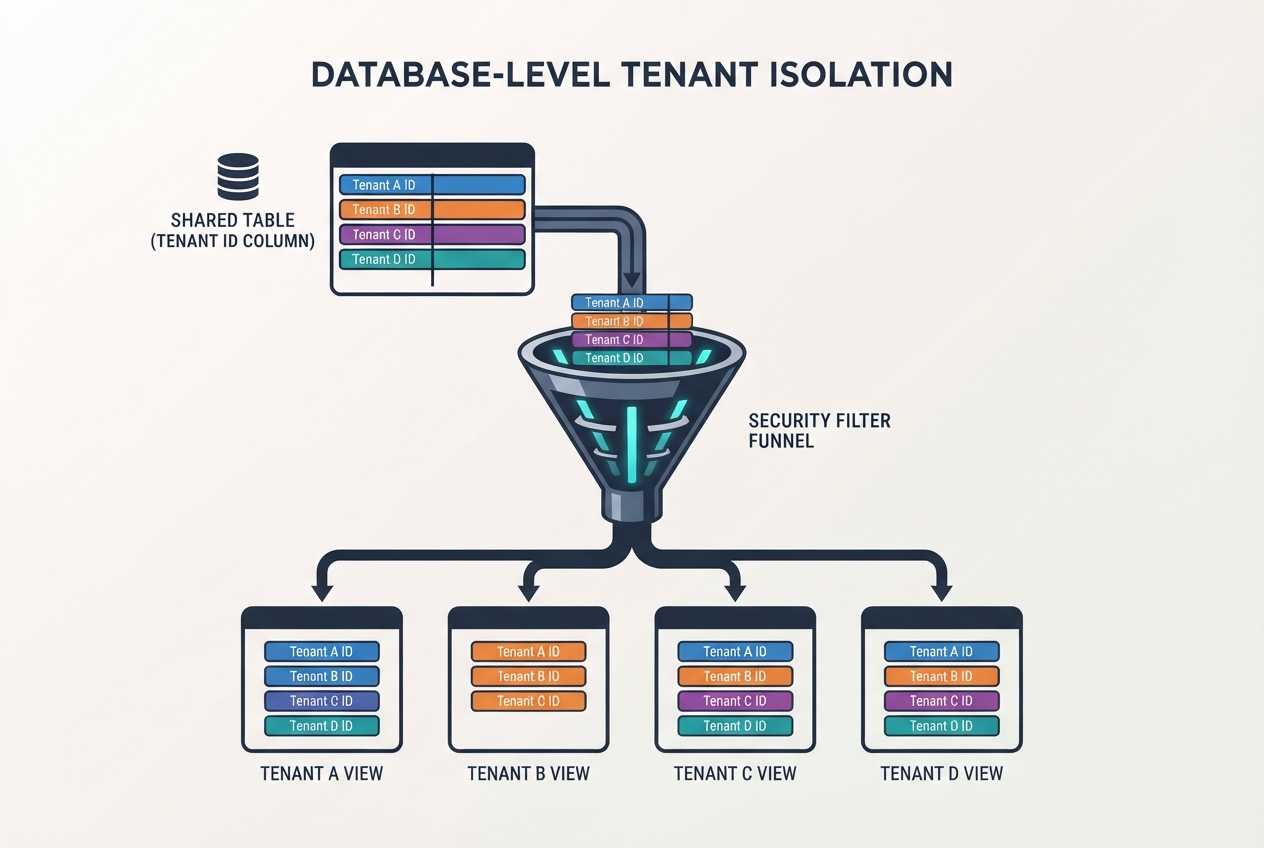
Shared database pooled isolation hosts all tenant records within identical physical tables. Logical segregation is achieved by embedding a mandatory tenant identifier column across every data schema. In this shared-nothing-at-the-data-layer model, every database query must include deterministic filtering predicates to isolate records. This architecture delivers optimal resource utilization and effortless maintenance, making it the primary pattern for high-volume SaaS applications.
The primary drawback of pooled isolation is elevated application-level vulnerability. A developer who forgets an explicit tenant filter in an ad-hoc query or misconfigures an object-relational mapper relationship can leak cross-tenant records to unauthorized end users. Consequently, relying exclusively on software engineers to remember manual WHERE clauses is considered an unacceptable security posture for enterprise-grade SaaS platforms.
To mitigate software risks, engineering teams implement defense-in-depth isolation directly within the persistence tier. Teams seeking external architectural guidance often review specialized offerings like SnapKodex services to configure robust isolation guardrails across production database clusters.
- Pooled environments minimize operational complexity by running schema migrations over a single consolidated table structure.
- Neglected query predicates present severe security risks if boundary enforcement relies solely on application code.
- Database-level policy enforcement provides automated safeguards that intercept queries before data leaves the storage engine.
Enforcing Database Row-Level Security
Database Row-Level Security, widely supported by enterprise engines such as PostgreSQL and Azure SQL, provides a native mechanism to enforce query isolation. RLS allows database administrators to establish programmatic access policies directly on target tables. When an application initiates a query, the database engine evaluates session variables and automatically injects security predicates into the internal execution plan.
By setting an active session variable corresponding to the authenticated tenant identifier upon acquiring a connection, the database engine guarantees that records belonging to competing tenants are invisible. Even if an application bug executes an unrestricted query, the database engine silently restricts returned rows to the active tenant context.
Managing Asynchronous and Batch Workflows
Modern web platforms rely heavily on background workers, automated event queues, and batch analytics processors. These asynchronous jobs run outside the original HTTP request-response cycle and lack default session headers. When processing background operations, systems must explicitly propagate tenant identifiers within message payloads to preserve isolation integrity.
Failing to forward tenant context into background queues can cause workers to process jobs under broad administrative permissions. Designing reliable message envelopes ensures that asynchronous workers set appropriate session context before interacting with pooled database records, preventing background data contamination.
What are the best practices for implementing tenant context?
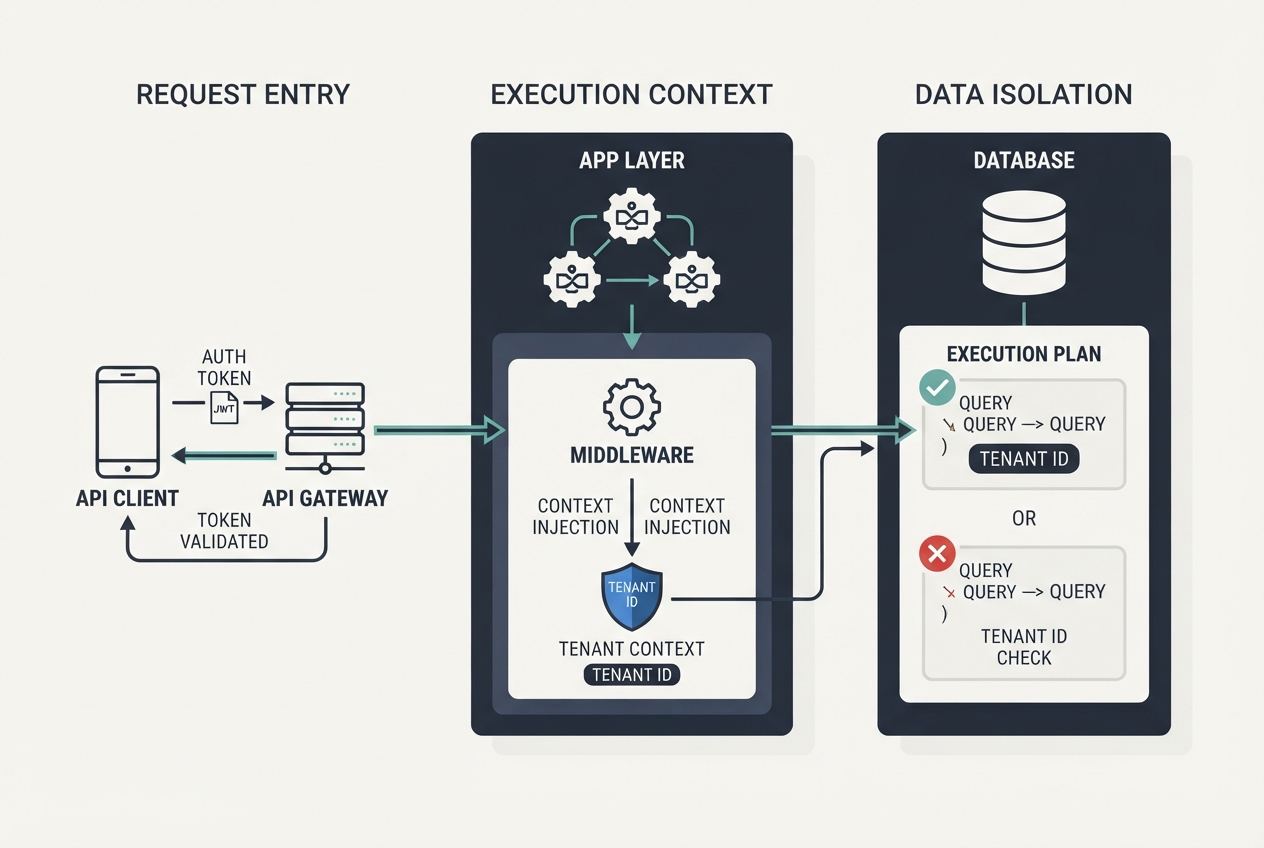
Enforcing reliable data isolation requires establishing an immutable chain of custody for tenant identity throughout the entire request lifecycle. Tenant identification must originate from trusted authentication mechanisms, such as cryptographically signed JSON Web Tokens issued by verified identity providers. Systems must never rely on client-supplied URL query parameters or unverified request headers, which can be modified by unauthorized actors.
Once validated by the API gateway, the tenant context should be injected into the application execution context and propagated automatically to all downstream service calls. Establishing unified context propagation ensures that every microservice, cache lookup, and database transaction operates with explicit tenant awareness. Organizations planning multi-tier software releases can reference technical guides on https://snapkodex.com/services/seo-content to learn how clear architectural documentation aids platform positioning.
To guarantee high reliability, middleware layers should reject any database invocation that lacks an explicit tenant context. Setting zero-trust defaults at the connection pool layer ensures that queries without valid session attributes fail immediately rather than defaulting to broad global permissions.
- Derive tenant identity exclusively from cryptographically verified claims within authentication tokens.
- Inject validated tenant context into request scopes to ensure seamless propagation across microservice calls.
- Configure database connection pools to block queries that omit required tenant session attributes.
Infrastructure Attribute-Based Access Control
Cloud-native isolation patterns extend tenant context beyond application software down to the cloud infrastructure layer. Using Attribute-Based Access Control mechanisms, such as AWS IAM session tags via assume-role workflows, platforms can dynamically assign temporary cloud credentials bound to specific tenant identities.
This architectural approach ensures that storage buckets, messaging queues, and database compute engines enforce boundaries independently of application logic. Even if an application container is compromised, the temporary credentials prevent lateral data access across infrastructure boundaries.
Architecting Hybrid Multi-Tier Isolation
High-growth SaaS enterprises frequently implement hybrid isolation architectures to serve varied market segments profitably. High-volume self-serve users and freemium accounts are placed in cost-effective pooled database tables with row-level security, maximizing hardware utilization.
Conversely, premium enterprise clients with strict compliance or data residency demands are provisioned dedicated database silos. A routing layer inspects the incoming tenant identifier and routes queries dynamically to the appropriate persistence target, providing commercial flexibility without maintaining separate codebases.
How do you audit and validate multi-tenant data security?
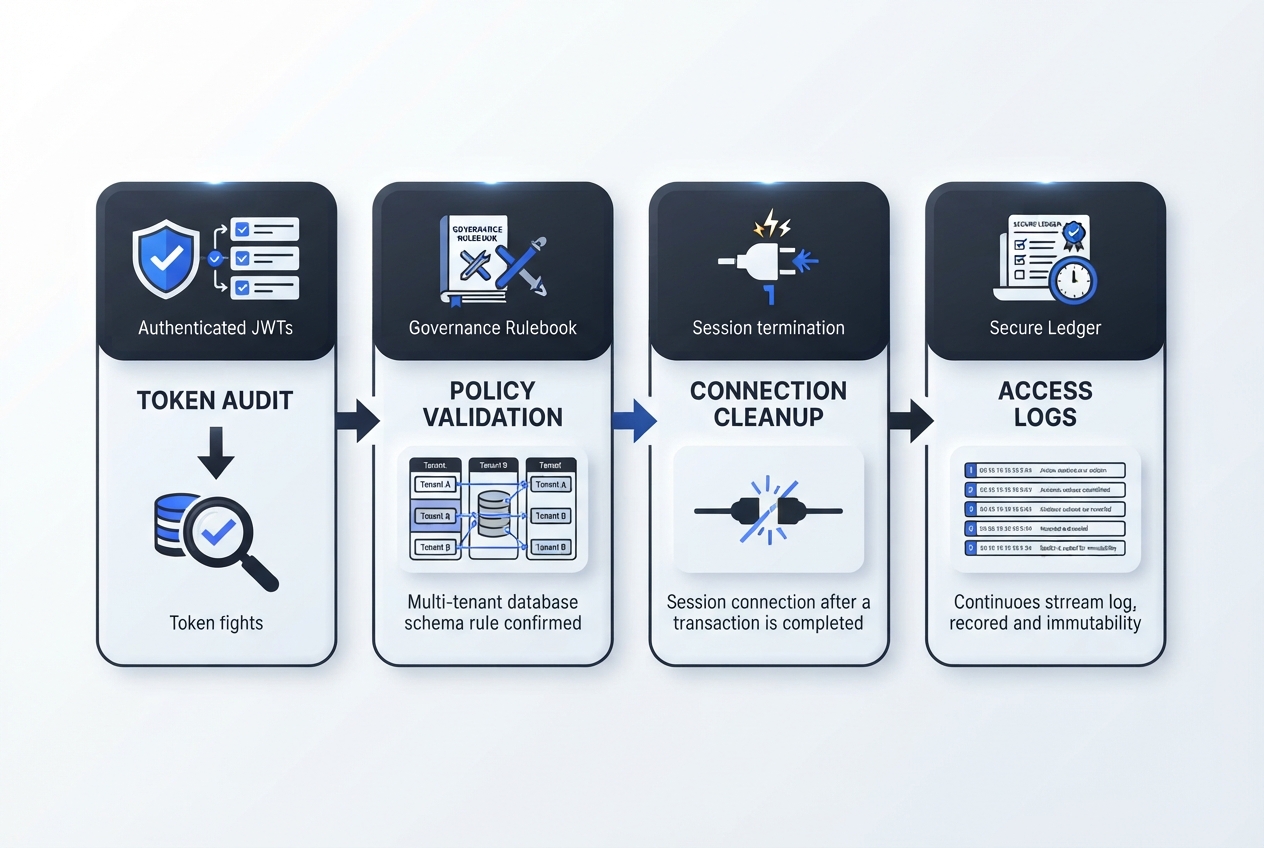
Deploying multi-tenant data isolation mechanisms is insufficient without continuous automated validation and verification. Software regression suites must incorporate specific multi-tenant integration tests designed to simulate cross-tenant breaches. These automated suites execute transactions using valid authentication credentials from Tenant A while attempting to access or modify records belonging to Tenant B, asserting that every layer rejects the request.
Continuous security scanning should also examine object-relational mapping definitions and raw SQL scripts to identify missing tenant predicates. Incorporating static code analysis into deployment pipelines ensures that common developer oversights are resolved before reaching production environments.
For teams managing complex architectural modernization or preparing for rigorous enterprise audits, reaching out via Contact SnapKodex offers access to specialized engineering consulting that strengthens platform compliance and boundary enforcement.
- Execute automated integration tests that attempt cross-tenant read and write operations on every build.
- Implement static analysis rules to flag database queries that lack tenant predicate filters.
- Maintain immutable audit logs tracking administrative data access and permission modifications across tenants.
Detecting Connection Pool Session Bleed
In high-concurrency environments utilizing database connection pooling, persistent connections are reused across multiple sequential HTTP requests. If an application sets a database session variable for one tenant but fails to clean up upon releasing the connection, subsequent requests from another tenant could inherit the previous context.
Engineering teams prevent session leakage by wrapping connection checkouts in automated cleanup routines. Resetting connection state via discard commands or using scoped connection pools guarantees that every incoming transaction starts from a sanitized, unassigned session state.
Satisfying Enterprise Compliance and Sovereignty
Enterprise buyers evaluate SaaS vendors through comprehensive technical due diligence processes, requiring proof of data segregation and sovereignty. Platforms must demonstrate that customer data cannot be co-mingled in violation of GDPR, HIPAA, or regional governance frameworks.
Maintaining clear architectural specifications, automated test reports, and tenant isolation documentation simplifies enterprise sales cycles. Establishing rigorous cryptographic controls and documented access reviews transforms technical security from a potential liability into a commercial differentiator.
Comparison of Multi-Tenant Data Isolation Models
Evaluating architectural trade-offs across silo, bridge, and pooled data isolation patterns to inform database infrastructure choices.
| Isolation Model | Infrastructure Cost | Isolation Strength | Operational Complexity | Ideal Use Case |
|---|---|---|---|---|
| Database-per-Tenant (Silo) | High (scales linearly with customers) | Maximum (physical database separation) | High (migrations across multiple databases) | Enterprise tiers, highly regulated healthcare, and financial services |
| Schema-per-Tenant (Bridge) | Moderate (shared database compute) | Strong (logical namespace separation) | Moderate (schema loops during migrations) | B2B platforms with moderate tenant counts needing logical separation |
| Shared Database (Pool) | Low (maximum compute consolidation) | Moderate (relies on RLS and query filters) | Low (single centralized migration process) | High-volume self-serve SaaS and cost-sensitive cloud applications |
Frequently asked questions
What is the primary difference between silo and pooled data isolation?
The silo model provides each customer with a dedicated database instance, ensuring absolute physical isolation and independent backup schedules. In contrast, the pooled model hosts all customer data in shared tables, using tenant identifier columns and database row-level security policies for logical separation.
Why is user authentication alone insufficient for multi-tenant isolation?
Authentication only verifies user identity and privileges. Data isolation ensures that queries cannot access another organization's records. Without data-level constraints, application bugs or missing query filters can leak data to authenticated users belonging to different organizations.
How does database Row-Level Security protect pooled SaaS tables?
Row-Level Security enforces access rules at the database engine level. It inspects session attributes associated with the current connection and automatically appends filtering predicates to incoming SQL statements, blocking cross-tenant record retrieval even if the application query omits explicit filters.
Can a SaaS application combine multiple isolation models?
Yes. Many SaaS platforms use a hybrid model where free and self-serve customers are pooled in a shared database with row-level security, while premium enterprise customers paying higher fees are allocated dedicated database silos to satisfy strict regulatory requirements.