How to Design Effective API Governance Policies for SaaS
What is SaaS API Governance and Why Does It Matter?
API governance is the formal system of rules, decision rights, and accountability mechanisms that guide how software interfaces are designed, published, and maintained across an enterprise. In a multi-tenant software-as-a-service environment, APIs represent both the primary customer integration surface and the core communication highway between internal microservices. Without deliberate oversight, rapid feature releases inevitably cause endpoint fragmentation, erratic data models, and breaking changes that erode downstream customer confidence.
Establishing comprehensive governance protects organizational velocity rather than slowing it down. When teams lack central guidelines, individual product squads invent custom error handling conventions, incompatible pagination schemes, and divergent authentication flows. Over time, this compounding architectural drift produces severe technical debt, complicating maintenance and multiplying the attack surface across public and private cloud environments.
Engineering organizations seeking broader technical growth often explore educational material such as https://snapkodex.com/blog/ai-marketing-guide to understand how systematic structures streamline developer operations. Clear policies provide software teams with predictable boundaries, turning architectural consistency into an automated baseline rather than an endless subject of debate.
- Establishes explicit organizational decision rights and domain ownership for every endpoint.
- Prevents duplicate, orphaned, or shadow APIs through central catalog discoverability.
- Decouples strategic policy definitions from runtime gateway execution and developer portal management.
- Maintains strict multi-tenant isolation and security compliance across expanding product portfolios.
Governance Versus Management Versus Gateways
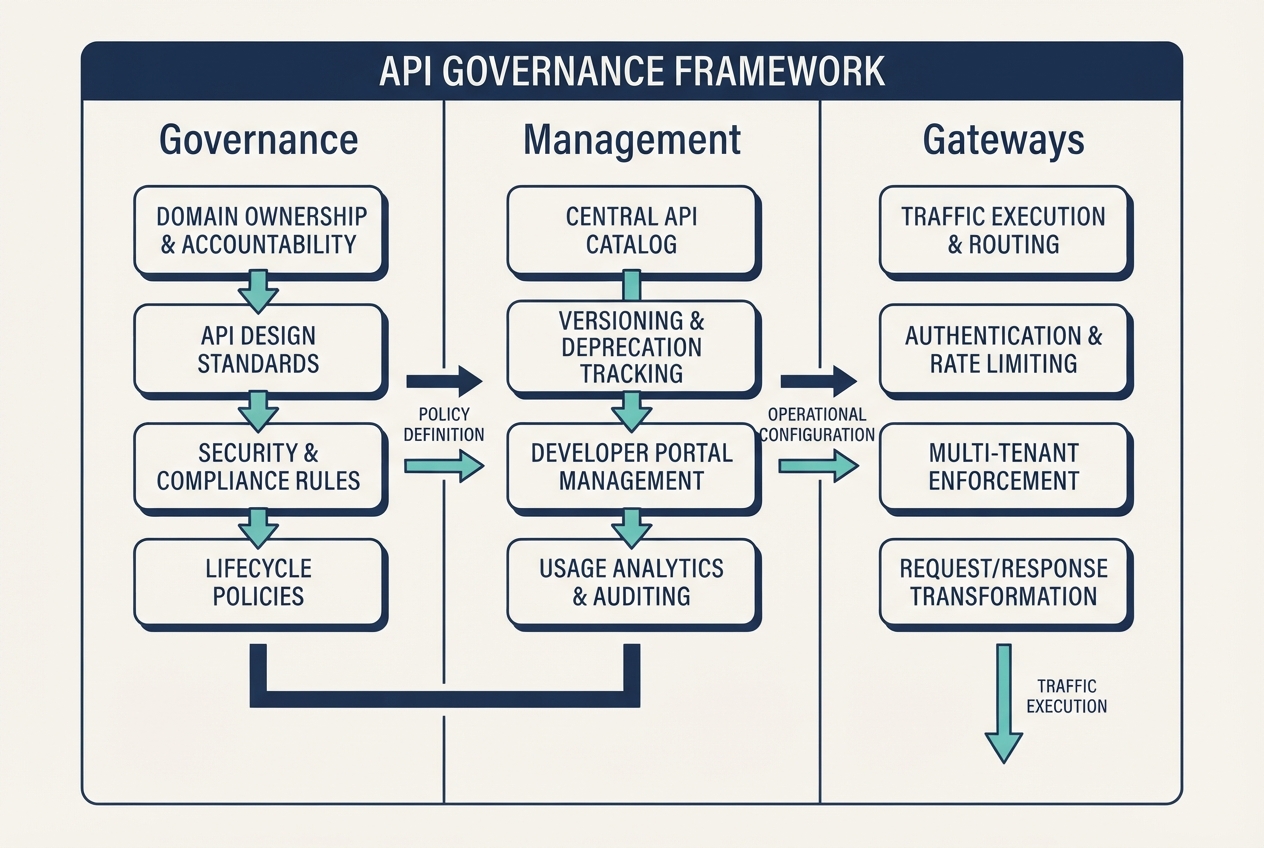
A frequent source of organizational friction is confusing API governance with API management or edge gateway infrastructure. API governance defines the structural laws, style rules, data taxonomies, and compliance thresholds of the ecosystem. API management handles the administrative lifecycle, including customer onboarding, developer portals, billing metering, and API key provisioning. API gateways represent the operational edge, enforcing runtime policies such as rate limiting, TLS termination, and token verification.
When engineering leaders blur these distinctions, they often attempt to solve governance deficits strictly by purchasing gateway appliances. However, a gateway cannot determine whether an endpoint follows semantic URL hierarchies or adheres to enterprise schema standards. True architectural maturity requires uniting all three distinct domains into a cohesive operational workflow where policies govern gateway runtime behaviors.
- Governance specifies schema contracts, breaking change policies, and review cadences.
- Management coordinates self-service portal catalogs, subscription plans, and credential distributions.
- Gateways execute dynamic traffic inspection, tenant quota enforcement, and payload transformations.
The Real Cost of Ungoverned SaaS APIs
Neglecting API governance carries tangible financial and security liabilities for scaling SaaS providers. Uncataloged internal interfaces frequently leak sensitive customer metadata across tenant boundaries, exposing organizations to costly regulatory fines and reputational harm. Furthermore, uncoordinated deprecations force enterprise customers to urgently rewrite their integration code, driving contract cancellations and negative customer sentiment.
From an operational standpoint, redundant endpoints bloat cloud infrastructure costs. Separate engineering squads often build duplicate internal services because an unindexed API inventory prevents efficient discovery. By introducing disciplined governance standards, organizations eliminate this waste and ensure that every microservice provides distinct, reusable business value.
- Severe integration friction and unexpected downtime for enterprise API consumers.
- Heightened security vulnerabilities caused by unmonitored shadow APIs and orphaned endpoints.
- Duplicated engineering labor and inflated cloud infrastructure hosting expenses.
How Should Teams Implement the Four-Tier API Governance Framework?
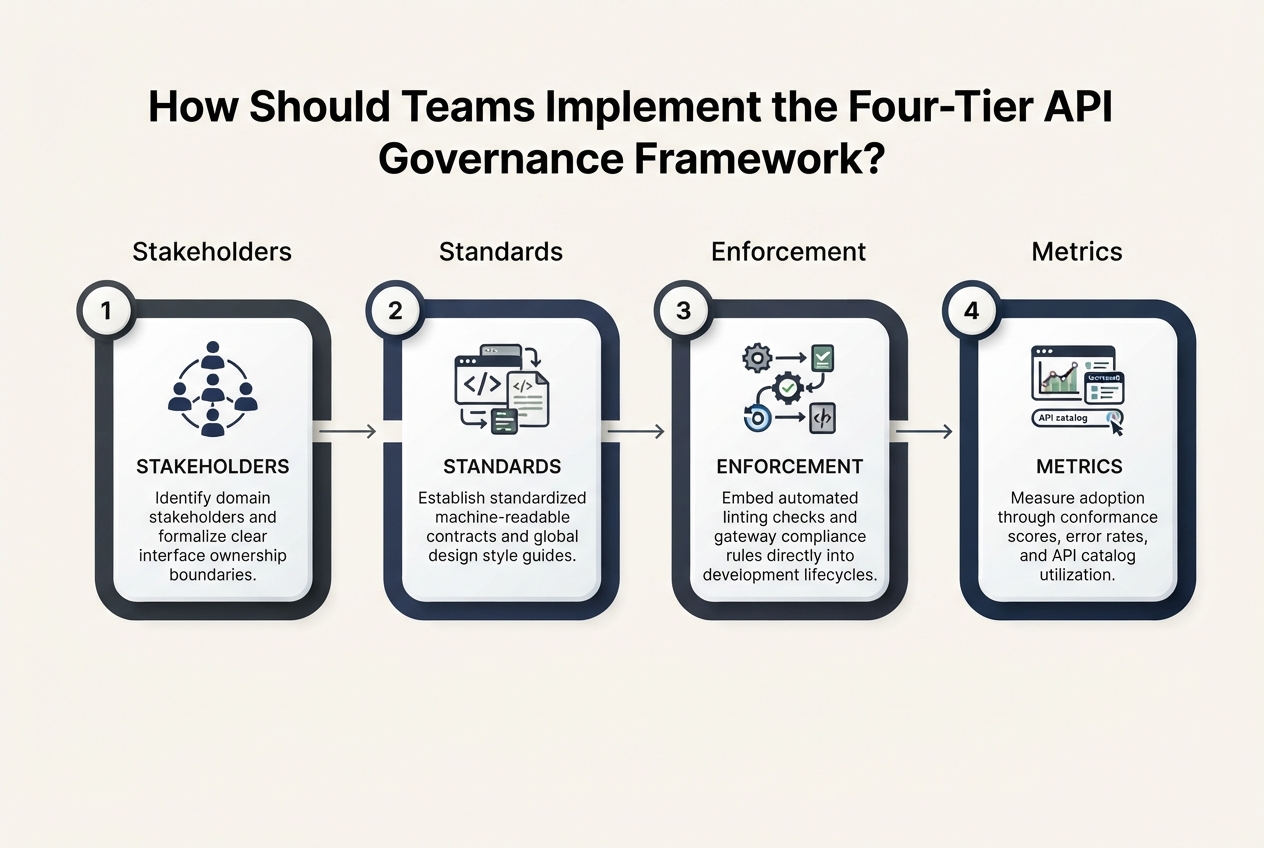
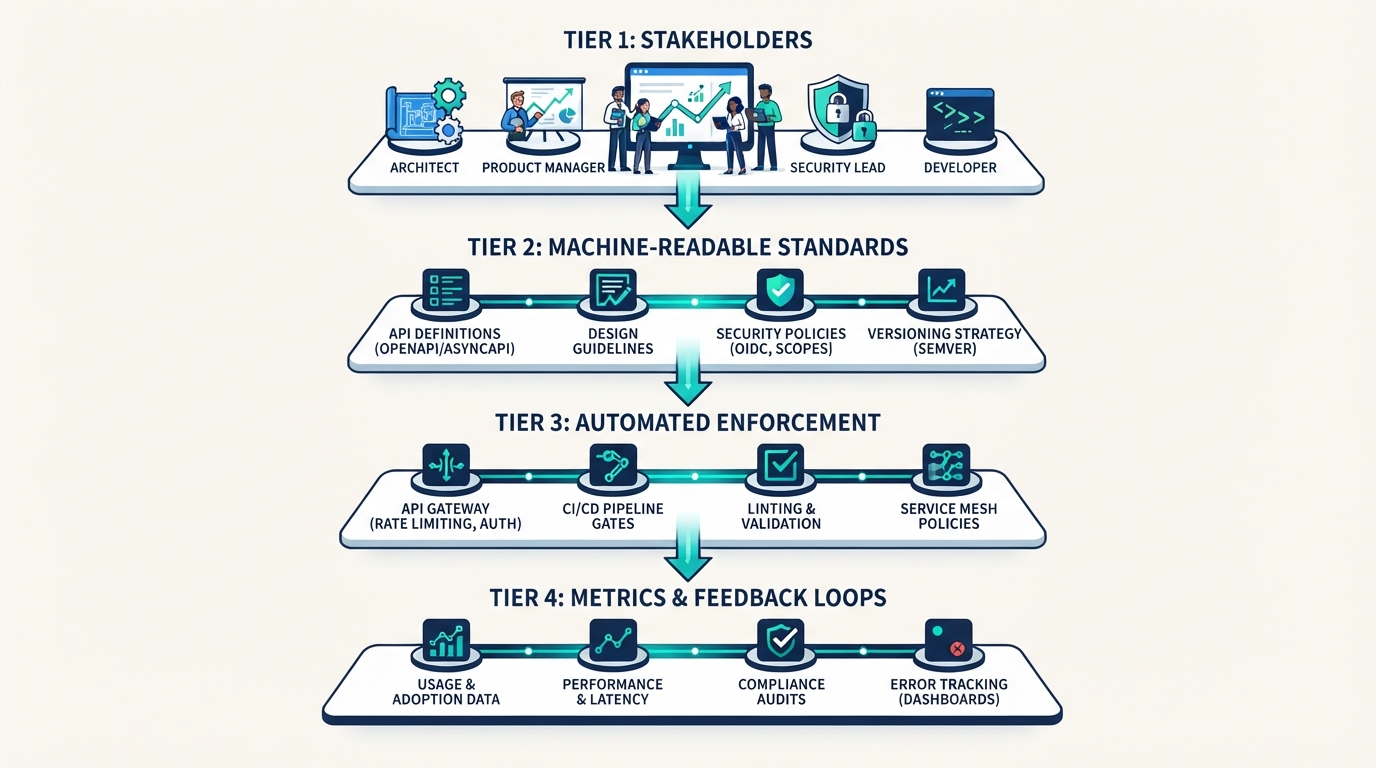
Executing a sustainable governance program requires following a disciplined dependency chain rather than attempting to enforce broad mandates immediately. Rushing into automated pipeline gates before achieving consensus on basic schema conventions inevitably triggers pushback from product engineering squads. Technical leaders should instead adopt a progressive four-tier framework that moves deliberately from organizational ownership to automated execution and operational monitoring.
The foundational tier focuses on identifying API domain stakeholders and establishing clear lines of accountability. Tier two articulates machine-readable standards, such as OpenAPI specifications and centralized style rules. Tier three automates enforcement across design tools and CI/CD pipelines. Tier four tracks ongoing ecosystem health through measurable conformance scoring and catalog discovery metrics.
- Tier 1: Identify domain stakeholders and formalize clear interface ownership boundaries.
- Tier 2: Establish standardized machine-readable contracts and global design style guides.
- Tier 3: Embed automated linting checks and gateway compliance rules directly into development lifecycles.
- Tier 4: Measure adoption through conformance scores, error rates, and API catalog utilization.
Balancing Central Standards With Federated Team Autonomy
Modern platform engineering rejects the historical model of a centralized architectural review board that manually inspects every pull request. Rigid review committees create severe delivery bottlenecks, encouraging engineers to bypass oversight entirely. Instead, leading organizations implement a federated model where a central platform team provides automated linting tools, templates, and baseline guardrails, while individual product squads retain autonomy over implementation details.
To maintain security without hampering development speed, organizations should categorize interfaces into risk-based tiers. A core billing API handling financial transactions demands stringent verification, whereas an ephemeral internal telemetry service can proceed through automated CI/CD checks without delay. Technical teams can consult SnapKodex services when establishing structured architectural standards across expanding digital platforms.
- Empower product squads to act as primary stewards of their respective domain APIs.
- Provide standardized starter templates and machine-readable linters to minimize manual compliance friction.
- Apply calibrated review rigor based on data sensitivity, customer exposure, and integration criticality.
What Are the Core Policy Components for Versioning, Rate Limiting, and Security?
A practical governance strategy must provide unambiguous technical standards for recurring architectural challenges. Chief among these is interface versioning. SaaS engineering teams must decide between URL path versioning, custom HTTP headers, or media type content negotiation. For public-facing developer ecosystems, URL path versioning remains the industry preference due to its discoverability and clear routing characteristics across standard caching proxies.
Every versioning policy must explicitly outline deprecation timelines and breaking change definitions. Minor non-breaking updates, such as adding optional response attributes, should deploy continuously under the existing version. Conversely, removing fields, altering data types, or modifying authentication demands requires incrementing major versions alongside a structured client notification period of at least six to twelve months.
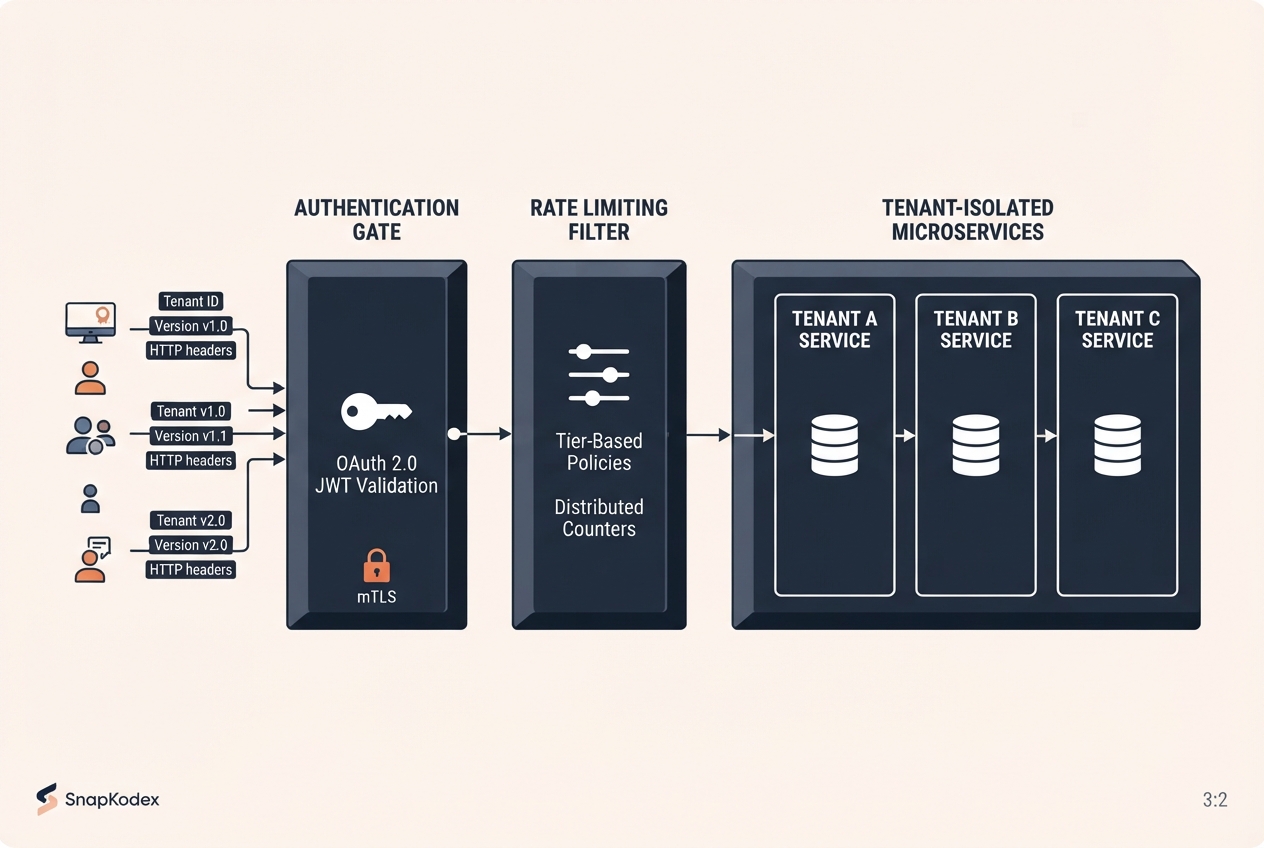
Beyond versioning, robust rate limiting policies protect multi-tenant infrastructure against cascading service degradation and malicious resource exhaustion. Engineering teams should implement tenant-aware sliding window or token bucket algorithms managed through distributed caching clusters like Redis. Standardizing these throttle limits across product tiers ensures fair tenant resource distribution and predictable infrastructure expenses.
- Define strict breaking change criteria and enforce transparent client deprecation timelines.
- Implement tier-based rate limiting using distributed sliding window counters to protect shared backends.
- Standardize on modern authentication protocols, mandating OAuth 2.0 with short-lived JWT tokens.
- Require mutual TLS for internal microservice communication and strictly validate tenant context tokens.
Enforcing Security Compliance and Tenant Isolation
Data isolation is paramount in multi-tenant SaaS platforms. Governance policies must mandate that every incoming API request carries an immutable tenant identifier validated cryptographically at the gateway layer. Services must enforce tenant isolation at both the application logic layer and the database query tier, completely preventing cross-tenant data leakage.
Additionally, governance standards must dictate data masking rules for sensitive personal information within logs, traces, and external responses. Automated security scanners integrated into deployment pipelines verify that endpoints adhere to encryption mandates for both in-transit traffic and persistent storage.
- Mandate cryptographic verification of tenant context tokens across every service boundary.
- Enforce automated stripping and masking of personally identifiable information in API telemetry.
- Require end-to-end encryption using modern TLS standards across all public and internal routes.
How Can Engineering Teams Overcome Common Governance Rollout Pitfalls?
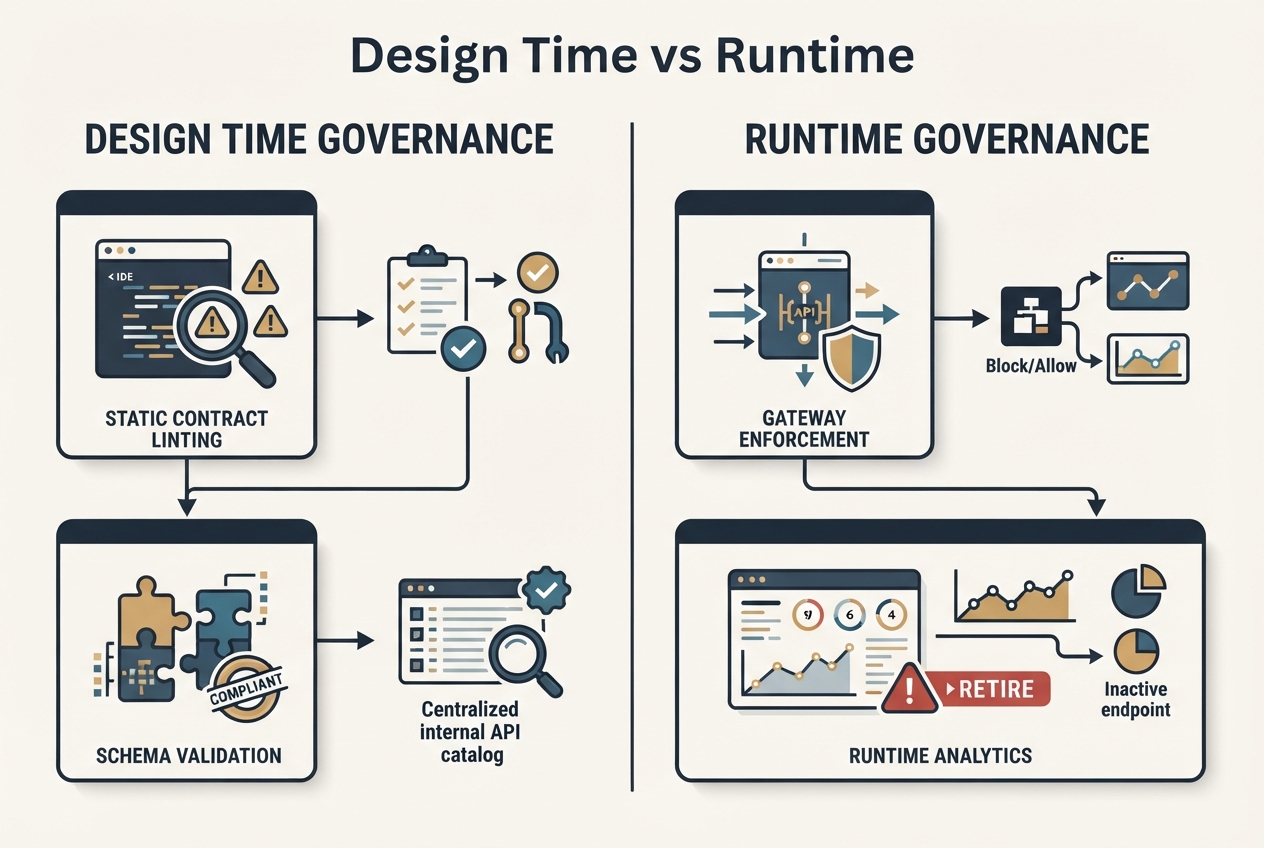
The most frequent reason API governance initiatives stumble is treating guidelines as passive documentation rather than active, executable code. When architecture teams publish static style guides in internal wikis, engineers under project delivery deadlines rarely read or follow them. Successful governance programs translate architectural rules into executable rulesets using automated open-source linters embedded directly into developer IDEs and Git pull request workflows.
Another critical hurdle is catalog fragmentation. When engineering squads store interface schemas across disconnected repositories and private workspaces, duplicate endpoints proliferate unnoticed. Establishing a centralized internal API catalog ensures every interface is discoverable, documented, and actively monitored for compliance scores.
To discover additional guidance on establishing coherent digital systems, engineering leaders can explore the SnapKodex home platform. Organizations preparing comprehensive communication programs for new platform policies can also review specialized solutions like https://snapkodex.com/services/seo-content. If customized operational guidance is required, teams can Contact SnapKodex directly to evaluate their architectural alignment.
- Embed machine-readable design linters into local code editors and continuous integration gates.
- Reject manual pull requests that introduce schema violations or unapproved breaking changes.
- Maintain a unified private API catalog to ensure full discoverability and eliminate duplicate services.
- Review API portfolio health metrics periodically to retire inactive or deprecated endpoints.
SaaS API Governance Operating Models
A comparison of centralized, decentralized, and federated governance models to help technical leaders select the optimal balance between operational speed and architectural consistency.
| Governance Model | Core Mechanism | Primary Benefit | Key Trade-off |
|---|---|---|---|
| Centralized Committee | Manual review boards inspect all API design proposals before coding begins. | Guarantees rigorous consistency and uniform security compliance across products. | Creates severe delivery bottlenecks and slows down routine engineering velocity. |
| Decentralized Squads | Individual product teams define and maintain interfaces independently. | Maximizes local team agility and accelerates short-term feature delivery. | Leads to widespread endpoint sprawl, duplicate services, and security drift. |
| Federated Platform | Central teams provide automated linters and templates; squads own execution. | Combines rapid feature velocity with automated architectural consistency. | Requires initial investment in developer tooling and platform infrastructure. |
Frequently asked questions
What is the core difference between API governance and API management?
API governance establishes architectural rules, design standards, risk classifications, and organizational decision rights. API management handles operational aspects such as developer portals, plan subscriptions, monetization, and runtime execution via edge gateways.
How can engineering teams prevent API governance from becoming a bottleneck?
Organizations can prevent bottlenecks by adopting a federated model that replaces slow manual review boards with automated design-time linters embedded directly into continuous integration workflows and developer environments.
Which API versioning approach is most effective for SaaS platforms?
URL path versioning is widely favored for external SaaS APIs because of its explicit routing behavior and clear integration visibility. It must be supported by transparent deprecation schedules and automated contract tests.
How do automated linters support API governance?
Automated linters inspect machine-readable specifications against organizational style guides, automatically catching inconsistent field names, missing security schemas, and missing documentation during pull requests.
What role does a private API catalog play in SaaS governance?
A central private API catalog indexes internal and external interfaces, providing visibility across engineering teams to prevent duplicate development, streamline service discovery, and highlight unmaintained endpoints.