How to Design a Resilient Multi-Agent System Architecture
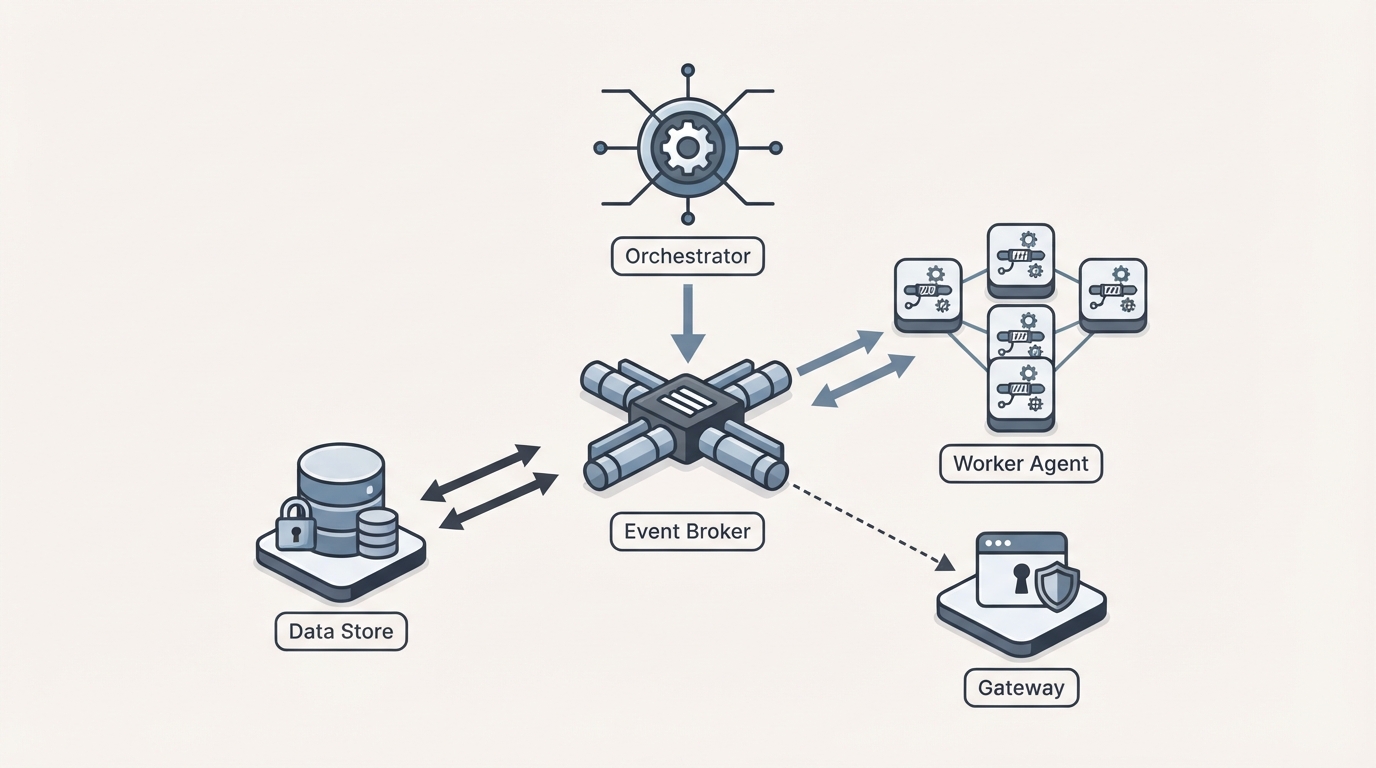
Why Do Local Multi-Agent Prototypes Fail in Enterprise Production?
Prototyping multi-agent swarms on a local machine using open frameworks often gives engineering teams false confidence. In development environments, local scripts run isolated prompts with small context payloads, minimal latency, and zero concurrency. Moving these prototypes into high-throughput production exposes fundamental architectural vulnerabilities. Autonomous agent swarms frequently consume fifteen times more tokens than traditional single-turn conversational models. This token explosion causes rapid cost escalation and frequent context window exhaustion, which degrades model reasoning capacity over extended business operations.
Beyond resource depletion, multi-agent pipelines struggle with compounding error rates. When an upstream model hallucinates tool parameters or produces malformed text, every downstream agent receives corrupted context. Without strict defensive checkpoints, these non-linear execution paths amplify subtle inaccuracies into widespread operational breakdowns. Engineering teams seeking structured guidance on building stable infrastructure often consult the SnapKodex home resource library to align their deployment strategies with enterprise software standards.
Enterprise architectures must treat agents as fallible distributed microservices rather than infallible autonomous actors. Systems cannot rely on lucky prompt execution or unmonitored agent-to-agent chatter. Instead, engineering leaders must introduce deterministic operational envelopes that constrain agent interactions, enforce timeouts, monitor token quotas, and maintain persistent audit logs across every transactional phase.
- Multi-agent networks generate approximately fifteen times the token volume of standard chat interfaces, creating severe cost and context constraints.
- Unchecked parsing anomalies and hallucinated parameters compound rapidly across downstream reasoning nodes.
- Non-linear operational flows make debugging and root-cause analysis impossible without dedicated distributed tracing.
Managing Context Windows and Serialization Overhead
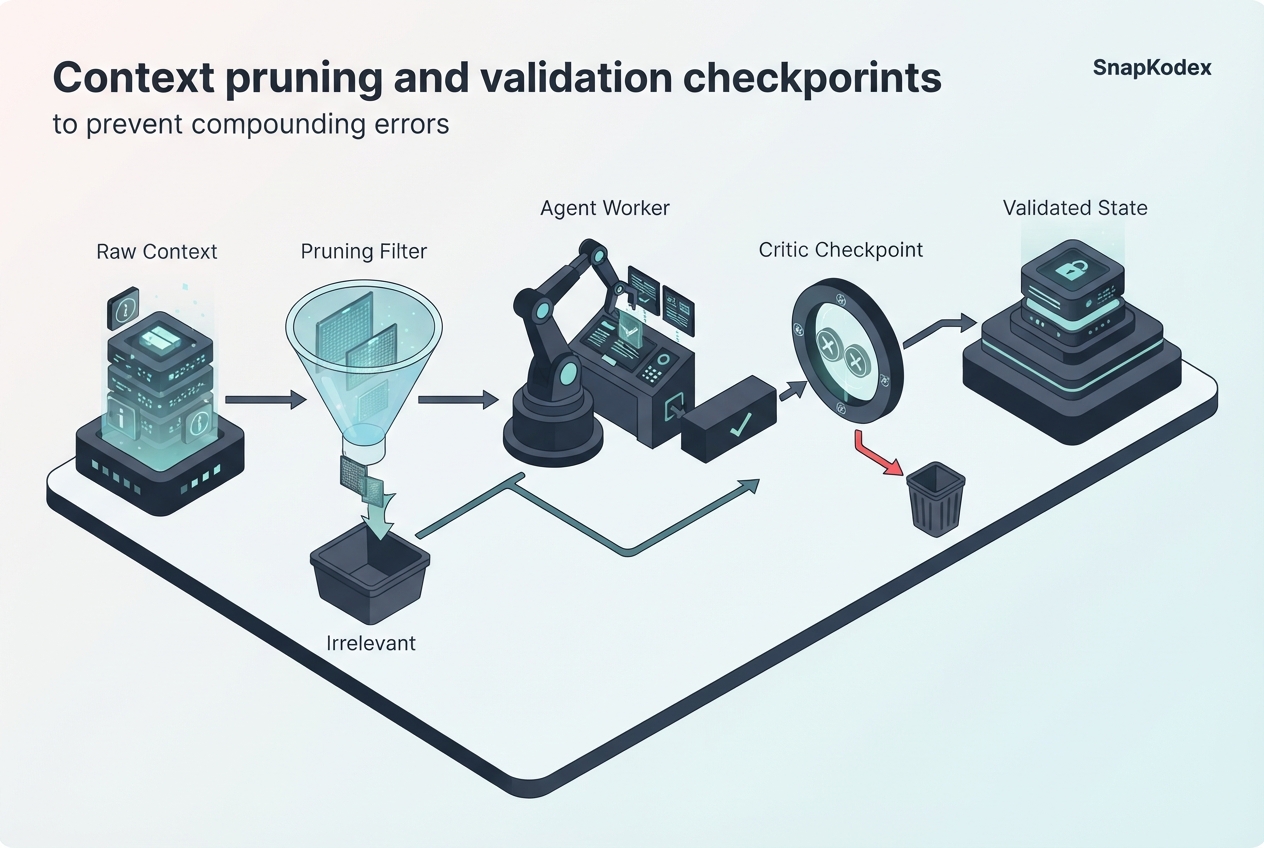
As subagents exchange messages, conversational histories expand rapidly. Passing unpruned conversational threads between agents degrades context window capacity, slows down inference latency, and inflates cloud expenses. Technical leaders must enforce strict state serialization boundaries, ensuring each agent only receives the precise operational variables necessary for its assigned task.
Selective summarization and state pruning prevent context contamination. By discarding irrelevant conversational filler before handing tasks across execution boundaries, systems maintain sharper reasoning accuracy and lower prompt token overhead across complex long-running operations.
Mitigating Compounding Failures Across Chained Prompts
In autonomous workflows, one misconfigured tool call can trigger a cascade of erroneous decisions. Defensive engineering requires independent verification layers where specialized critic nodes inspect intermediate outputs before committing changes. If an anomaly is identified, the system halts execution rather than broadcasting invalid state data across downstream services.
Automated recovery routines can prompt the failing agent to regenerate output using structured validation error messages. When retry budgets are exhausted, workflows divert execution to deterministic fallback paths or human review queues.
How Do Centralized and Decentralized Orchestration Topologies Compare?
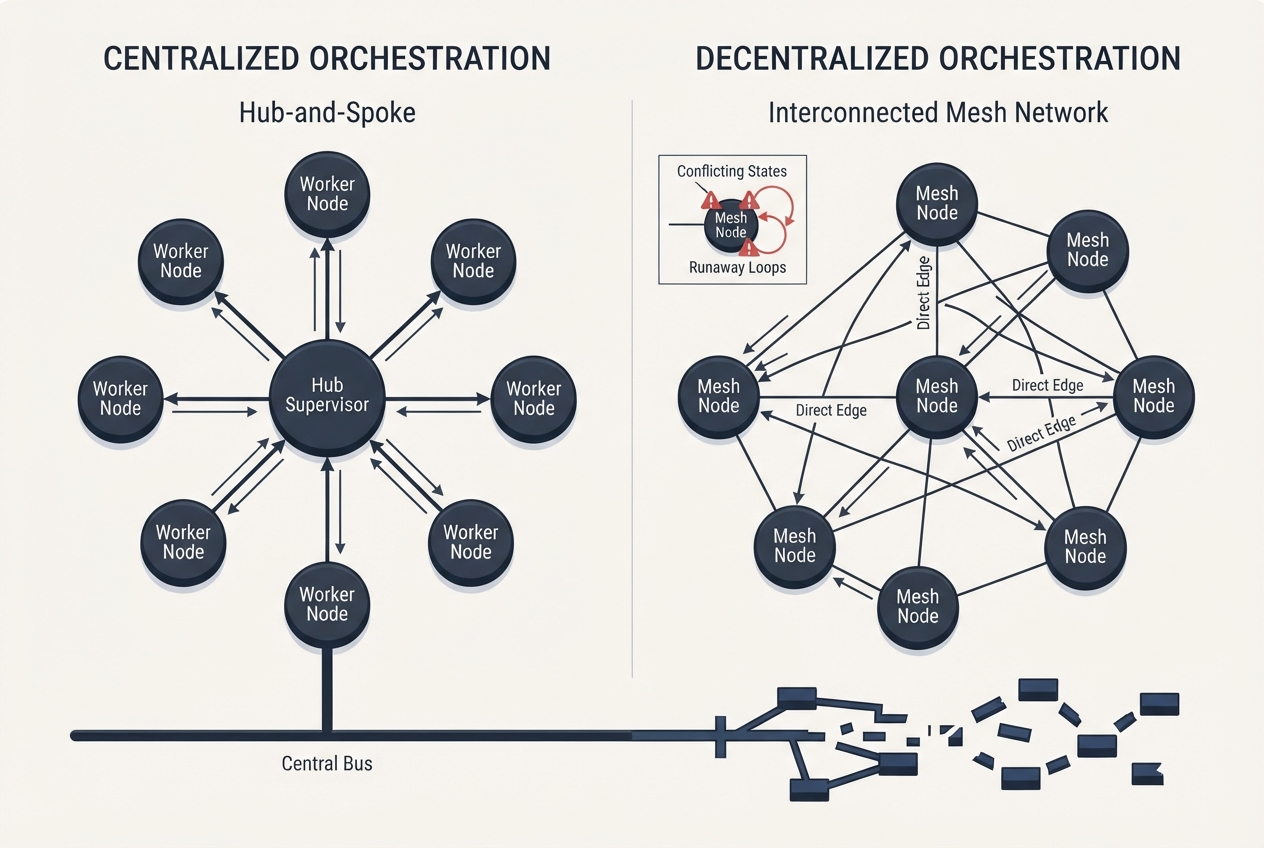
Selecting an architectural topology determines how state flows, how failures are isolated, and how workflows scale under production load. A centralized orchestration model relies on a primary supervisor or hub-and-spoke pattern. In this setup, a central orchestrator decomposes user requests, schedules discrete jobs, passes structured inputs to specialized worker agents, and aggregates results. This pattern offers strict predictability, centralized access control, and straightforward auditability, making it the preferred choice for compliance-driven enterprise applications.
Despite its governance advantages, centralized orchestration creates an architectural bottleneck and a single point of failure. If the supervisor model experiences context degradation or infrastructure failure, the entire operational pipeline stalls. Furthermore, routing every micro-decision through a primary controller introduces network overhead and increases latency, particularly in workflows requiring rapid parallel execution.
Decentralized peer-to-peer mesh networks allow autonomous agents to communicate directly with one another without intermediate routing controllers. This architecture increases local fault tolerance, as the failure of a single node does not necessarily bring down the entire mesh. However, peer-to-peer topologies make maintaining global state consistency exceptionally difficult, significantly increasing the risk of recursive execution loops and untraceable anomalies.
- Centralized supervisors ensure strict deterministic routing, consolidated logging, and straightforward regulatory auditing.
- Hub-and-spoke models introduce potential controller bottlenecks and single points of system failure.
- Decentralized mesh networks improve localized node resilience but heighten the risk of conflicting states and runaway loops.
Balancing Governance and Autonomy Across Topologies
Many high-scale systems adopt a hybrid orchestration approach to capture the benefits of both paradigms. In a hierarchical hybrid model, a primary supervisor establishes project-level constraints and high-level milestones while delegating execution blocks to semi-autonomous agent clusters. Teams can explore specialized SnapKodex services to evaluate these structural trade-offs and build dependable multi-agent frameworks tailored to business objectives.
Hierarchical topologies isolate catastrophic agent failures within designated sub-clusters. If a code synthesis cluster fails or encounters rate limits, the supervisor agent isolates the error while allowing unrelated analysis pipelines to progress unimpeded.
What Communication Protocols Guarantee Distributed State Consistency?
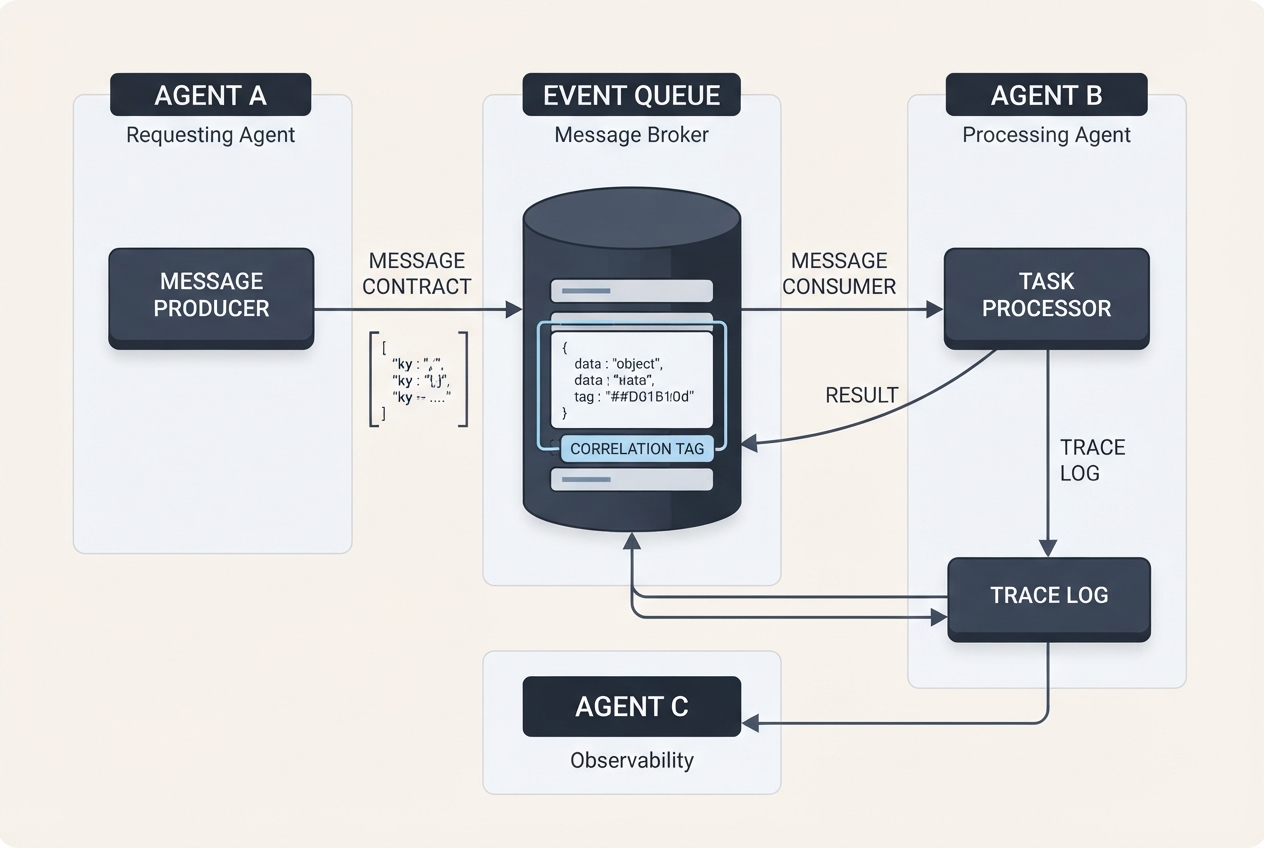
State consistency across distributed agent networks requires structured communication standards. In early prototypes, developers often permit agents to communicate via freeform natural language strings. In an enterprise system, however, unstructured communication generates unpredictable tool parameters and parsing failures. Production multi-agent frameworks mandate strongly typed data contracts, such as strict JSON schemas, to govern every inter-agent request and response payload.
Synchronous HTTP request-response patterns prove brittle for multi-step agent interactions. Complex operational tasks involving web browsing, database synthesis, or code generation can take several minutes to finish. Holding open synchronous HTTP connections during long execution cycles invites network timeouts and connection drops. Implementing asynchronous message brokers with persistent event queues decouples agent execution, enabling durable message delivery across distributed infrastructure.
By treating inter-agent communication as an event-driven sequence, engineering teams prevent worker crashes from corrupting global state. If an agent crashes while processing an event, the broker retains the message in the queue until a healthy agent replica becomes available. For additional perspectives on connecting modern automated workflows with broader organizational strategies, technical leaders often review the published https://snapkodex.com/blog/ai-marketing-guide for architectural and go-to-market alignment.
- Strongly typed JSON schemas ensure message payloads parse reliably without syntactical degradation.
- Asynchronous message queues prevent network timeouts caused by long-running agent tool executions.
- Event-driven decoupling guarantees that failing worker nodes do not cause catastrophic message loss.
Implementing Correlation IDs for Distributed Tracing
Because multi-agent systems execute non-linear, multi-branching reasoning chains, diagnosing failures requires robust observability. Assigning an immutable correlation identifier at the start of a parent transaction ensures every subsequent subagent dispatch, database query, and tool execution shares a unified tracking tag.
Tracing infrastructure uses these correlation tags to reconstruct detailed transaction graphs. When an agent produces an unexpected outcome or encounters an unhandled exception, engineers can isolate the exact prompt, model output, and environment parameters that caused the failure.
- Correlation IDs link parent workflows with child agent subprocesses across disparate cloud environments.
- Distributed telemetry pinpoints latency bottlenecks, repetitive retries, and malformed tool calls in production.
How Can Engineering Teams Implement Fault Tolerance and Durable Execution?
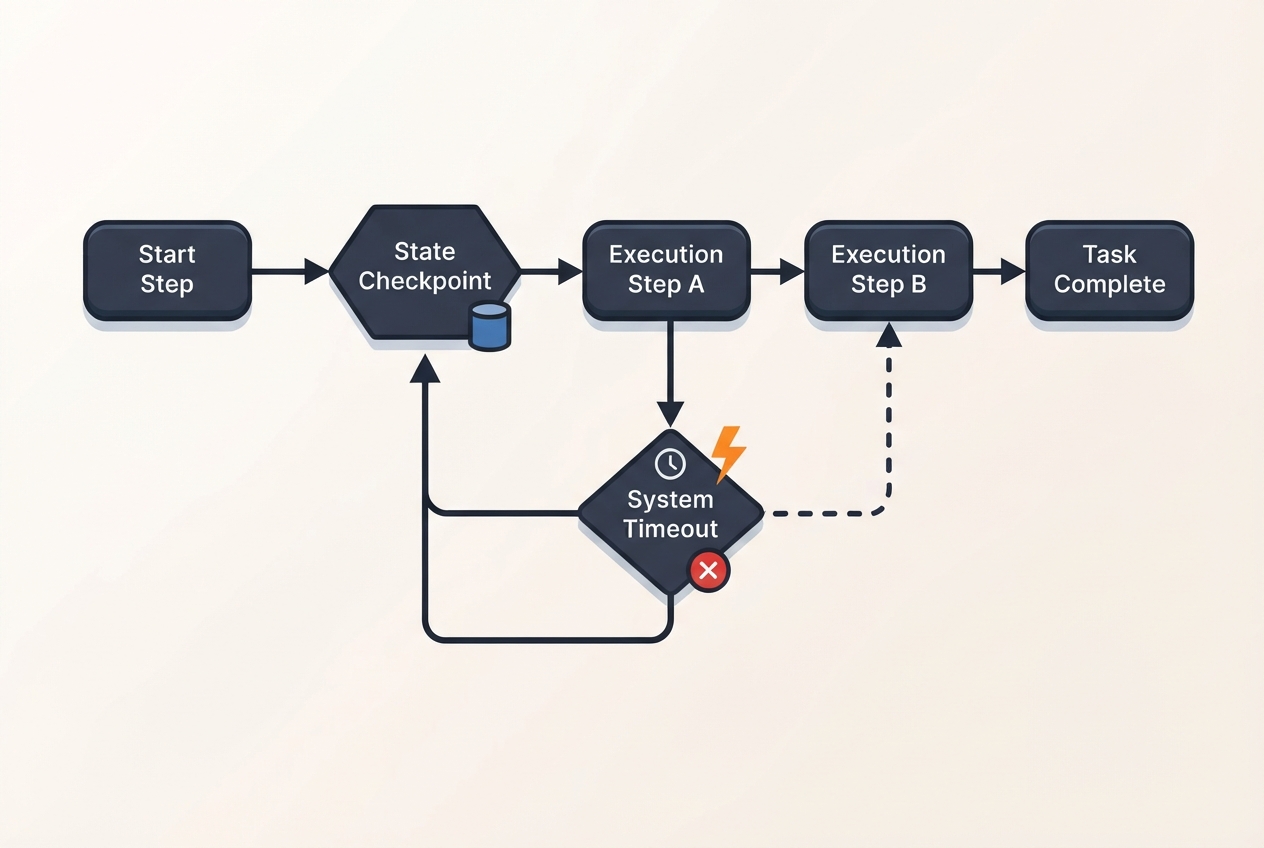
Standard microservice architectures assume deterministic outputs for given inputs, but large language models exhibit non-deterministic behavior. Identical prompts can yield variations in reasoning length, function call ordering, and response formatting. To achieve enterprise-grade resilience, systems must incorporate durable execution engines. These platforms record every execution step, state change, and external side effect to durable storage checkpoints.
When an agent encounters a network partition, third-party API rate limit, or runtime crash, the durable workflow engine pauses the execution thread. Once the external dependency recovers, the engine resumes the workflow from the exact recorded state checkpoint, eliminating the need to re-execute completed steps and burn unnecessary API tokens. This capability is vital for long-running business processes that take hours or days to conclude.
In addition to durable recovery, resilient multi-agent systems enforce zero-trust tool authorization at the API gateway layer. Agents must never possess ambient administrative access. Every tool invocation requires independent token verification, permission checks, and parameter boundary validations. To review integration requirements or discuss custom architectural reviews, engineering leaders can Contact SnapKodex to establish secure deployment pipelines.
- Durable execution engines persist workflow state to resume interrupted tasks without duplicating work or costs.
- Zero-trust API gateways independently validate credentials and role scopes for every autonomous tool invocation.
- Human-in-the-loop checkpoints enforce manual review gates for sensitive, state-altering database or financial operations.
Architectural Patterns for Multi-Agent Systems
Understanding the structural trade-offs between orchestration topologies helps engineering teams select the right architecture for their scalability and compliance requirements.
| Architecture Pattern | Core Advantage | Primary Operational Risk | Recommended Use Case |
|---|---|---|---|
| Centralized Supervisor | High predictability, clear execution boundaries, and simple compliance audits | Single point of failure and potential orchestrator processing bottlenecks | Regulated enterprise processes requiring strict audit trails and consistent oversight |
| Decentralized Mesh | High localized node resilience and distributed parallel processing | High risk of global state inconsistency, message loops, and difficult debugging | Exploratory research swarms, autonomous simulations, and high-throughput data filtering |
| Event-Driven Blackboard | Decoupled communication, durable event queuing, and isolated worker lifecycles | Increased message broker infrastructure overhead and distributed state management | Long-running asynchronous enterprise workflows with multi-service dependencies |
Frequently asked questions
Why do multi-agent systems require significantly more tokens than single-turn chat applications?
Multi-agent systems continuously pass conversational histories, reasoning traces, tool execution outputs, and inter-agent coordination schemas between nodes. This iterative exchange creates a compounding token footprint that frequently consumes roughly fifteen times the token volume of standard single-turn interactions.
What is the role of durable execution in multi-agent architecture?
Durable execution engines persist the state and progress of an agent workflow to durable storage at every step. If an agent crashes or encounters an API timeout, the workflow resumes from the exact saved checkpoint rather than restarting from the beginning, preventing wasted compute and duplicate tool calls.
How do correlation IDs assist in multi-agent debugging?
A correlation ID is a unique, immutable tracking tag assigned to an incoming user request that propagates across all child agents, message queues, and tool invocations. Distributed tracing systems use this identifier to reconstruct execution trees, pinpoint latency bottlenecks, and diagnose specific failure points.
How should organizations secure tool execution in autonomous multi-agent systems?
Tool calls must be governed by zero-trust API gateways rather than natural language instructions. The gateway independently validates authentication credentials, enforces role-based access control, restricts execution scopes, and triggers human-in-the-loop approvals for sensitive or irreversible actions.