How to Build a Technical Content Strategy for Dev Tools
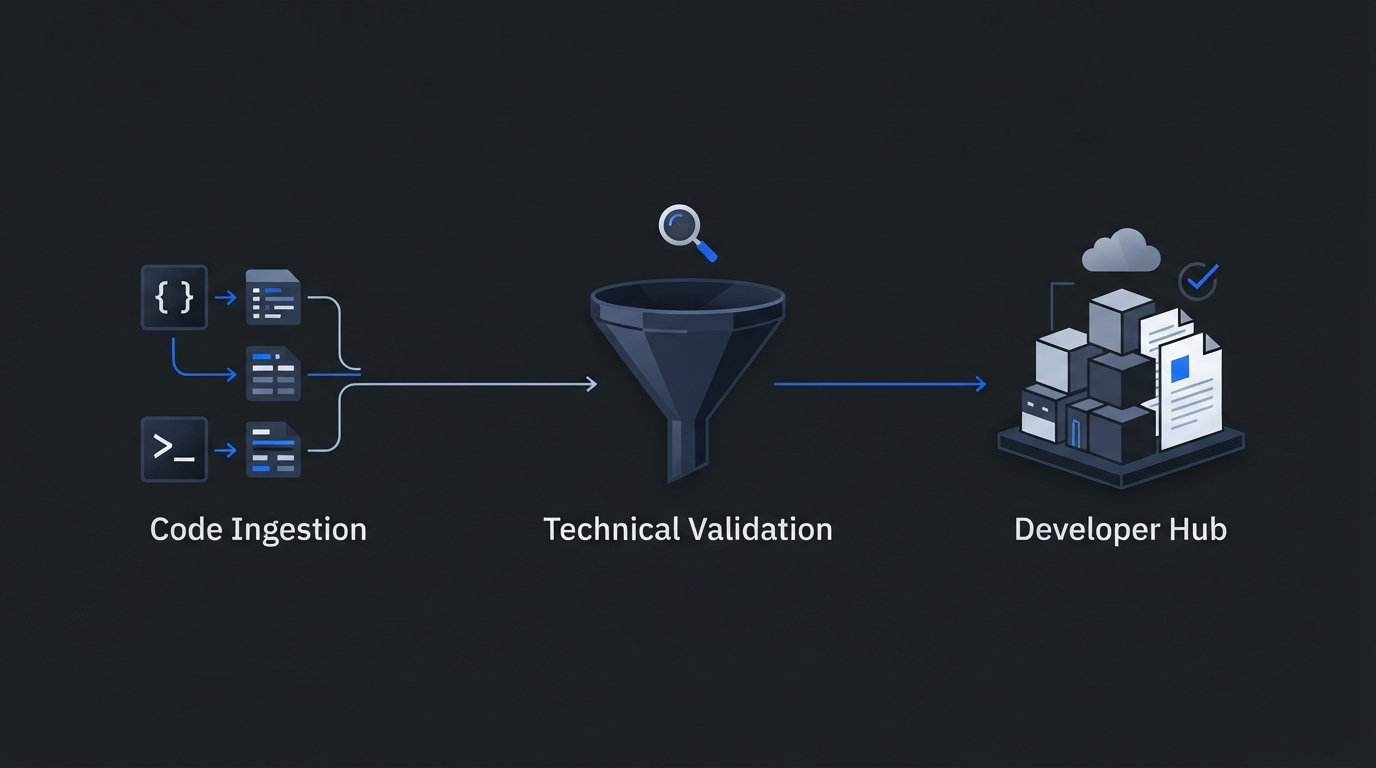
Why Do Traditional Marketing Tactics Fail with Software Developers?
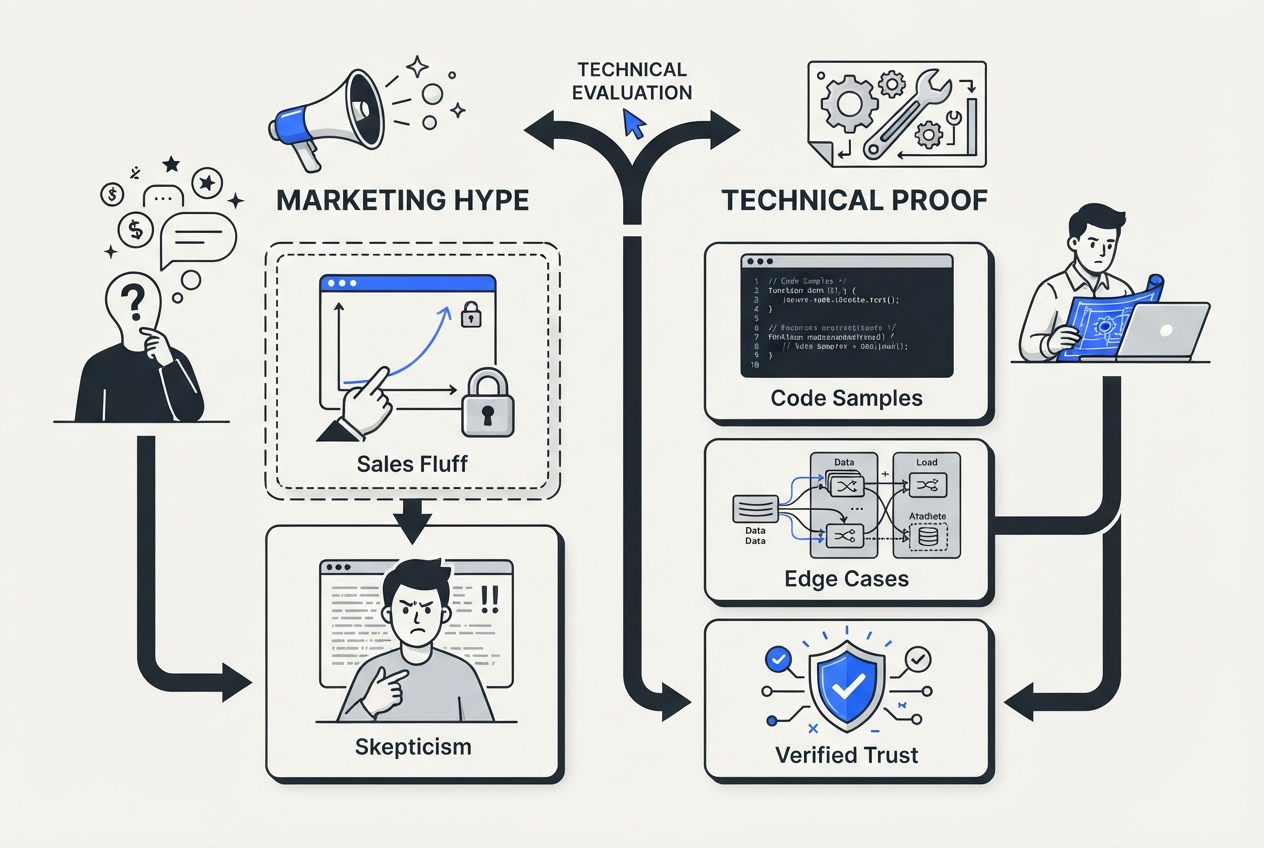
Conventional enterprise marketing playbooks routinely collapse when deployed against software engineers, system architects, and technical decision-makers. Technical professionals approach incoming information with analytical scrutiny, actively testing assertions against their own domain experience. Polished sales slogans, exaggerated claims of effortless scalability, and gated promotional assets signal an absence of engineering depth, triggering immediate skepticism across engineering teams.
Developer behavior also presents significant structural hurdles to traditional digital advertising. Industry analyses indicate that ad-blocker adoption rates among software engineers and DevOps professionals hover between 50 and 60 percent. This widespread usage renders paid display impressions, sponsored banners, and generic remarketing sequences largely ineffective for developer tool organizations seeking sustainable inbound demand.
Establishing genuine engagement demands that dev tool providers abandon shallow brand promotion in favor of peer-level technical instruction. Software engineers do not evaluate platforms based on corporate rhetoric; they assess syntax design, SDK ergonomic quality, deployment overhead, and failure isolation. When organizing a technical content strategy, founders must treat published tutorials, integration guides, and runbooks with the same code hygiene and peer review discipline demanded by production environments.
- Ad-blocker usage among engineering demographics ranges from 50 to 60 percent, limiting the reach of conventional paid display banners.
- Engineers prioritize verifiable system architectures, code examples, and explicit trade-off analyses over corporate buzzwords.
- Technical content functions as a direct sample of product quality; broken scripts or superficial advice destroy organizational trust immediately.
Overcoming the Developer Skepticism Barrier
Engineering culture thrives on open critique, reproducible verification, and empirical proof. When an engineering leader lands on an article containing outdated syntax, deprecated dependencies, or non-functional terminal commands, they reasonably conclude that the underlying developer tool exhibits similar defects. Technical authority cannot be purchased through aggressive promotion; it must be constructed through meticulous, error-free documentation that respects the developer's time.
Surmounting this initial skepticism requires teams to maintain radical transparency regarding tool constraints and architectural limitations. Highlighting precisely where a tool excels—as well as when an alternative framework represents a superior architectural choice—builds enduring credibility that traditional promotional copy cannot manufacture.
Balancing High-Utility Education with Commercial Visibility
Founders frequently struggle to harmonize purely educational writing with commercial pipeline generation. Successful dev tool platforms resolve this tension by adopting a philosophy of being useful in public. Rather than interrupting an engineer with intrusive sales pitches, the content resolves a real implementation problem before presenting the product as an automated or streamlined solution.
For organizations seeking structured guidance on positioning educational assets within competitive search verticals, reviewing specialized resources like https://snapkodex.com/services/seo-content helps establish disciplined editorial pipelines that balance rigorous technical teaching with sustainable discoverability.
How to Map Content to the Technical Search Journey?
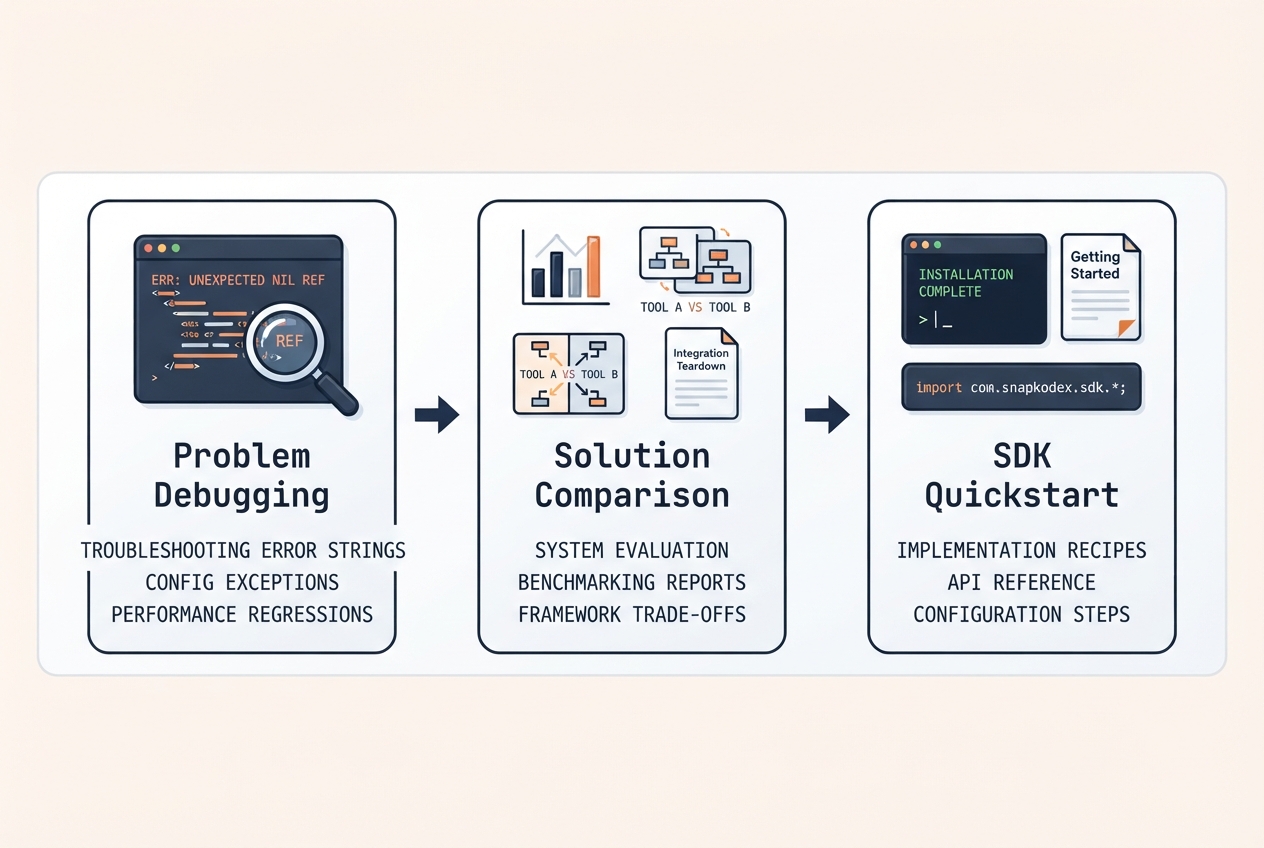
A successful developer content program reflects the specific mental model engineers employ when resolving operational roadblocks or evaluating software infrastructure. Traditional marketing categorizes prospects into generic top, middle, and bottom sales funnels, but software developers move through highly targeted, problem-centric exploration phases. Understanding these operational checkpoints enables dev tool startups to intercept technical buyers at moments of acute intent.
The technical search journey begins when an engineer encounters an active obstacle—such as an obscure compiler error code, an unexplained memory leak, or a restrictive framework constraint. By architecting articles around precise debugging scenarios and architectural questions, dev tool platforms capture engineers actively engaged in system design, positioning their tooling as a logical architectural component.
- Problem-aware phase: Captures developers troubleshooting explicit error strings, CLI flags, configuration exceptions, or performance regressions.
- Solution-aware phase: Targets system comparisons, database benchmarking reports, integration teardowns, and framework trade-off evaluations.
- Product-aware phase: Guides qualified prospects through SDK quickstarts, configuration recipes, API reference sheets, and enterprise security evaluations.
Targeting Search Intent Precision Over Raw Search Volume
Traditional search optimization strategies often chase massive monthly search volumes across broad, non-specific keywords. For developer tools, this tactic creates substantial vanity traffic that yields zero terminal installations or API keys. Developers searching for broad terms like cloud computing are rarely evaluating specific developer tooling; conversely, an engineer searching for distributed tracing header propagation in Go possesses clear, actionable intent.
Prioritizing search intent precision requires content strategists to focus on long-tail technical queries and developer-specific terminology. To study how modern visibility strategies connect with engineering audiences, teams can explore the SnapKodex home platform to review structured technical marketing methodologies.
Developing Code-Centric Content Assets for Every Stage
Every stage of the developer search journey requires distinct content formats tailored to technical evaluation habits. Problem-aware queries require concise, reproducible troubleshooting guides complete with environment specifications and copyable code fixes. Solution-aware readers demand quantitative benchmarks, latency percentiles, and architectural component diagrams that clarify systemic trade-offs.
Finally, product-aware content must eliminate onboarding friction entirely. Providing self-contained sandbox environments, copy-paste curl commands, and modular repository templates ensures that evaluating engineers can achieve a working proof-of-concept within minutes.
How Do You Solve the Technical Content Creation Bottleneck?
The most critical operational bottleneck facing developer tool companies is technical content production capacity. Generalist marketing copywriters lack the deep systems programming, distributed infrastructure, or security background required to write convincingly for senior engineers. When non-technical writers attempt deep technical analysis, the resulting drafts routinely suffer from superficial generalizations, incorrect terminology, and broken code snippets that instantly alienate practitioners.
Conversely, internal staff engineers, architects, and technical founders possess unmatched subject matter depth but are heavily occupied with feature development, infrastructure scaling, and defect triage. Pulling core engineers away from the product roadmap to write 2,000-word blog tutorials creates severe engineering velocity drag that most early-stage and growth-stage companies cannot afford.
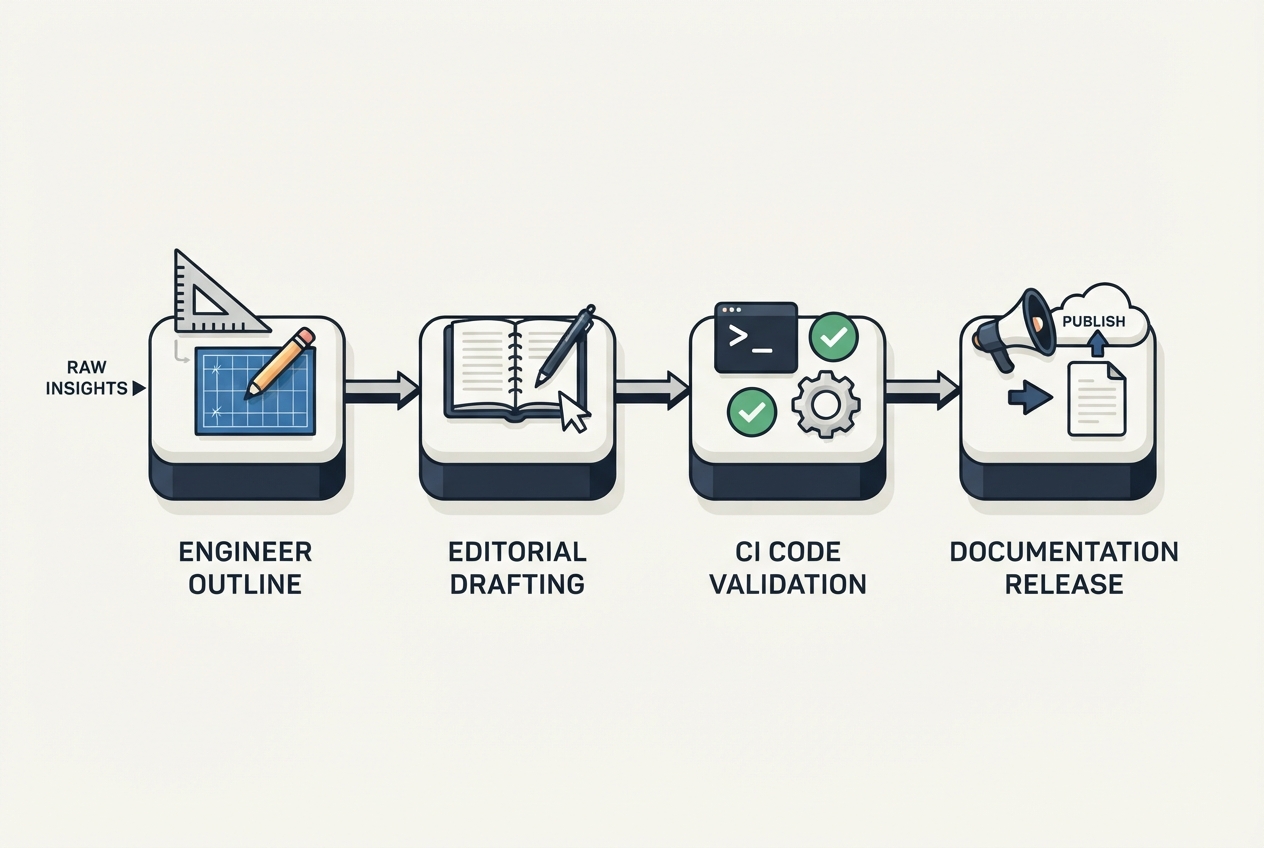
Overcoming this fundamental bottleneck requires instituting a structured hybrid content workflow. Internal engineers should not be tasked with writing complete long-form essays from scratch; instead, teams should extract their expertise through structured fifteen-minute technical interviews, architecture sketches, or pull request annotations. Technical editors then transform these engineering outlines into polished, comprehensive guides.
- Extract raw technical insights via short recorded engineer debriefs, CLI transcripts, and architecture diagrams.
- Employ specialized technical editors who understand code execution, debugging, and continuous integration workflows.
- Establish automated testing pipelines for all documented code snippets to catch breaking API changes prior to publication.
- Teams can review SnapKodex services to discover technical workflow consultation and professional content frameworks tailored to software teams.
Establishing a Code-Testing Pipeline for Editorial Artifacts
Nothing erodes developer trust faster than code samples that fail upon execution. As underlying frameworks update and dependencies evolve, static code snippets published in technical blogs rapidly suffer from documentation drift. Leading developer tool teams treat all editorial code snippets as validated software artifacts.
Integrating automated continuous integration checks that execute code snippets against supported runtime environments ensures long-term tutorial integrity. When an API version deprecates a parameter, the CI pipeline flags the article repository, allowing the editorial team to patch the guide before readers encounter runtime exceptions.
Where Should Dev Tool Startups Distribute Technical Content?
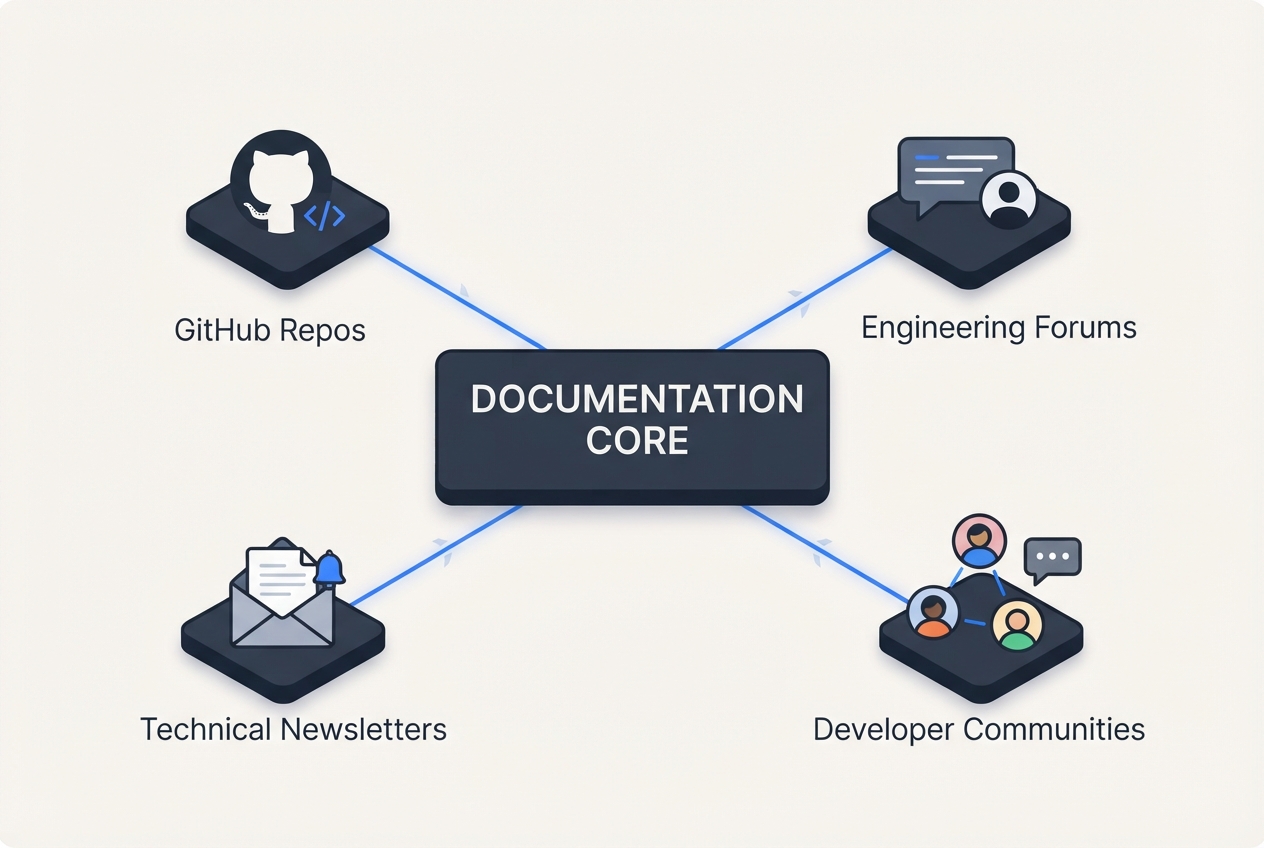
High-caliber technical guides provide negligible business value if they remain undiscovered within an isolated company blog. Because software developers avoid traditional paid banner advertisements and sponsored social placements, distribution must focus on authentic presence within developer-native communication hubs and organic discovery engines.
Authentic distribution requires participating as a constructive peer within technical communities. Rather than broadcasting promotional links, founders and developer advocates should summarize core findings, share performance benchmarks, and publish open-source utilities directly to developer aggregators, specialized forums, and repository ecosystems.
To evaluate broader promotional frameworks and multichannel visibility strategies across modern technology stacks, founders can consult our AI Marketing Guide for additional perspective on balancing algorithmic discovery with authentic community engagement.
- GitHub repositories: Releasing functional starter templates, open-source CLI tools, and reproducible benchmark suites directly within relevant repositories.
- Developer community hubs: Engaging organically on platforms like Hacker News, Reddit engineering subreddits, Discord server channels, and Discourse boards.
- Curated engineering newsletters: Securing placements in niche technical digests read by senior engineering leaders and infrastructure architects.
- Founder-led technical discourse: Sharing authentic architectural post-mortems, scaling challenges, and runtime trade-offs directly from engineering leadership.
Executing Founder-Led Technical Thought Leadership
Engineering leaders respect founders who demonstrate hands-on architectural competence and intellectual honesty. When technical founders write transparent retrospectives detailing production outages, database migration hurdles, or internal microservice transitions, other software leaders pay attention. These deep post-mortems establish brand authority far more effectively than traditional product announcements.
By documenting genuine technical decisions and explaining why specific engineering trade-offs were accepted, founders construct an authentic narrative that naturally introduces their developer tooling to peer architects facing identical structural challenges.
Comparison of Traditional B2B SaaS vs. Dev Tool Content Strategies
Developing content for engineering audiences requires fundamentally different editorial parameters, validation standards, and distribution channels than traditional enterprise SaaS marketing.
| Strategic Parameter | Traditional B2B SaaS Content | Developer Tool Content Strategy |
|---|---|---|
| Target Audience Mindset | Business managers seeking operational efficiency, departmental ROI, and executive oversight. | Engineers and architects evaluating code maintainability, technical ergonomics, and system reliability. |
| Primary Content Formats | Gated PDF whitepapers, executive eBooks, sales webinars, and high-level case studies. | Interactive API documentation, code walkthroughs, CLI quickstarts, and benchmark repositories. |
| Search Intent Orientation | High-volume, commercial keywords focused on software category comparisons and pricing queries. | Specific debugging strings, framework error logs, CLI arguments, and architectural design patterns. |
| Validation and Review Standard | Editorial proofreading focused on brand voice, tone compliance, and conversion rate optimization. | Rigorous continuous integration testing of code snippets, API compatibility checks, and peer engineering review. |
| Primary Discovery Channels | Search engine ads, LinkedIn sponsored posts, programmatic display banners, and outbound email. | GitHub repositories, technical developer forums, niche newsletters, and peer community discussions. |
Frequently asked questions
Why do traditional B2B marketing tactics fail when marketing to software developers?
Software developers possess analytical mindsets and maintain deep skepticism toward sales hype and unverified promotional claims. Furthermore, with ad-blocker usage exceeding 50 to 60 percent across engineering demographics, conventional display campaigns and paid advertisements fail to achieve reliable reach, making educational and code-backed content essential.
How should dev tool startups balance search volume against developer intent?
Dev tool startups should prioritize search intent precision over sheer monthly search volume. Targeting long-tail queries, obscure runtime exceptions, and specific architectural comparisons attracts active practitioners with high operational intent, resulting in significantly higher product adoption than broad top-of-funnel traffic.
How can early-stage teams solve the developer content creation bottleneck?
Startups should adopt a hybrid workflow where internal engineers supply raw architectural notes, code snippets, or brief recorded walkthroughs, while dedicated technical writers or specialized technical agencies structure, edit, and optimize the material for publication.
What is the best way to prevent code drift in technical blog articles?
Treat editorial code samples like production software by integrating automated continuous integration checks. Testing snippets against active runtime environments and target SDK versions ensures broken commands and deprecated parameters are flagged and corrected immediately.
Where should dev tool teams focus their content distribution efforts?
Teams should focus on developer-native ecosystems where engineers naturally seek answers, including open-source GitHub repositories, technical aggregators like Hacker News, engineering subreddits, specialized Discord servers, and curated technical newsletters.