How to Audit and Optimize Cloud Costs for SaaS Platforms
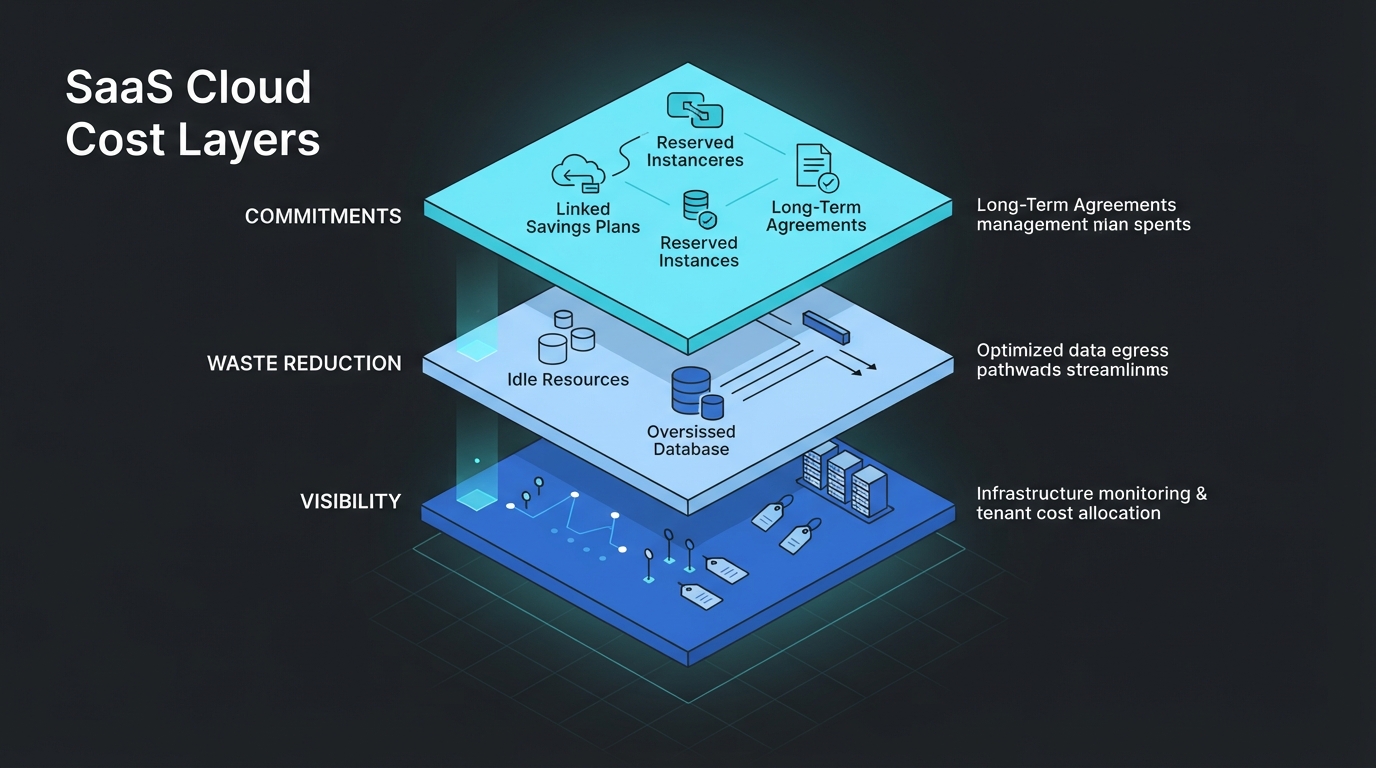
Why is cloud cost visibility essential for SaaS gross margins?
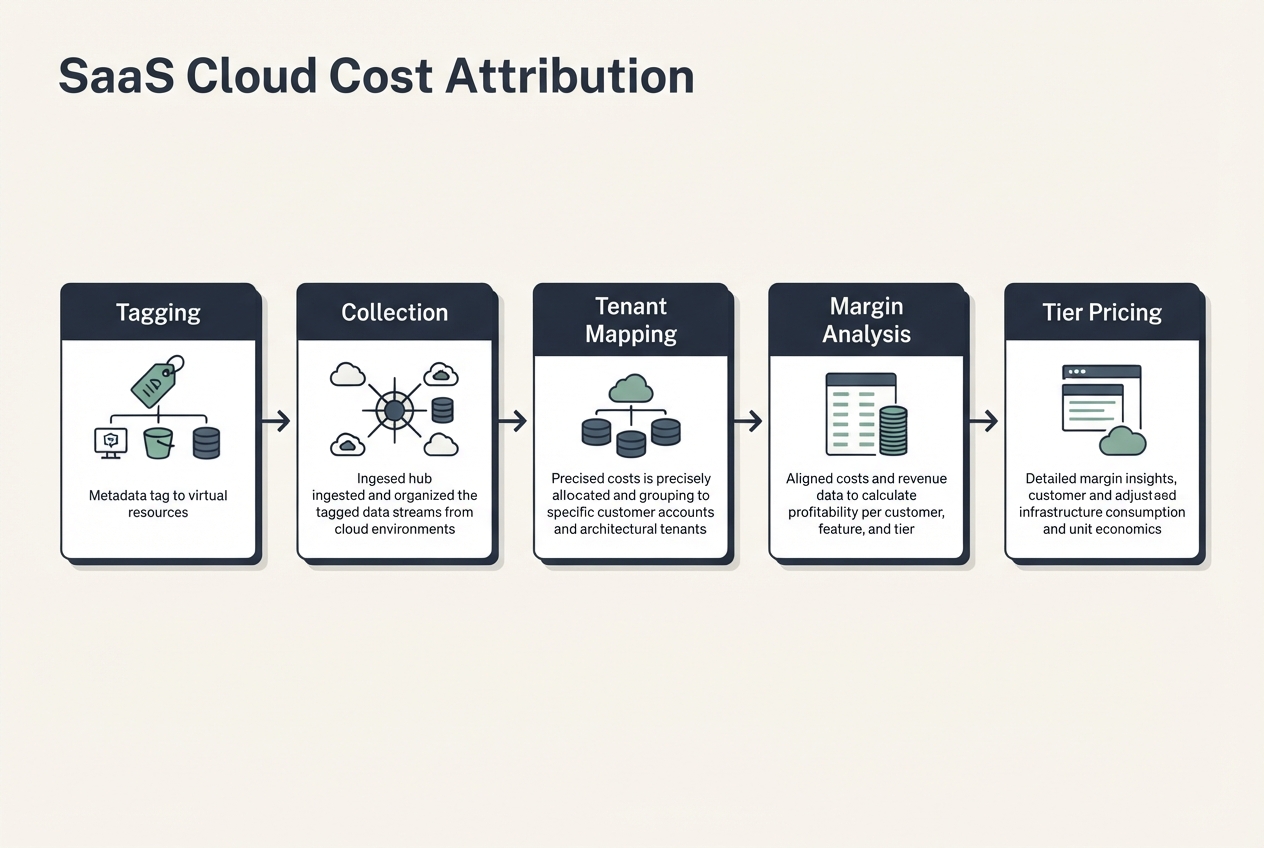
SaaS engineering leaders can no longer evaluate total monthly cloud bills in isolation. When infrastructure expenses grow faster than incoming subscription revenue, product gross margins degrade rapidly. Achieving true cost visibility requires moving beyond aggregate monthly cloud invoices and directly connecting hosting costs to unit economics, customer tiers, and P&L financial inputs. Without precise data attribution, leadership cannot determine whether a newly deployed background workflow or a specific enterprise customer is consuming disproportionate computing capacity.
Establishing this visibility requires engineering organizations to enforce comprehensive resource tagging standards across all environments. Every virtual machine, database cluster, storage bucket, and serverless function must carry mandatory metadata identifying its service owner, operational environment, and designated cost center. Combining these tagging policies with showback or chargeback reporting gives product engineering squads direct financial accountability. Teams seeking structured architectural audits often leverage specialized consulting through SnapKodex services to systematically uncover unmonitored infrastructure spend.
Modern cloud environments extend far beyond traditional single-cloud infrastructure. The contemporary FinOps maturity framework mandates that third-party software tools, hybrid cloud deployments, and external analytics pipelines are evaluated under a unified financial governance discipline. When all operational expenses are visible within an integrated reporting layer, technical founders can make data-driven decisions regarding pricing adjustments, subscription tier packaging, and long-term capacity planning without jeopardizing operating margins.
- Implement mandatory resource tagging schemas across all compute, storage, and networking layers.
- Link infrastructure expenditures directly to individual customer tiers and tenant architectures.
- Establish internal showback and chargeback reports to assign clear financial ownership.
Mapping cloud expenses to tenant architectures
Multi-tenant SaaS architectures frequently obscure cost attribution because multiple customer accounts share identical application clusters and relational database pools. To untangle shared resource costs, engineering teams must implement tenant-aware metrics that capture usage at the individual tenant boundary. By recording query execution times, background worker runtimes, API request frequencies, and per-tenant object storage consumption, engineering teams can accurately measure tenant-level cost of goods sold.
This granular tracking reveals whether certain power users are eroding company margins. If high-tier accounts execute resource-intensive analytics or high-volume indexing tasks, standard monthly subscription fees might fail to cover the underlying infrastructure burn. Pinpointing these specific utilization anomalies empowers product managers to adjust commercial contracts, introduce consumption-based overage pricing, or optimize inefficient query patterns before margin dilution spreads across the customer base.
How can engineering teams eliminate infrastructure waste and data egress expenses?
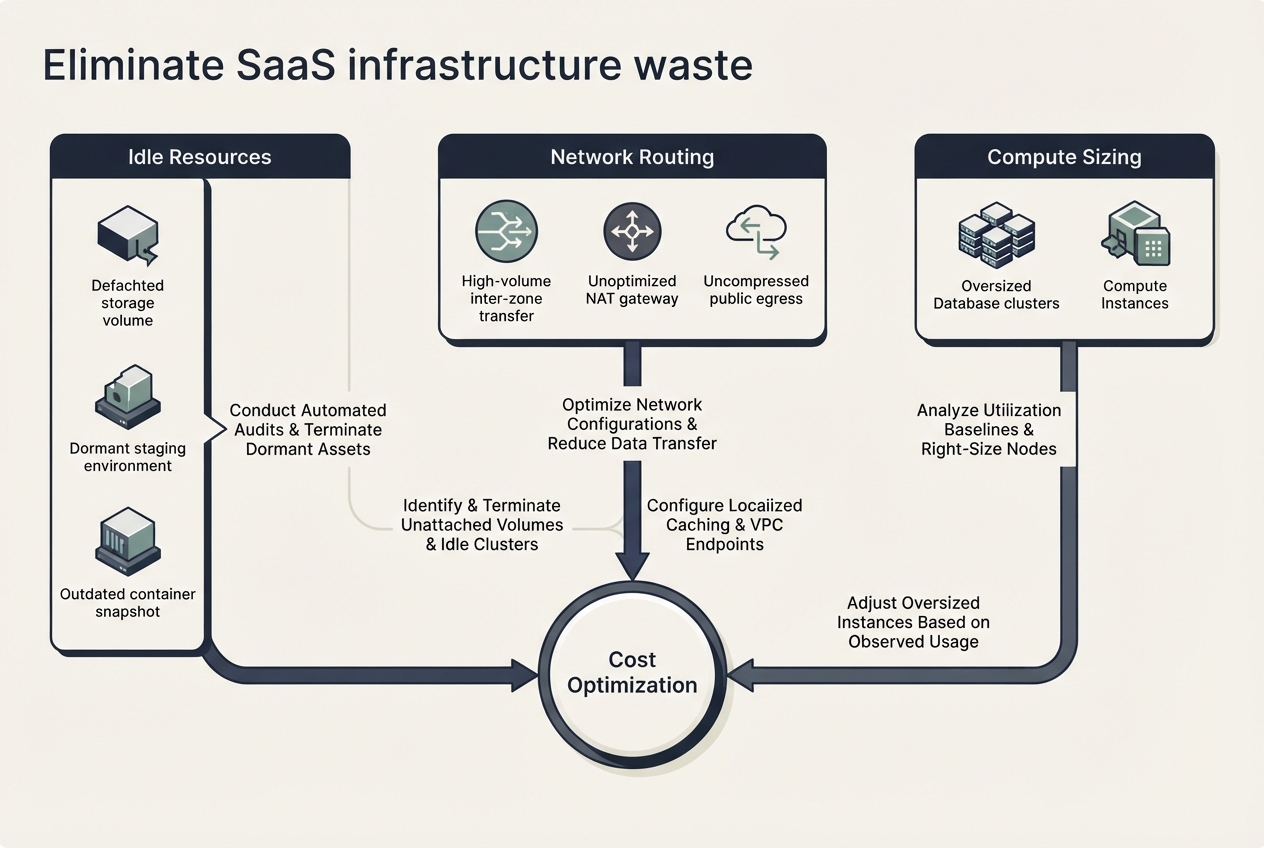
Once resource visibility is established across services, optimization efforts must target infrastructure waste. Modern SaaS platforms regularly accumulate dormant assets, including unattached block storage volumes, abandoned staging environments, outdated container snapshots, and overprovisioned database clusters deployed during rapid feature launches. Conducting automated weekly infrastructure audits allows engineering squads to terminate idle resources safely without risking production downtime or degrading application reliability.
In addition to idle compute instances, inefficient networking configurations often generate massive monthly cost overruns. High-volume data transfers between different availability zones, unoptimized NAT gateway routes, and uncompressed public egress calls quietly inflate infrastructure invoices. Engineering teams can dramatically reduce network bills by co-locating interdependent microservices within shared subnets, establishing localized caching layers, and deploying VPC endpoints for internal service communications.
Addressing structural cloud inefficiencies requires continuous architectural refinement alongside regular product development sprints. Technical teams can review comprehensive software engineering blueprints by browsing the SnapKodex home platform to align infrastructure scaling strategies with sustainable development practices. Eliminating unnecessary compute overhead frees up technical capital, enabling teams to reinvest operational budget into revenue-generating product improvements.
- Automate the identification and termination of unattached storage volumes and idle staging clusters.
- Configure localized caching layers and VPC endpoints to cut expensive inter-zone networking fees.
- Right-size oversized database nodes and compute instances based on observed utilization baselines.
Managing variable AI and data processing expenditures
Modern SaaS architectures increasingly incorporate high-throughput data processing layers and generative artificial intelligence capabilities. LLM token consumption, vector search indexing, and managed data warehousing introduce volatile, consumption-based expenditures that standard infrastructure monitoring dashboards often fail to capture. Unchecked automated agent loops or unoptimized vector queries can trigger sudden, severe cost spikes that severely damage software gross margins.
Protecting product margins in data-heavy environments requires establishing rigorous consumption limits, prompt caching, and tiered rate limits. Implementing Redis caching layers for repetitive model queries eliminates redundant calls to external foundational model APIs. Furthermore, setting automated anomaly detection alerts on token consumption and vector read units prevents runaway execution loops from generating catastrophic monthly hosting surprises.
What role does commitment coverage play in long-term cloud financial management?
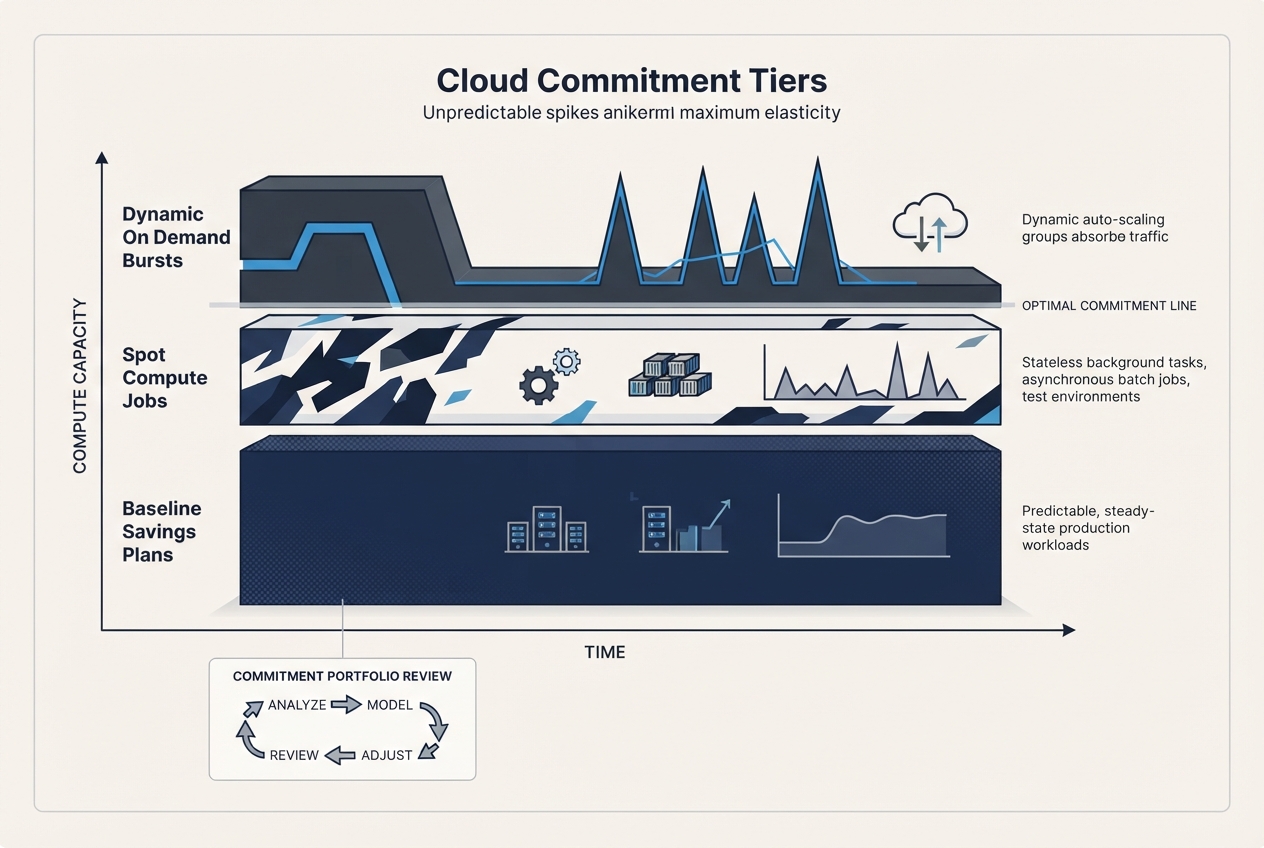
Relying exclusively on on-demand cloud compute pricing creates unnecessary overhead for established SaaS applications. On-demand pricing offers maximum elasticity for unpredictable spikes, but steady-state production workloads operate far more cost-effectively under commitment-based discount models. By utilizing Reserved Instances and Savings Plans, SaaS companies can achieve substantial hourly discounts across long-term compute and database deployments.
However, maximizing commitment coverage requires rigorous capacity planning and historical usage modeling. Committing prematurely to inflexible instance families risks stranding the engineering organization on legacy hardware when architecture shifts occur. Conversely, maintaining insufficient commitment coverage leaves substantial infrastructure savings uncaptured. Seasoned FinOps professionals recommend maintaining a sixty to eighty percent commitment baseline for predictable core workloads while absorbing traffic bursts using dynamic auto-scaling groups.
Spot instances offer another high-impact savings mechanism when deployed strategically across asynchronous workloads. Background data processing pipelines, non-urgent batch transformations, and integration test environments can run reliably on low-cost spot capacity when paired with graceful termination handlers. Combining baseline savings plans with opportunistic spot provisioning ensures that SaaS platforms maintain continuous budget efficiency without sacrificing application performance.
- Cover predictable steady-state production workloads with flexible compute savings plans.
- Utilize spot instances for stateless background tasks, asynchronous batch jobs, and test environments.
- Conduct quarterly commitment portfolio reviews to adjust instance types as technical architectures evolve.
How do you align engineering culture with cloud financial accountability?
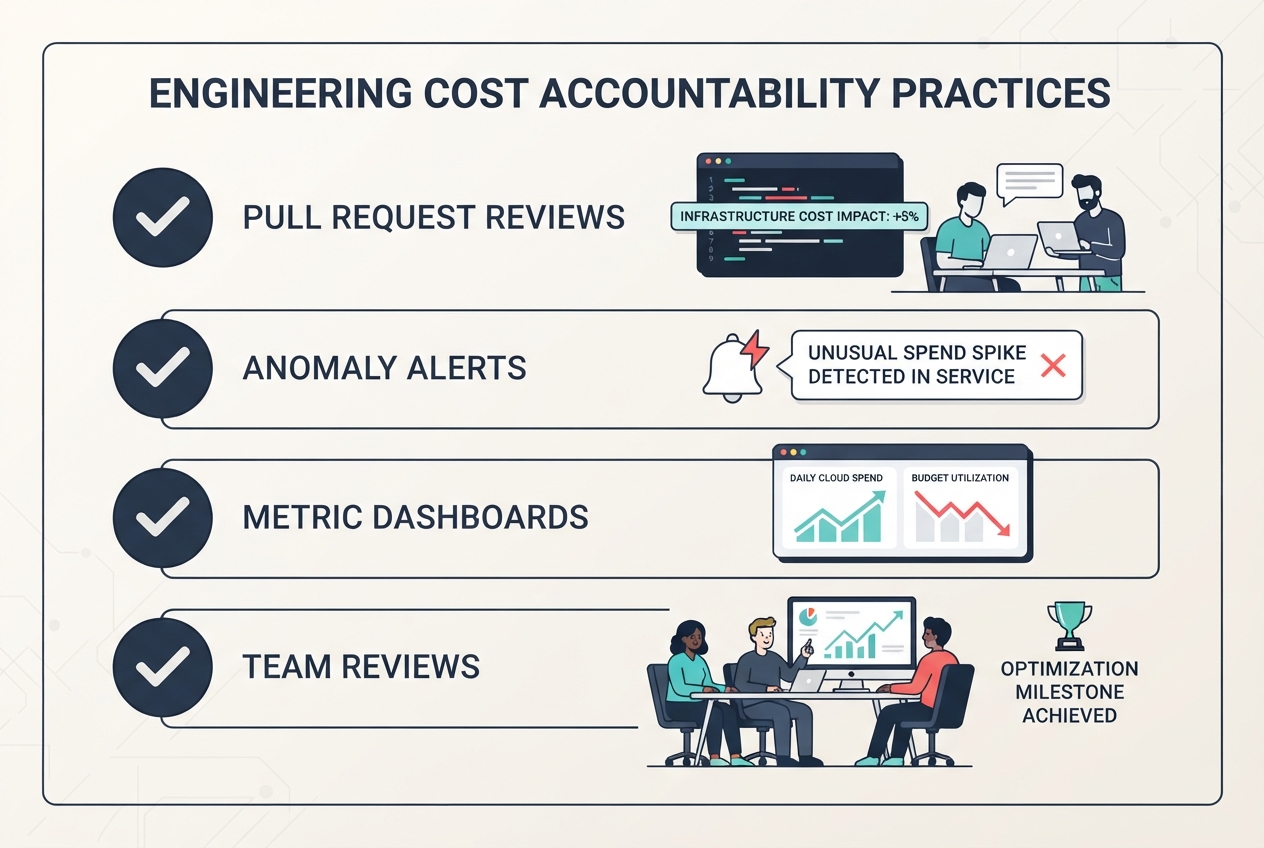
Cloud cost optimization cannot remain solely an accounting task or a periodic infrastructure review; it demands an engineering culture anchored in financial accountability. When software developers write, test, and release code without real-time insight into the infrastructure consequences of their architectural designs, inefficient queries, redundant polling loops, and wasteful database schemas inevitably slip into production deployments.
Fostering financial awareness requires integrating infrastructure cost metrics directly into regular development workflows. Engineering squads should inspect infrastructure spend anomalies alongside application error tracking, integrate cost-impact assessments into architectural pull requests, and celebrate optimization milestones during sprint retrospectives. When developers view infrastructure efficiency as a core quality attribute, cloud spend stabilizes naturally.
Sustaining this cultural balance between rapid delivery and operational thrift ensures that SaaS margins scale predictably as customer acquisition accelerates. Engineering leadership looking to audit infrastructure workflows and establish resilient development practices can engage with advisors through Contact SnapKodex to build sustainable engineering governance protocols.
- Incorporate infrastructure cost impact evaluations into engineering pull request reviews.
- Surface spending anomaly alerts directly within developer communication channels.
- Recognize and reward architectural refactoring initiatives that deliver measurable cost reductions.
Cloud Cost Optimization Strategy Comparison
Evaluating the operational impact and implementation complexity of core SaaS FinOps strategies.
| Optimization Strategy | Primary Impact | Implementation Complexity |
|---|---|---|
| Resource Tagging & Showback | Enables accurate tenant cost attribution and margin analysis. | Medium |
| Idle Waste Decommissioning | Delivers immediate reduction in unoptimized monthly hosting spend. | Low |
| Reserved Instances & Savings Plans | Lowers baseline compute costs through long-term commitments. | Medium |
| AI Token Optimization & Caching | Mitigates variable inference expenses and prevents margin erosion. | High |
Frequently asked questions
What is the primary goal of cloud cost optimization for SaaS platforms?
The primary goal is maximizing cost efficiency per user or transaction to protect gross margins, rather than simply pursuing arbitrary reductions in total monthly cloud spend.
How do multi-tenant architectures complicate cloud cost attribution?
Because multiple customers share underlying databases and application servers, standard billing summaries cannot distinguish who consumed specific resources. Teams must implement tenant-aware metrics to track usage accurately.
Why are AI infrastructure and LLM inference costs difficult to manage?
AI features introduce variable costs tied to token consumption, vector database operations, and GPU usage that often bypass traditional cloud cost management tools.
How can engineering teams prevent wasteful cloud spending during development?
Teams can integrate cloud cost estimates into pull request reviews, monitor spending anomalies in real time, and establish rigorous resource tagging standards from the outset.