How to Architect a Secure Multi-Tenant SaaS Platform
What Are the Fundamental Tenancy Models in Modern SaaS?
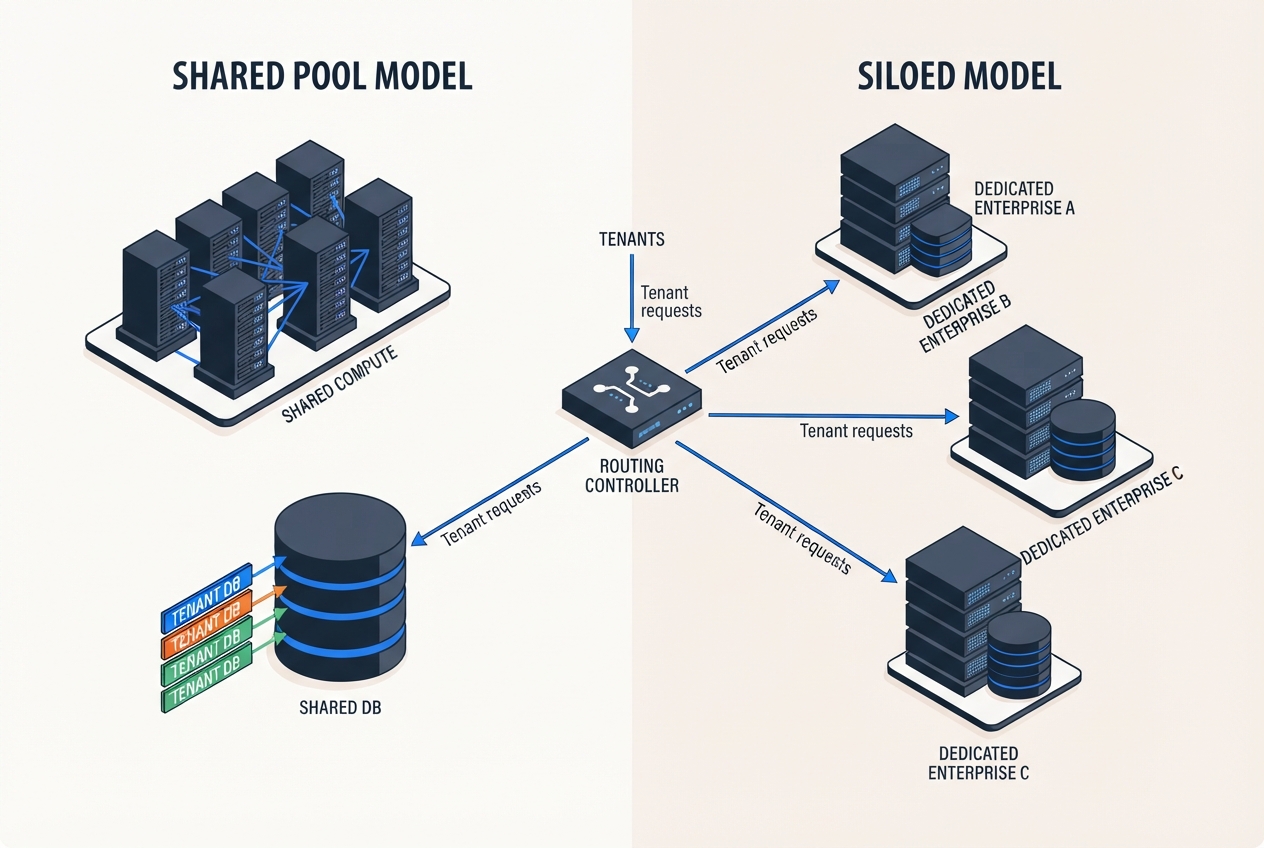
Selecting the foundational tenancy model dictates how an engineering organization balances infrastructure cost, maintenance overhead, and security isolation. Multi-tenancy operates along an architectural spectrum rather than as a single binary choice. Engineering leaders must evaluate operational requirements, compliance obligations, and projected scaling economics before committing code to a specific pattern.
In a shared pool model, all subscribing tenants share compute instances, network resources, application servers, and databases. Logical isolation is maintained purely through software constructs such as tenant identifiers on database rows, application-level filters, or storage namespaces. The pool model yields the lowest operational cost per tenant and streamlines continuous deployment cycles, but it carries a higher blast radius if application code fails to filter queries properly.
Conversely, the silo model provisions dedicated, isolated infrastructure components for every tenant. Each customer operates within separate virtual networks, container clusters, or independent database instances. While this model introduces higher hosting bills and complex operational orchestration, it virtually eliminates cross-tenant data contamination risks and satisfies rigid enterprise compliance standards. For engineering leaders reviewing architecture options across product lines on SnapKodex home, evaluating customer tiering early determines whether pooling or siloing will best preserve unit margins.
- The shared pool model maximizes resource utilization and simplifies software updates across large customer cohorts.
- The silo model provides complete infrastructure isolation for high-value enterprise tiers requiring custom compliance assurances.
- Blast radiuses in pooled models must be mitigated through automated security gates and database-enforced boundaries.
Evaluating the Hybrid Tenancy Pattern
Modern SaaS organizations frequently combine patterns into a hybrid tenancy model. Under this architecture, the platform routes standard, price-sensitive tenants to a pooled application and database cluster, while high-paying enterprise customers receive dedicated database schemas or isolated serverless compute instances. This setup protects overall operating margins without forfeiting high-contract enterprise deals.
Implementing a hybrid approach demands a modular storage abstraction layer. The persistence adapter must inspect the authenticated tenant identifier and dynamically resolve connection pools, database routing keys, or schema parameters at runtime without requiring specialized branches in upstream application logic.
How Do You Implement Tenant Identity and Context Propagation?
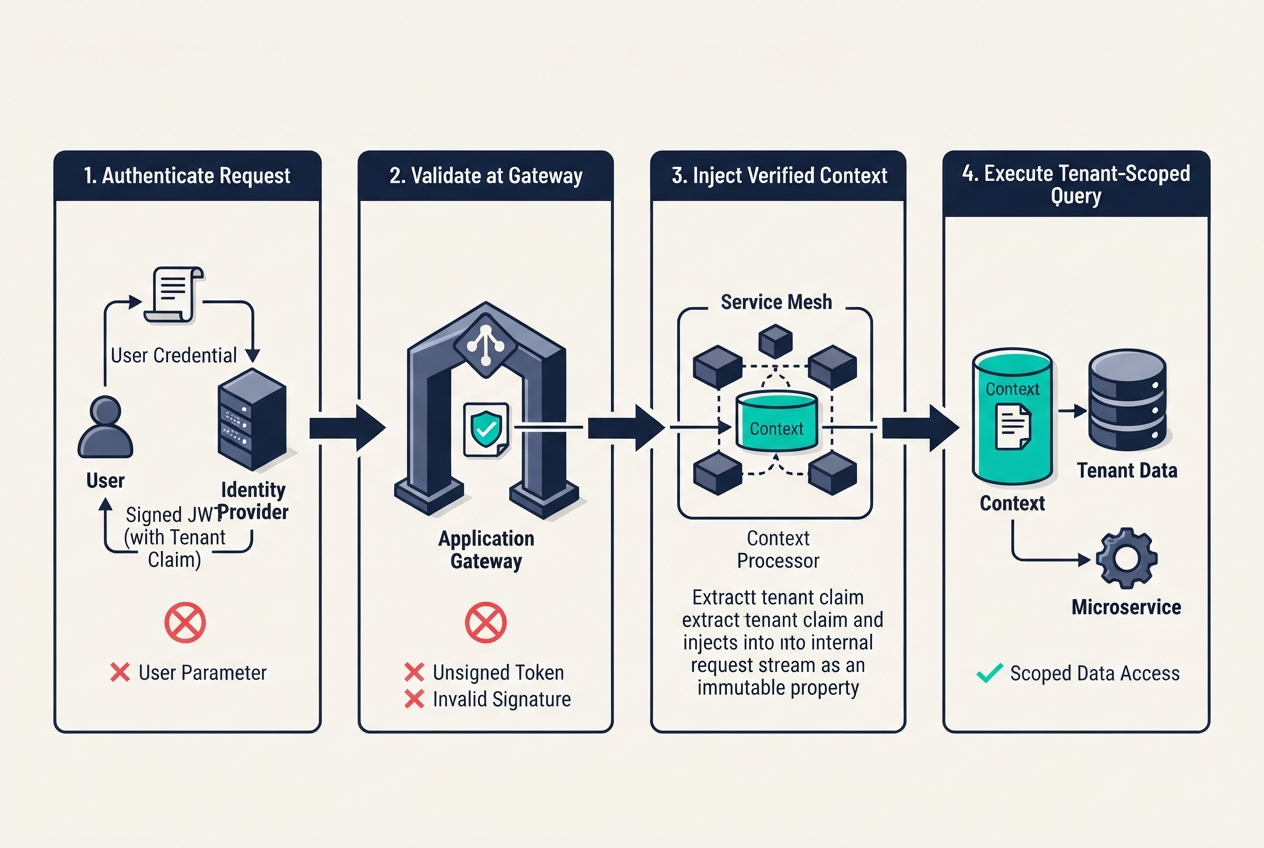
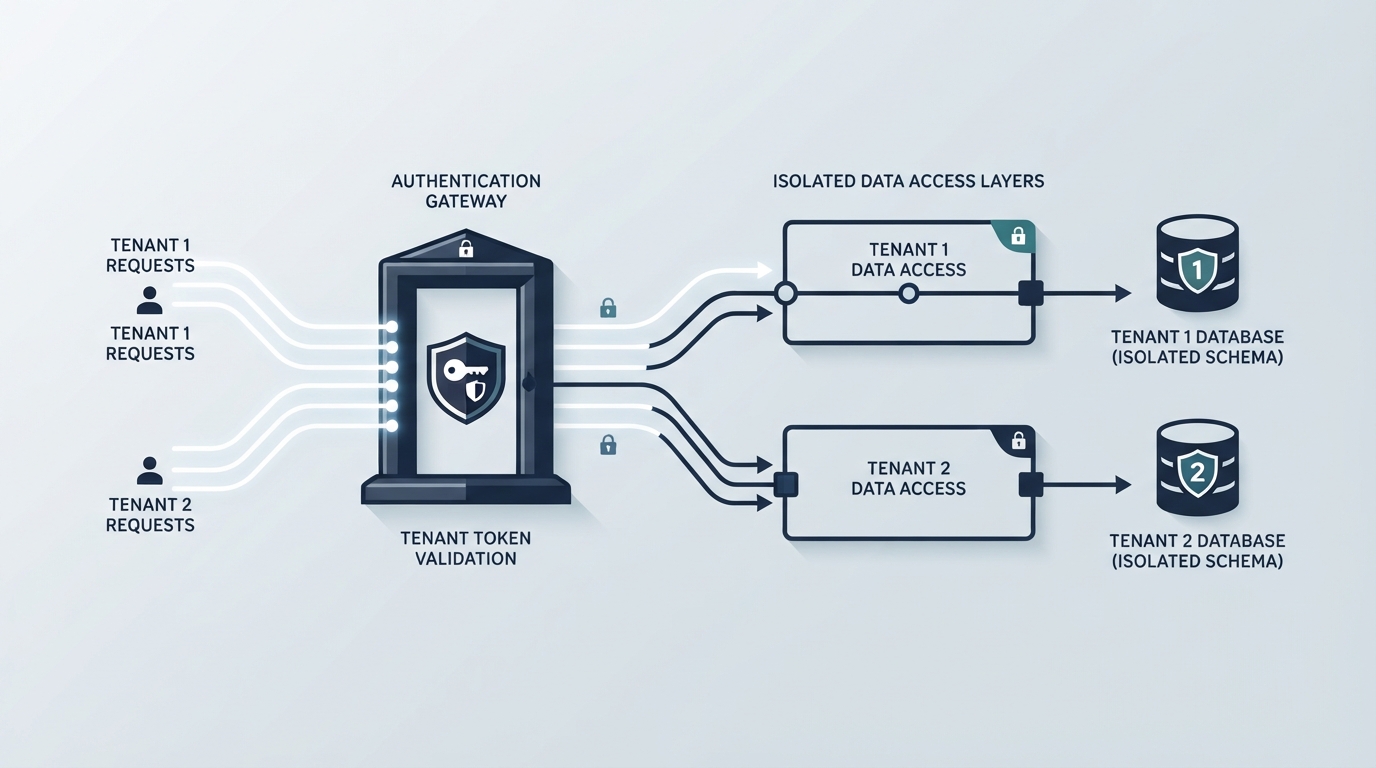
Authenticating user credentials verifies identity, but authentication alone does not guarantee multi-tenant security. A user may successfully authenticate with valid credentials yet attempt to query resources belonging to a different workspace or corporate tenant. Robust architectures treat tenant context as an immutable platform primitive that must be established at the identity boundary and propagated across every subsystem.
During authentication, the identity provider injects verified tenant membership claims into cryptographically signed JSON Web Tokens. Application gateways and upstream reverse proxies validate the token signature before extracting the tenant context. Downstream microservices must never trust user-supplied parameters, query strings, or unvalidated request headers to determine tenant scope; all operations must derive their boundaries solely from the validated token claims.
Teams designing reliable systems can explore specialized operational frameworks through SnapKodex services to standardize their authentication pipelines. Ensuring that tenant identifiers remain strictly coupled with user identities throughout the entire request execution path prevents insecure direct object references and unauthorized data modification.
- Embed tenant membership claims directly inside signed cryptographic tokens during initial authentication handshakes.
- Prohibit upstream services and endpoints from deriving tenant scope from raw user-supplied query parameters or headers.
- Enforce token signature verification at API gateways before routing traffic to internal service meshes.
Securing Distributed Caches and Background Message Queues
Context propagation challenges frequently arise when requests trigger asynchronous processing or interact with distributed memory caches. In shared caching systems like Redis, key collisions represent an immediate data leakage vulnerability. Engineers must enforce structured key namespacing, prepending validated tenant identifiers to every cache key pattern before storing or retrieving sensitive data.
Similarly, background job queues and event streams must serialize tenant context directly into event payloads. When asynchronous worker processes consume messages from queues, they must reconstruct the execution context, re-verifying tenant parameters before executing business logic, running database migrations, or sending external notifications.
- Prefix all distributed cache keys with verified tenant identifiers to prevent cross-tenant key contamination.
- Serialize cryptographic tenant context into asynchronous message payloads before publishing to background queues.
- Re-instantiate execution context inside asynchronous consumer jobs to validate boundaries prior to executing commands.
What Are the Best Practices for Database-Level Data Isolation?
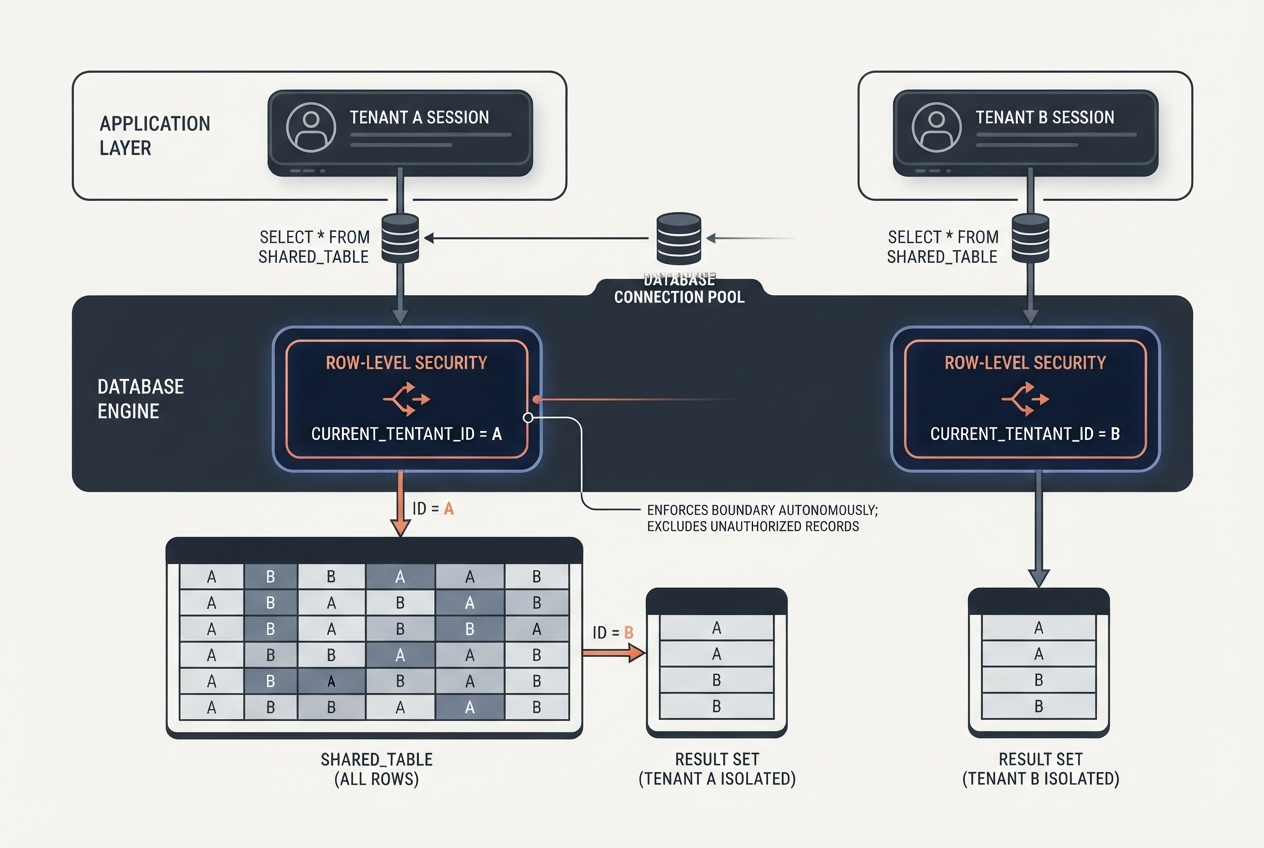
Securing data at rest within shared storage requires defense-in-depth mechanisms that function independently of application code. Relying exclusively on developers to remember tenant filtering clauses in object-relational mapping (ORM) queries inevitably leads to human error and data leakage incidents. Enforcing boundaries directly inside the database engine provides an authoritative safety barrier.
PostgreSQL Row-Level Security (RLS) offers an effective approach for pooled databases. By defining security policies on database tables, PostgreSQL automatically restricts queries to rows matching the tenant context variable set in the current database session. Even if an application developer omits a tenant identifier filter in an application query, the database engine enforces the isolation policy and excludes unauthorized records from the result set.
For teams seeking to build authoritative content workflows around their software capabilities, visiting https://snapkodex.com/services/seo-content illustrates how clear technical documentation supports engineering adoption. At the database layer, combining row-level policies with dedicated connection pooling safeguards isolation across concurrent transactions.
Beyond logical separation, enterprise platforms frequently adopt cryptographic siloing. Under this model, sensitive tenant fields or entire table partitions are encrypted using customer-managed encryption keys. If an unauthorized actor gains access to raw database files or backup archives, the stored data remains unintelligible without the corresponding tenant-specific decryption key.
- Activate database-level row-level security policies to prevent developer oversights from exposing tenant records.
- Set session-level tenant variables dynamically upon opening database connection pool checkouts.
- Utilize tenant-specific encryption keys for sensitive fields to ensure cryptographic isolation at the storage tier.
How Can Engineering Teams Maintain Compliance and Security Governance?
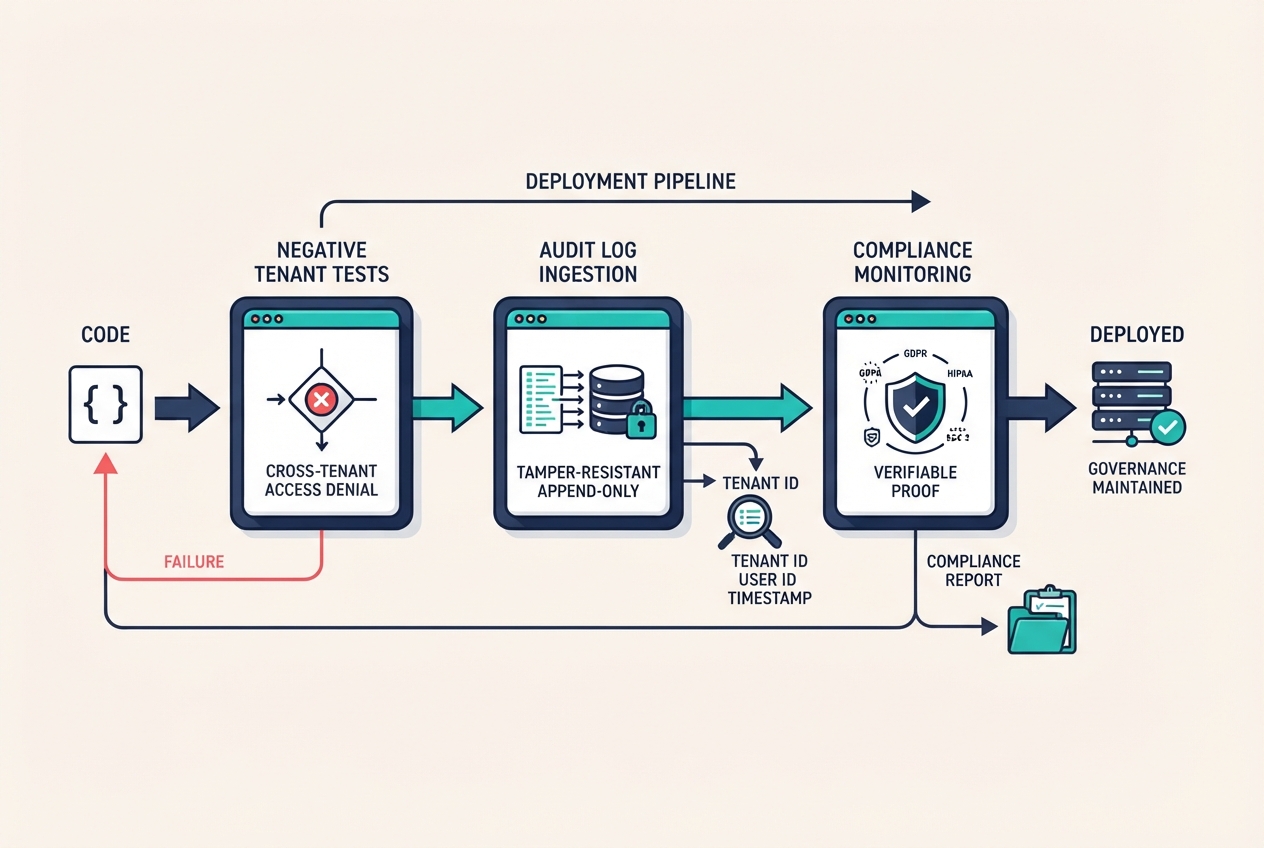
Regulatory standards such as GDPR, HIPAA, and SOC 2 require SaaS providers to demonstrate appropriate technical and organizational safeguards for customer data. Compliance audits demand verifiable proof that tenant isolation boundaries cannot be crossed. Building a defensible platform requires ongoing automated verification, audit logging, and strict access controls.
Comprehensive audit logging must record all tenant administrative operations, access delegation changes, and authentication events. Audit logs should be immutably stored in append-only storage solutions, with each entry tagged with tenant identifiers, user IDs, and timestamps. This structured telemetry allows security teams to detect anomalous access patterns rapidly and produce definitive compliance reports during third-party security audits.
Automated integration testing must validate tenant isolation boundaries within continuous integration and continuous deployment pipelines. Automated tests should deliberately execute unauthorized cross-tenant requests, asserting that the application gateway, database policies, and caching layers reject illicit access with appropriate error codes. Engineering leaders can Contact SnapKodex to discuss custom platform roadmaps and technical compliance implementations.
Maintaining architectural governance also means establishing clear tenant offboarding procedures. When a tenant terminates their contract, the platform must execute comprehensive data deletion protocols across primary databases, backup snapshots, cache nodes, and file storage buckets. Documented deletion workflows verify compliance with statutory data privacy mandates and prevent orphaned records from lingering in shared storage pools.
- Implement tamper-resistant, append-only audit logs tagged with immutable tenant and user identifiers.
- Run automated negative security tests in CI/CD pipelines to verify cross-tenant access denial.
- Establish automated tenant offboarding workflows to guarantee complete data eradication across all storage layers.
Architectural Comparison of Data Isolation Approaches
Understanding the functional trade-offs between pooled application filtering, database row-level security, schema-per-tenant, and dedicated database silo architectures.
| Isolation Pattern | Cost Efficiency | Leakage Resistance | Operational Complexity | Compliance Fit |
|---|---|---|---|---|
| Pooled with Application Filtering | Maximum | Low (vulnerable to ORM bugs) | Low | Basic consumer SaaS |
| Pooled with Row-Level Security (RLS) | High | High (engine-enforced) | Moderate | Mid-market B2B & regulated SaaS |
| Schema-per-Tenant | Moderate | High (logical separation) | High (migration overhead) | Enterprise with isolation needs |
| Dedicated Database Silo | Low | Maximum (physical isolation) | Very High | Strict compliance (HIPAA, banking) |
Frequently asked questions
What is the primary danger of relying solely on ORM filters for tenant isolation?
Relying exclusively on application-level ORM filters leaves platforms vulnerable to developer oversight. A single omitted WHERE clause or poorly structured database join can bypass filtering and expose entire tables of sensitive data across tenant boundaries.
How does PostgreSQL Row-Level Security prevent cross-tenant data leaks?
PostgreSQL Row-Level Security applies security policies directly inside the database query planner. By evaluating session variables against tenant columns on every read and write, the database engine excludes unauthorized rows regardless of how the application query is written.
How should tenant context be managed in distributed caching systems like Redis?
Tenant context in distributed caching systems must be enforced by prepending verified tenant identifiers to all cache keys. This systematic namespacing ensures that keys from different tenants remain separated, preventing cache collisions and cross-tenant data leaks.
Can pooled multi-tenant architectures satisfy enterprise regulatory standards like HIPAA or GDPR?
Yes. Regulatory frameworks mandate appropriate technical safeguards rather than specific physical hosting models. Pooled architectures can comply by pairing database row-level security with cryptographic field-level encryption, tamper-proof audit trails, and strict tenant access controls.