How to Secure API Endpoints for AI-Powered SaaS Apps
Why Does Traditional API Security Fail in AI Architectures?
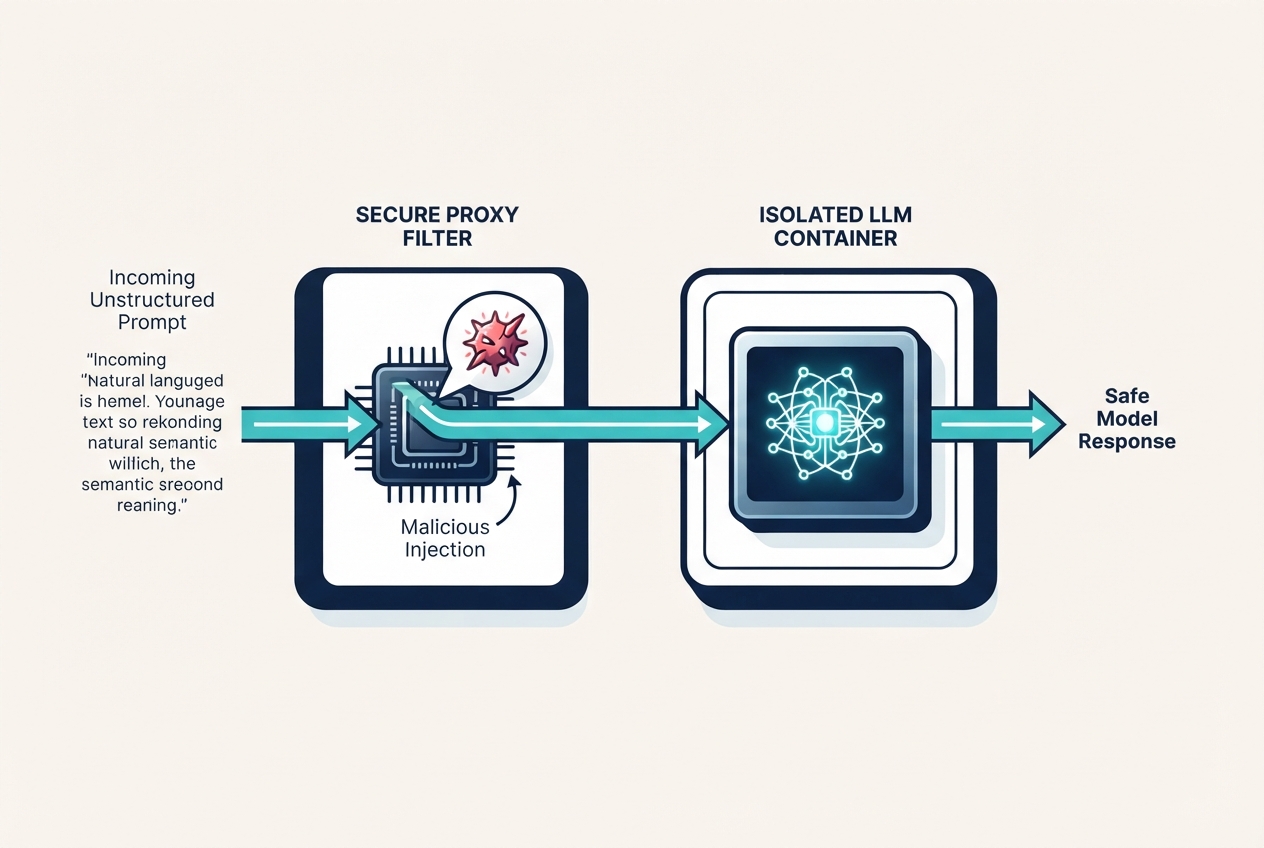
Traditional API security frameworks are built to ingest structured, strongly typed parameters such as unique identifiers, strings, numbers, and rigid enumerations. Because legacy backends execute deterministic logic based on predictable user inputs, conventional web application firewalls verify payloads using static pattern matching and known signature rules. However, generative software-as-a-service applications process freeform natural language prompts. This unstructured interface renders traditional perimeter defenses ineffective because dangerous intent can be masked within innocuous conversational phrasing or embedded indirectly inside external documents, emails, and database records retrieved during model execution.
When an artificial intelligence system ingests unstructured text, attackers can execute prompt injection attacks that manipulate downstream tool calls and remote procedure calls. Unlike typical injection vectors that target relational database syntax, generative prompt manipulation hijacks the semantic reasoning engine itself. The model may consequently trigger unauthorized internal microservices or expose sensitive context data. Teams building enterprise platforms can consult the SnapKodex home resource to review modern full-stack development patterns designed to isolate generative layers from core application infrastructure. Modern architectures must treat every model interaction as potentially adversarial rather than assuming verified network perimeters guarantee safe payloads.
- Traditional APIs handle deterministic parameters while AI systems process unpredictable natural language inputs.
- Unstructured text prompts introduce indirect prompt injection vectors that bypass conventional web application firewalls.
- Semantic reasoning hijacking can force models to trigger unauthorized downstream remote procedure calls.
Managing Non-Deterministic Execution Risks
Autonomous agents and tool-calling routines introduce non-deterministic execution paths that static testing cannot fully anticipate. An agentic workflow dynamically decides which API endpoints to query, what parameters to supply, and how to chain dependent operations based on intermediate model interpretations. When unexpected context shifts or adversarial prompts occur, an autonomous loop can trigger unexpected recursive requests across internal microservices.
Preventing cascading failures requires teams to enforce strict execution boundaries and real-time behavioral baselines. API gateways must baseline agent intent against declared system capabilities, terminating anomalous execution chains before they interact with sensitive services. Technical leaders can review SnapKodex services for expert architectural guidance on structuring resilient backend microservices and isolation layers.
Handling Unstructured Data and Retrieval Boundaries
Generative retrieval pipelines frequently access large corpora of internal documentation, proprietary customer records, and operational databases to augment model context. Without rigorous data isolation enforced at the retrieval layer, conversational prompts can coax models into summarizing restricted customer records or confidential intellectual property. This makes multi-tenant data boundaries a vital security requirement.
Organizations prevent unauthorized information retrieval by embedding row-level security and deterministic filtering directly into vector search engines. The API middleware attaches authenticated cryptographic tenant metadata to every semantic query, guaranteeing that the underlying embedding search only exposes documents the authenticated user has formal authorization to view.
How Should SaaS Teams Enforce Least-Privilege Authorization?
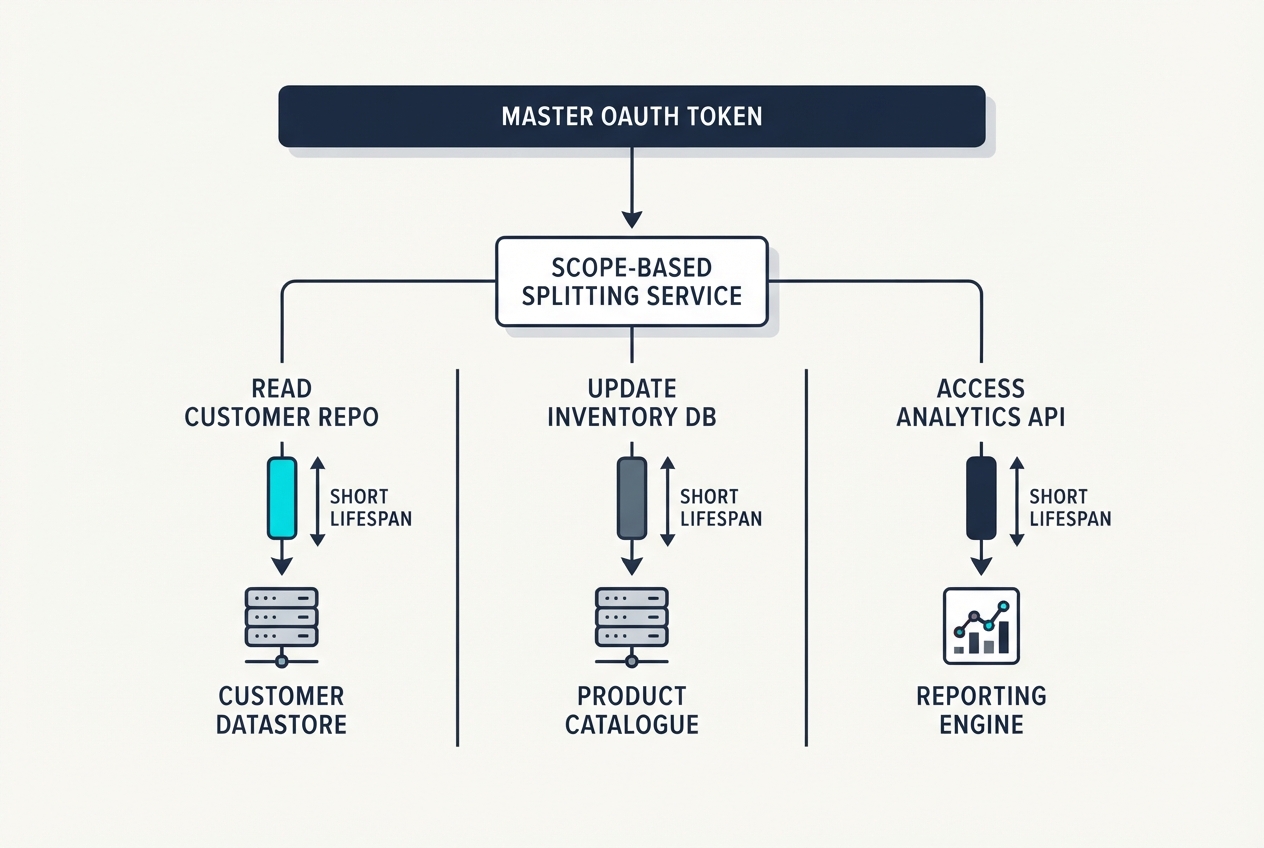
A critical vulnerability in early-stage generative applications involves provisioning broad API keys or permanent administrative credentials to automated agentic loops. When an agent possesses long-lived or overly permissive access, any prompt manipulation or execution compromise allows lateral movement across enterprise repositories, databases, and customer records. Systems must follow zero-trust principles by granting only the minimum necessary authority for each discrete tool call.
Engineering teams should treat every AI agent as an untrusted client service account. Every downstream action must be authorized through short-lived access tokens containing explicit claims, coarse-grained scopes, and restricted target audiences. This containment strategy prevents a compromised model from reading unassociated customer files or modifying global database records. Technical founders refining their development stacks should also evaluate https://snapkodex.com/services/seo-content to understand how structured content architectures support technical communication.
- Avoid issuing long-lived tokens or permanent master keys to automated background workers.
- Enforce strict audience validation and minimal permission claims on all downstream tool calls.
- Ensure that agentic service accounts cannot traverse boundaries into unrelated tenant datastores.
Utilizing Scoped JWTs and Fine-Grained Claims
JSON Web Tokens issued for generative workflows must carry precise scopes that restrict actions to individual records and narrow time horizons. Rather than issuing a blanket token for an entire database, the authentication middleware should generate a scoped token valid only for reading a specific resource identifier during a single user session.
API gateways can cryptographically validate these claims locally without generating repetitive database lookups for each inference step. This architecture guarantees high throughput and low latency while strictly enforcing zero-trust access control across all supporting microservices.
Preventing Lateral Movement in Agentic Workflows
When microservices interact across complex enterprise workflows, a security flaw in one component can easily expose adjacent systems. Enforcing mutual transport layer security and strict service-to-service authorization ensures that agentic workers cannot invoke arbitrary endpoints.
By isolating background AI processes within dedicated network segments, engineering teams limit the potential blast radius of an exploit. If an external model output is manipulated, the agent remains confined to its designated operational sandbox without network routes to sensitive enterprise cores.
How Can Engineering Teams Prevent Denial-of-Wallet Attacks?
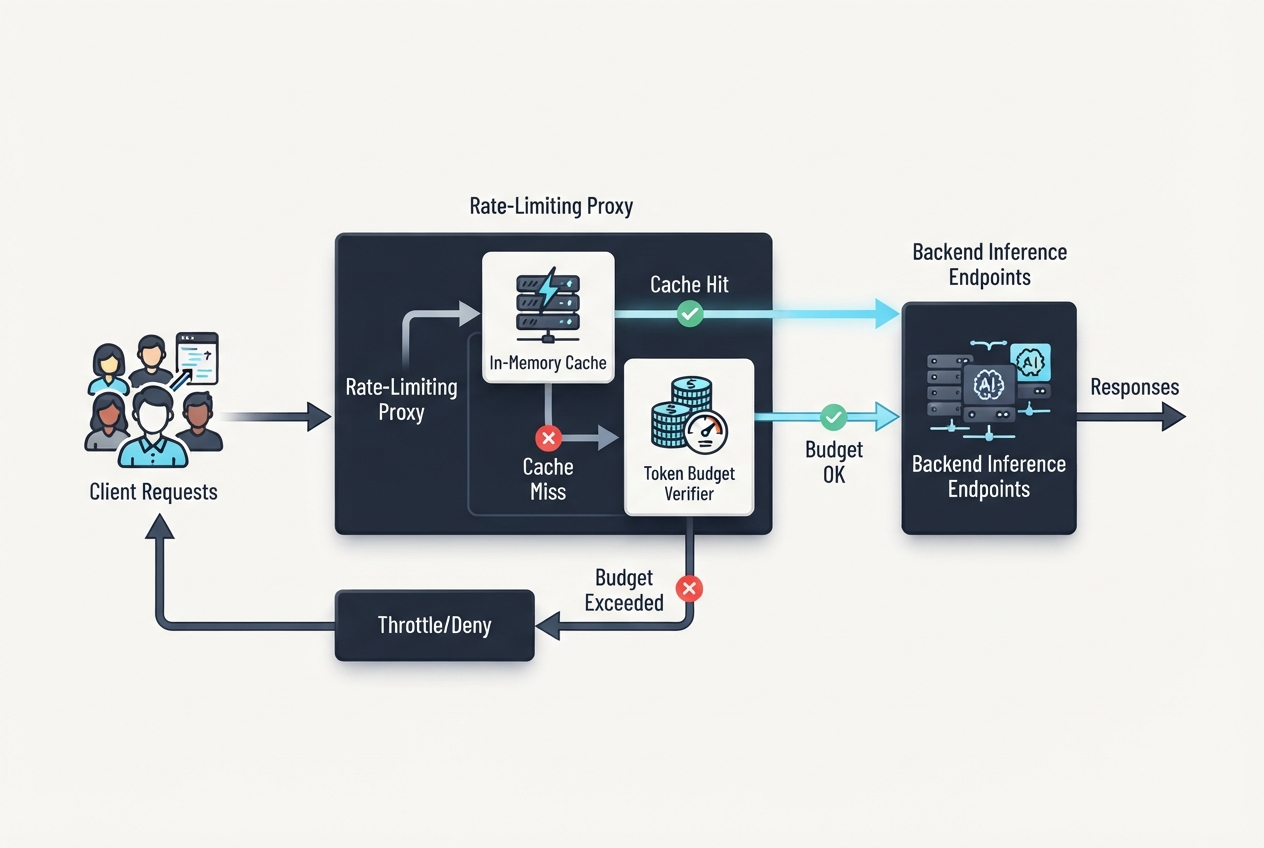
Exposing model inference endpoints directly to public networks introduces severe financial exposure through denial-of-wallet attacks. Because large language model inferences, embedding generations, and vector queries require substantial computing resources and per-token fees, malicious actors or runaway scripts can rapidly drain infrastructure budgets. Flooding an unauthenticated or poorly restricted endpoint can trigger massive cloud expenditures within hours before manual alerting responds.
Defending against resource exhaustion demands multi-layered rate limiting and distributed caching architectures. Instead of relying on traditional IP-based filtering, rate limiting must track authenticated user identifiers, organization subscriptions, and real-time token usage budgets. Founders seeking assistance with robust API infrastructure can Contact SnapKodex to discuss custom operational architectures tailored for mission-critical generative workloads.
- Inference processing and vector search create variable per-request compute costs that attract economic exhaustion attacks.
- Automated registration scripts can exploit unprotected free trials to generate massive third-party API expenses.
- Multi-tiered rate limits must throttle both request counts and aggregate token consumption.
Deploying Identity-Based Throttling and Semantic Caching
Static IP filtering fails in modern SaaS environments because legitimate enterprise users often connect through shared corporate proxies and dynamic networks. Effective rate limiting couples request volume with authenticated user profiles, workspace tiers, and rolling token budgets.
Pairing identity-based rate limits with distributed caching systems like Redis shields downstream endpoints from redundant processing. By returning verified responses for identical queries, the system conserves downstream API capacity and eliminates redundant model invocations.
Establishing Gateway and Proxy Boundaries
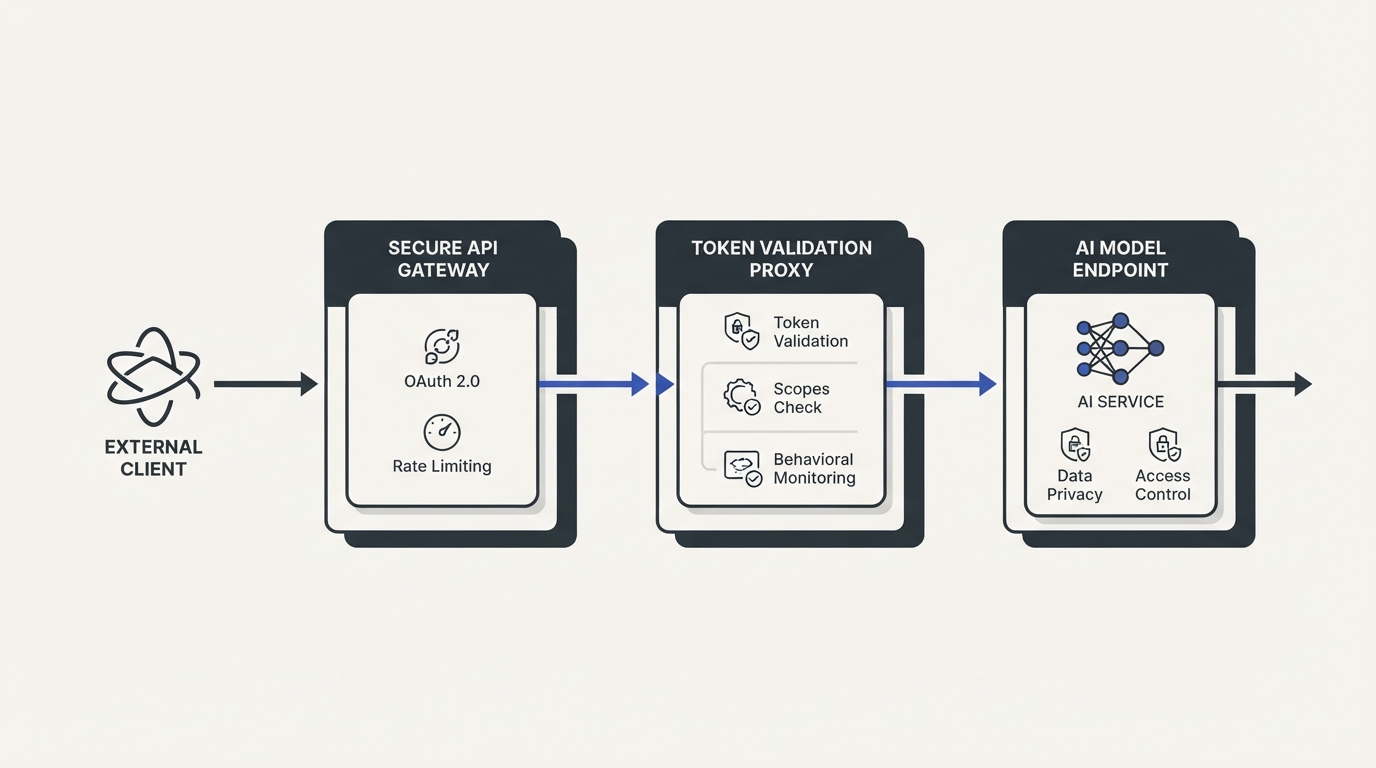
Deploying an intermediary API gateway or dedicated reverse proxy between public clients and backend models establishes an essential enforcement boundary. This gateway orchestrates token validation, cost attribution, request sanitization, and circuit breaking before requests reach expensive foundation models.
Centralized proxies prevent disparate microservices from implementing conflicting security logic. This architectural standard maintains consistent policy enforcement, real-time quota tracking, and audit logging across every model endpoint in the enterprise fleet.
Why Is Human Oversight Essential for State-Mutating APIs?
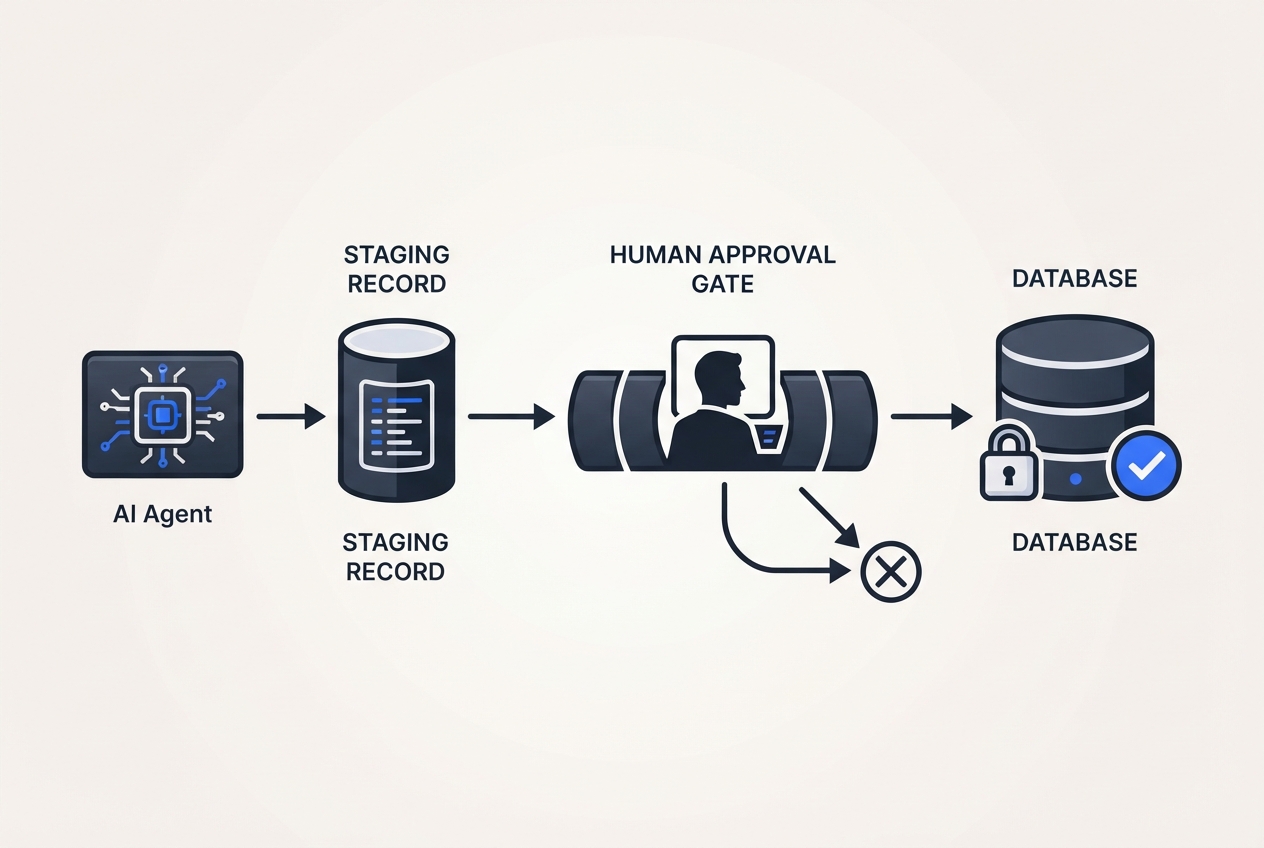
Architectural guidance frequently recommends restricting generative models to read-only retrieval workflows to protect the integrity of enterprise data. However, modern business applications regularly require automated actions such as creating invoices, updating billing details, or reconfiguring infrastructure settings. Allowing an artificial intelligence model to execute state-mutating changes directly without intermediate validation introduces significant operational hazards due to hallucination and data corruption risks.
Engineering teams resolve this challenge by separating proposal generation from final transaction execution. Autonomous agents can analyze unstructured context, assemble required parameters, and draft proposed modifications, but the middleware retains these proposals in a staged status. Mandatory human-in-the-loop review checkpoints verify payloads before changes are committed, ensuring that generative errors never compromise primary databases.
- Decouple automated proposal generation from final state-mutating execution steps.
- Stage all proposed updates in secure intermediate stores pending authorized verification.
- Implement human approval gates to eliminate the risk of generative hallucinations altering production data.
Separating Proposal Generation from Execution
To guarantee data safety, generative systems must output declarative, structured proposals rather than directly executing database modifications. When an agent determines that an enterprise record must be updated, it generates an inert structured payload containing the target resource ID and intended modifications.
The platform validates this payload against strict data schemas and authorization rules before notifying human operators. The actual write operation is only executed when an authorized reviewer provides an explicit cryptographic confirmation.
Structuring Immutable Audit Logs for Automated Actions
Maintaining tamper-resistant audit logs is critical for monitoring autonomous agent decisions and verifying compliance across regulated industries. Logs must record the incoming prompt context, intermediate reasoning tokens, generated tool payloads, and the approving operator identity.
Comprehensive audit logs simplify regulatory reviews, streamline security investigations after anomalous behavior, and ensure complete organizational accountability across all automated operational workflows.
Traditional vs. AI-Powered API Security Comparison
Comparing conventional web API safeguards against generative architectures reveals why technical teams must modernize security controls.
| Security Dimension | Traditional API Architecture | AI-Powered SaaS Architecture |
|---|---|---|
| Input Validation | Strict static parameter types and predictable enums | Natural language prompt sanitization and injection filters |
| Access Control | Role-based access control and static service tokens | Fine-grained claims, scoped JWTs, and vector row-level security |
| Abuse Mitigation | IP-based rate limits and volumetric DDoS rules | Identity-based limits, token consumption budgets, and caching |
| Execution Model | Deterministic synchronous calls and direct database writes | Non-deterministic agentic loops with human-in-the-loop staging |
Frequently asked questions
Why do conventional web application firewalls fail to protect AI endpoints?
Conventional web application firewalls check structured parameters against known exploit signatures. Generative applications process natural language prompts where malicious intent can be disguised as benign conversational text or indirect instructions, bypassing signature-based detection.
How can SaaS companies prevent denial-of-wallet attacks on LLM endpoints?
Organizations prevent denial-of-wallet attacks by deploying API gateways that throttle requests based on authenticated user identities and token consumption quotas rather than static IP addresses, while using Redis caching to fulfill repetitive queries without invoking inference.
What is the safest way to authorize AI agents accessing internal data?
Teams should enforce row-level security within vector databases and issue short-lived JWTs containing narrow, fine-grained scopes. The API middleware attaches verified user identity metadata to every retrieval query, preventing lateral movement across tenant boundaries.
Should AI agents be permitted to modify production databases autonomously?
Technical standards recommend decoupling proposal generation from execution. Agents should only generate inert, structured proposals held in staging until an authorized human operator reviews and confirms the modification before database commitment.