How to Scope and Price Custom Software Development
Why Do Software Quotes Vary So Wildly Between Vendors?
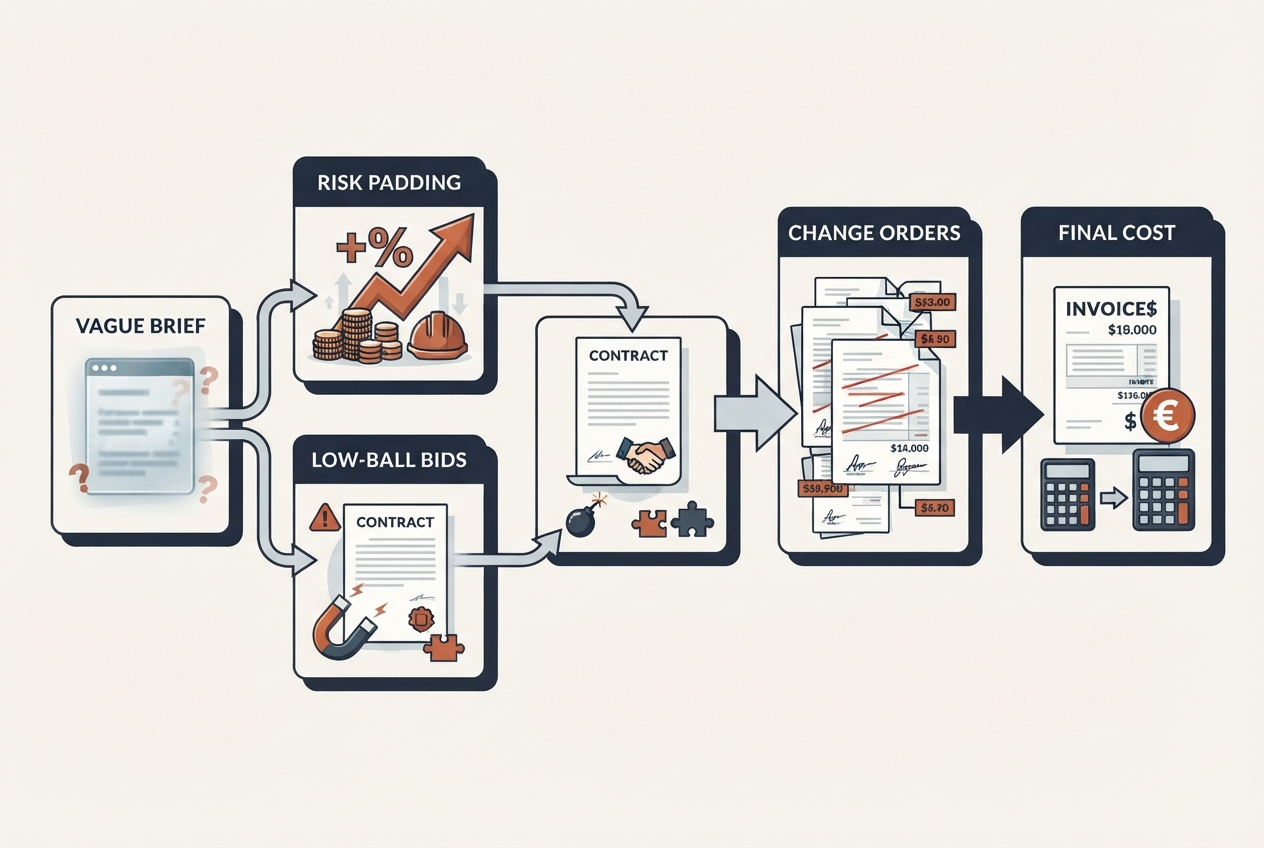
When business leaders send an identical project brief to several software development agencies, the returned quotes frequently diverge by tens or hundreds of thousands of dollars. This vendor variance causes immense frustration for startup founders and executives who lack an engineering background. The wide gap does not necessarily mean one agency is dishonest while another is competent; rather, it reflects fundamentally different assumptions about project scope, architectural depth, and financial risk.
Some agencies review an ambiguous brief and pad their estimates with substantial contingency margins to protect themselves from scope creep. Other vendors intentionally submit low-ball estimates to win the initial contract, planning to recover their profit margins later through frequent change orders when missing technical requirements inevitably surface. Geographic location also impacts hourly rates, creating a complex pricing landscape where identical feature descriptions result in drastically different financial bids.
To navigate this landscape, buyers must realize that a quote is an assessment of risk as much as an estimation of hours. Without clear boundary definitions, every software vendor will fill in missing details with their own interpretations, leading to wide discrepancies in architecture, security implementations, and functional deliverables.
- Agencies inflate fixed-price quotes to account for the financial risk of vague functional specifications.
- Low-ball bids often exclude critical edge cases, automated testing, and comprehensive deployment pipelines.
- Hourly billing rates differ dramatically based on whether teams are located onshore, nearshore, or offshore.
The Ambiguity Tax in Software Estimation
When requirements are poorly defined, development partners must guess at architectural complexities, integration limits, and user workflows. This guesswork is effectively an ambiguity tax. To guard against potential project delays and unbounded revisions, agencies price in worst-case scenarios, inflating their fixed-bid proposals accordingly.
Eliminating this ambiguity tax requires moving from broad concepts to granular system interactions. When technical specifications clearly define database structures, third-party interfaces, and performance standards, vendors spend less time calculating risk margins and can submit tighter, more realistic estimates.
Evaluating Global Team Rates and Overhead
Hourly rates vary significantly by region. Senior software engineers in the United States typically bill between $180 and $280 per hour. Nearshore development teams in adjacent time zones generally charge 30% to 55% less, while offshore engineering teams can run 50% to 70% lower than domestic benchmarks.
However, low hourly rates do not automatically produce a lower total invoice. Managing distributed teams across disparate time zones introduces communication overhead, project management friction, and the risk of rework, which can offset initial labor savings if technical governance is weak.
How Should You Define Your Project Scope Effectively?
Effective software scoping begins with identifying specific business problems and measurable outcomes rather than compiling an uncurated feature wishlist. For instance, rather than specifying a proposal generation tool, state the target outcome: cut proposal turnaround time from five days down to one day. Defining business outcomes allows engineers to suggest efficient technical pathways rather than over-engineering complex interfaces.
Mapping distinct user roles alongside their core journeys exposes functional requirements that simple feature lists regularly miss. A platform serving customers, platform administrators, and compliance auditors requires distinct access levels, data segregation rules, and notification workflows. Mapping these pathways early ensures that supporting backend systems are accounted for before contracts are signed.
In addition, early scoping must establish clear boundary conditions by explicitly defining what the software will not do in its initial deployment. Documenting out-of-scope items prevents unnecessary feature expansion and helps maintain strict alignment between the development team and key business stakeholders throughout the build.
- Anchor project requirements to quantifiable business outcomes rather than subjective feature requests.
- Map primary journeys for every user role to uncover necessary permission structures and workflow states.
- Explicitly document out-of-scope features early to protect project timelines from unnecessary scope expansion.
Prioritizing Requirements with the MoSCoW Method
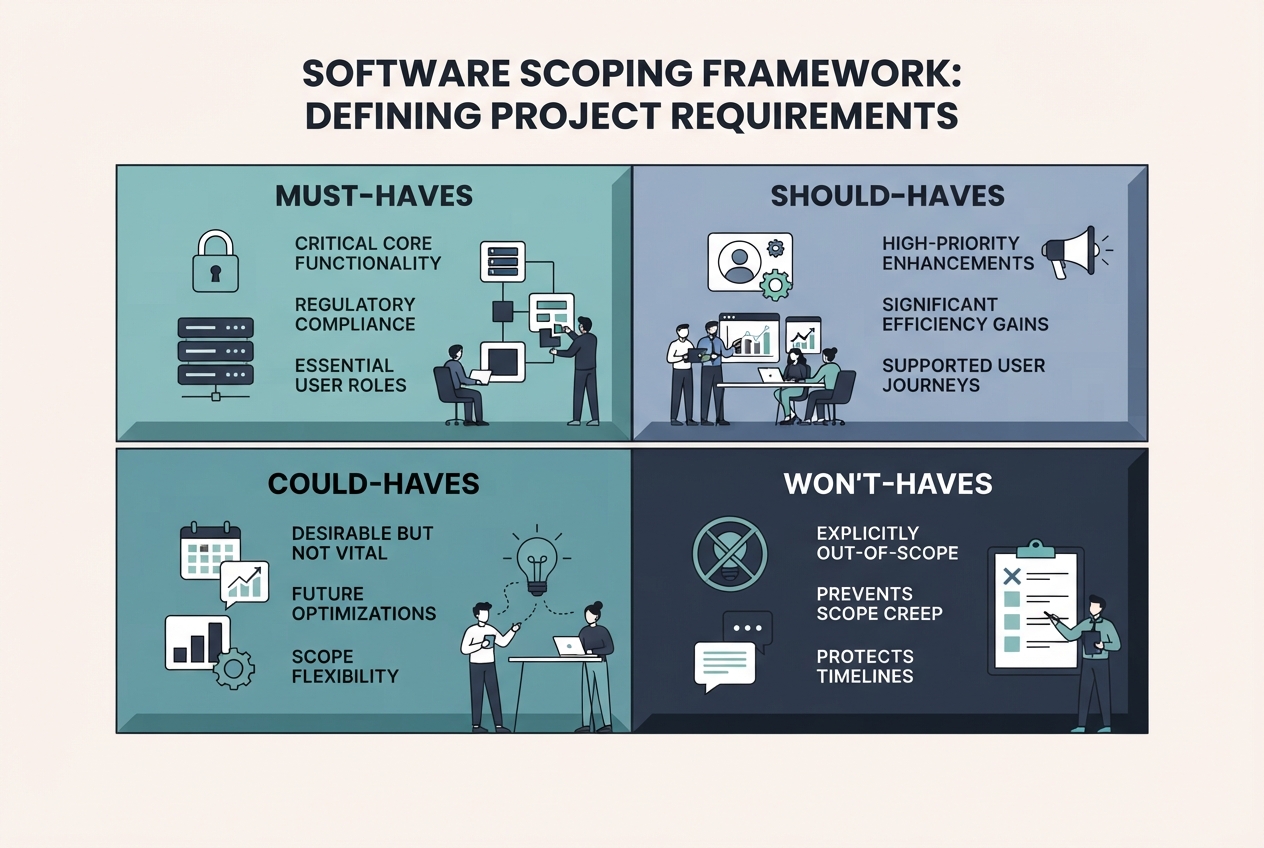
To keep software projects within defined financial constraints, product leaders utilize the MoSCoW framework. This methodology divides all prospective product requirements into Must-haves, Should-haves, Could-haves, and Won't-haves. Must-haves represent the non-negotiable core functionality required to launch.
Should-haves provide significant business value but can be temporarily worked around if time runs short. Could-haves are low-impact enhancements included only if extra capacity exists, while Won't-haves are explicitly excluded from the current scope to preserve engineering focus and protect the core budget.
Leveraging Paid Discovery Phases
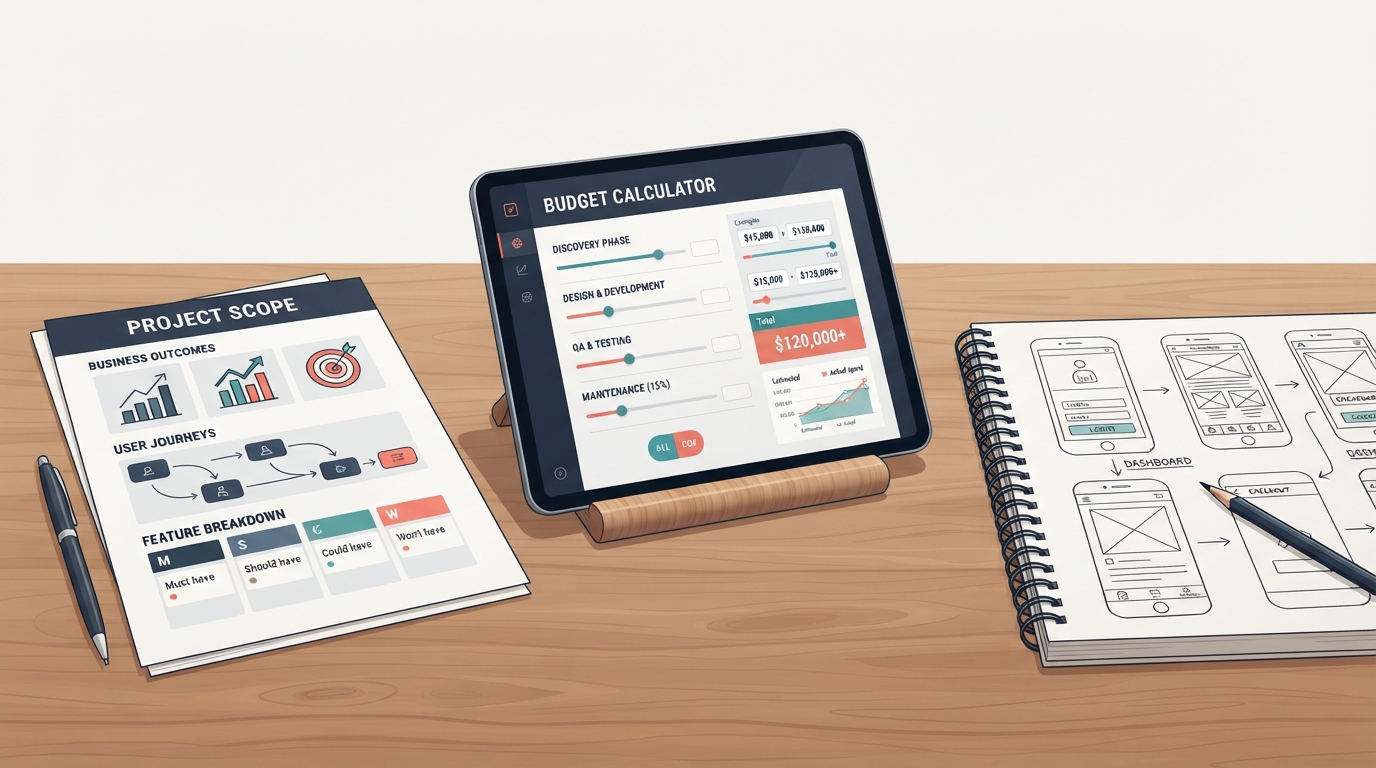
When technical requirements remain fluid, commissioning a dedicated, paid discovery phase is far more reliable than demanding a speculative fixed-price estimate. During a two-to-four-week discovery sprint, a development partner conducts system architecture planning, technical feasibility assessments, and user experience wireframing.
This structured discovery produces a detailed scope of work, technical architecture diagrams, and a prioritized feature backlog. With these blueprints completed, business leaders can gather accurate bids across multiple vendors or proceed with the discovery partner with predictable financial commitments.
What Are Current Market Cost Benchmarks and Primary Cost Drivers?
Custom software development pricing spans a wide spectrum depending on technical depth, architecture, and regulatory compliance requirements. Industry benchmarks categorize custom builds into clear tiers. Lean minimum viable products (MVPs) or focused internal tools typically range from $10,000 to $80,000, usually requiring two to four months to build and validate with early users.
Mid-complexity custom platforms involving multiple user roles, external API integrations, and customer-facing portals span $80,000 to $300,000, requiring four to ten months of engineering effort. Enterprise-grade systems with enterprise single sign-on (SSO), complex data migrations, multi-region infrastructure, and strict regulatory standards routinely range from $300,000 to well over $1,000,000 across nine to twenty-four months.
Across all project tiers, third-party integrations and data quality represent the most frequently underestimated cost drivers. Connecting legacy databases, external payment gateways, and proprietary APIs introduces unforeseen technical hurdles, unstandardized data formats, and authentication complexities that demand extensive engineering hours to resolve securely.
- Proof of concept and lean MVP applications generally require budgets between $10,000 and $80,000.
- Mid-tier platforms supporting custom workflows and external APIs range from $80,000 to $300,000.
- Enterprise platforms requiring complex compliance frameworks regularly exceed $300,000 to $1,000,000.
Breaking Down Non-Coding Cost Allocations
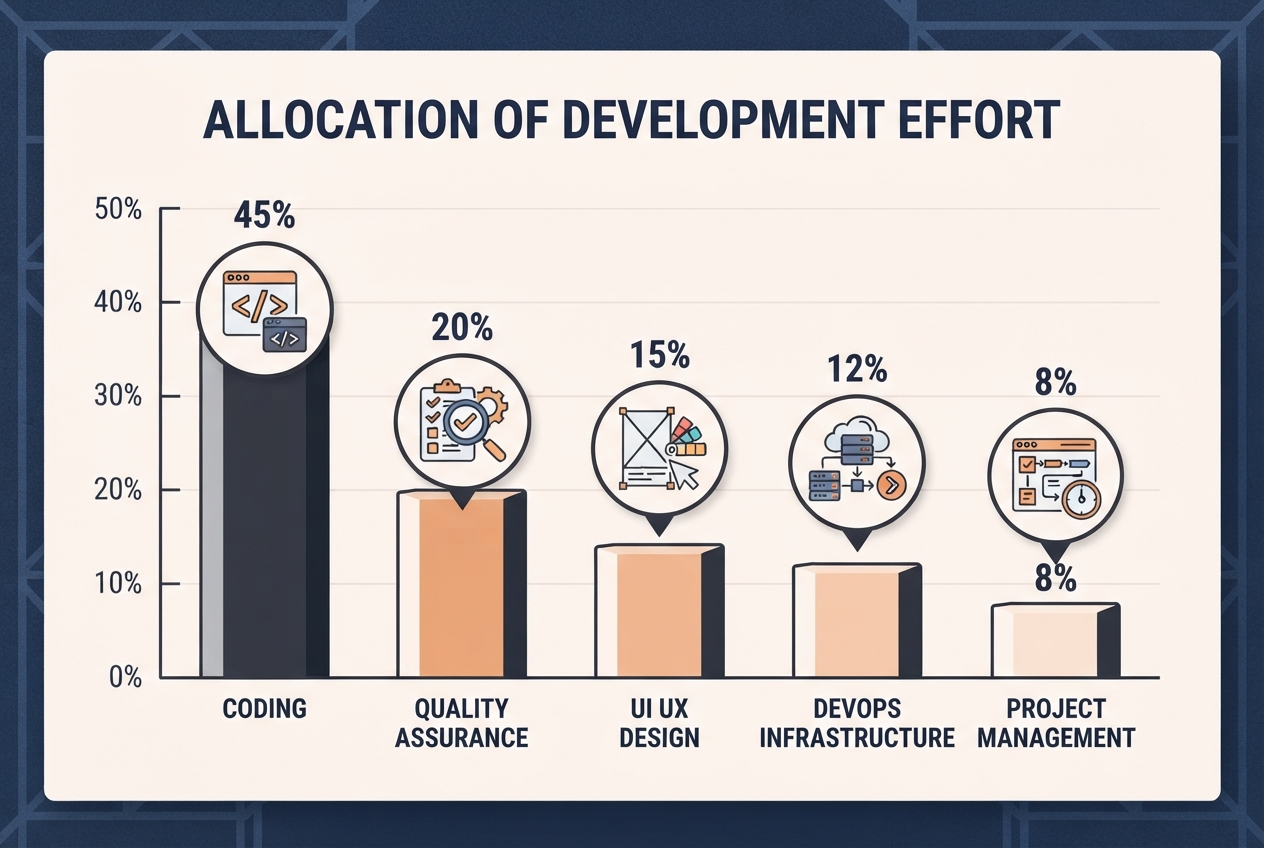
A frequent misconception among non-technical executives is assuming that an entire development budget is spent on software programming. In practice, writing code accounts for only 40% to 60% of total expenditure on a well-managed software project.
The remaining 40% to 60% of the budget supports critical multidisciplinary functions. These include user experience and interface design (UX/UI), rigorous automated and manual quality assurance testing, DevOps infrastructure provisioning, and continuous project management to keep deliverables aligned with timelines.
The Realistic Impact of AI Development Tools
The adoption of AI coding assistants has prompted questions regarding whether modern software costs will drop drastically. While AI acceleration speeds up boilerplate code generation and routine syntax creation, industry data shows it does not cut total project costs by 80%.
Complex architecture design, security validation, third-party system integration, and domain-specific logic still demand senior human oversight. In practice, AI tools deliver realistic cost and efficiency savings of 15% to 35% on well-scoped, modular development tasks rather than eliminating development expenses.
How Do You Budget for Ongoing Maintenance and Operational Overhead?
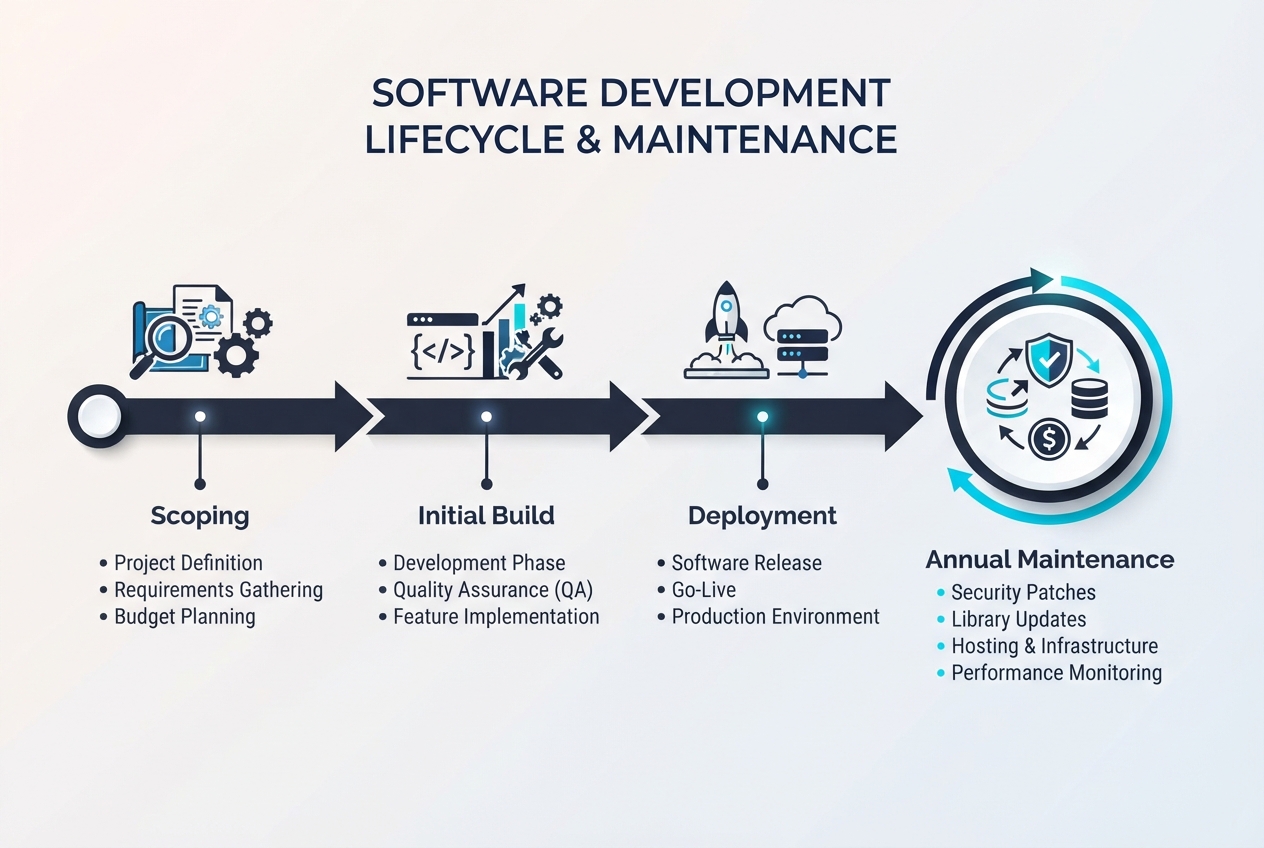
Treating custom software as a one-time capital expense is a critical budgeting error that often jeopardizes long-term product viability. After an application launches, ongoing operational expenses are required to keep the system secure, performant, and compatible with evolving operating environments. Failing to budget for post-launch maintenance leads to rapid system degradation and technical debt.
Industry benchmarks establish that companies must allocate an annual maintenance budget equal to 10% to 25% of the application's initial development cost. A $100,000 custom application requires between $10,000 and $25,000 each year to support routine security patching, library upgrades, hosting infrastructure adjustments, and minor functional improvements driven by initial user feedback.
Furthermore, operational budgeting must account for cloud consumption costs that scale alongside customer acquisition. As data storage volumes expand and database query frequencies multiply, server infrastructure costs grow. Proactively modeling hosting and third-party API usage fees prevents unexpected operational billing spikes as your user base expands.
- Plan for an ongoing annual maintenance budget equal to 10% to 25% of the original build expenditure.
- Regular dependency updates and security patches protect the codebase against newly discovered vulnerabilities.
- Cloud hosting, database provisioning, and third-party API subscription costs scale with transaction volumes.
Planning for Ongoing Security and Compliance Audits
Digital security requirements evolve constantly, necessitating routine vulnerability scanning and penetration testing. Applications handling personal information, healthcare data, or financial transactions must maintain alignment with frameworks like SOC2, HIPAA, or GDPR through recurring audits and code updates.
Neglecting continuous security monitoring exposes organizations to severe data breaches, system outages, and compliance fines. Factoring scheduled code reviews and compliance re-certification into your annual maintenance budget protects corporate assets and sustains institutional trust.
Refactoring Technical Debt and Scaling Infrastructure
Even well-architected applications accumulate technical debt as business requirements evolve and user numbers grow. System bottlenecks emerge under heavy production loads, requiring database query optimization, cache refactoring, and code cleanup to maintain rapid response times.
Allocating dedicated engineering hours for ongoing refactoring ensures that minor performance bottlenecks do not compound into catastrophic outages. Continuous optimization maintains architectural integrity and minimizes the necessity for disruptive, expensive rewrites in the future.
Custom Software Complexity Tiers and Cost Benchmarks
Reviewing standard industry tiers allows business leaders to align capital investments with realistic development timelines and functional requirements.
| Project Tier | Cost Range | Typical Timeline | Key Technical Characteristics |
|---|---|---|---|
| Proof of Concept / Lean MVP | $10,000 – $80,000 | 2 to 4 months | Single core user journey, basic interface, core value hypothesis validation |
| Mid-Complexity Custom Platform | $80,000 – $300,000 | 4 to 10 months | Multiple user roles, external API integrations, customer self-service portals |
| Enterprise-Grade System | $300,000 – $1,000,000+ | 9 to 24 months | Single sign-on, multi-region architecture, legacy migration, strict compliance |
Frequently asked questions
How much does it cost to build custom software?
Custom software development costs vary widely by complexity. Proof of Concept applications and lean MVPs typically range from $10,000 to $80,000, mid-complexity platforms span $80,000 to $300,000, and enterprise-grade systems with complex compliance and integrations run from $300,000 to over $1,000,000.
What is a paid discovery phase and why is it recommended?
A paid discovery phase is an initial two-to-four-week technical engagement where an agency maps user journeys, outlines system architecture, and builds detailed specifications. It eliminates the ambiguity tax, aligns expectations, and provides accurate estimates before entering major build contracts.
How much should organizations budget for ongoing software maintenance?
Industry benchmarks establish that organizations should budget an annual maintenance reserve equal to 10% to 25% of the application's initial development cost. This fund covers infrastructure hosting, dependency updates, security patches, and minor iterative improvements.
What percentage of a software budget goes directly to writing code?
Pure coding typically accounts for only 40% to 60% of total project expenditure. The remaining 40% to 60% is allocated to UI/UX design, quality assurance testing, DevOps infrastructure setup, and technical project management.
Do AI development tools significantly lower the total cost of custom software?
While AI code generators improve syntax generation and boilerplate workflows, they do not collapse total software costs by 80%. Because system architecture, integrations, security reviews, and business logic require human oversight, net savings realistically range from 15% to 35% on well-scoped modules.