How to Migrate Monolithic Legacy Systems to Modern Microservices
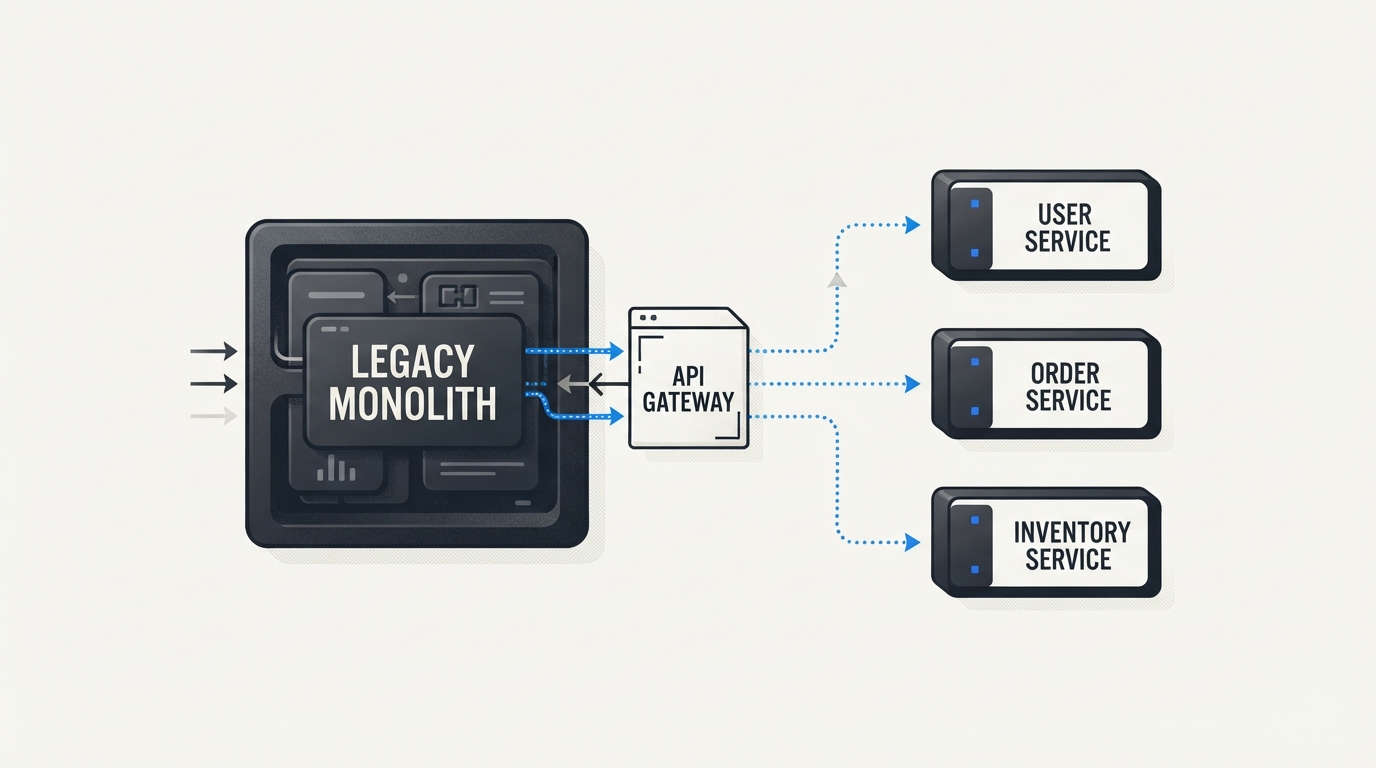
Why Do High-Risk Big-Bang Migrations Usually Fail?
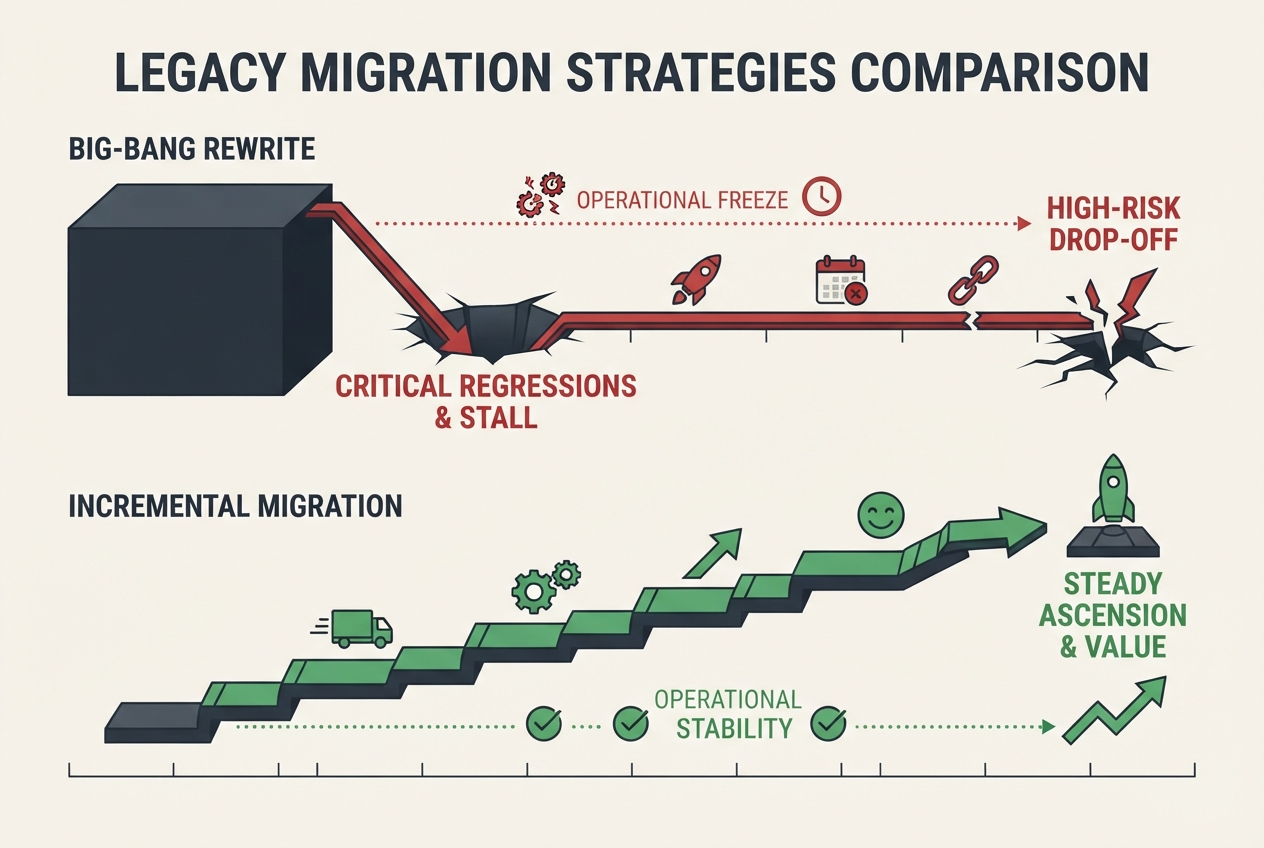
Many engineering organizations make the catastrophic mistake of attempting a complete, all-at-once rewrite of their legacy software. This high-risk approach, commonly known as a big-bang rewrite, forces development teams to freeze new feature delivery for months or even years while attempting to replicate decades of nuanced business logic inside a brand-new codebase. During this operational freeze, market demands continue shifting, competitors release critical improvements, and enterprise velocity stalls entirely.
Monolithic applications inevitably accumulate implicit business rules, hidden side effects, and undocumented database dependencies over years of iterative development. When architects attempt to rebuild these intricate interdependencies simultaneously from scratch, they almost universally underestimate systemic complexity. Big-bang initiatives routinely miss delivery deadlines, exhaust engineering budgets, and launch with critical regressions that disrupt customers and severely damage business credibility across the organization.
- Big-bang rewrites freeze production feature development and stall competitive momentum.
- Monolithic codebases contain undocumented tribal knowledge that cannot be rebuilt overnight.
- Incremental dismantling minimizes business exposure while preserving operational stability.
Recognizing the Hidden Costs of Monolithic Debt
Legacy monolithic applications frequently consume up to eighty percent of standard enterprise information technology budgets simply to keep routine services operational. This disproportionate expenditure leaves minimal budget or engineering capacity for strategic product innovation. As a single codebase swells, continuous integration builds become sluggish, integration test suites take hours to execute, and deploying minor bug fixes transforms into a high-stress ceremony fraught with systemic regression risks.
These operational bottlenecks compound cultural dissatisfaction across software teams. High-performing software engineers find themselves managing tangled dependency graphs and brittle deployment scripts rather than solving meaningful customer challenges. Engineering leaders interested in evaluating systemic bottlenecks can consult Contact SnapKodex to review deployment health and discuss practical modern application workflows with technical specialists.
- Maintenance overhead consumes technical resources that should fund product development.
- Monolithic deployment friction impedes developer velocity and lowers team morale.
How Does the Strangler Fig Pattern Mitigate Migration Risk?
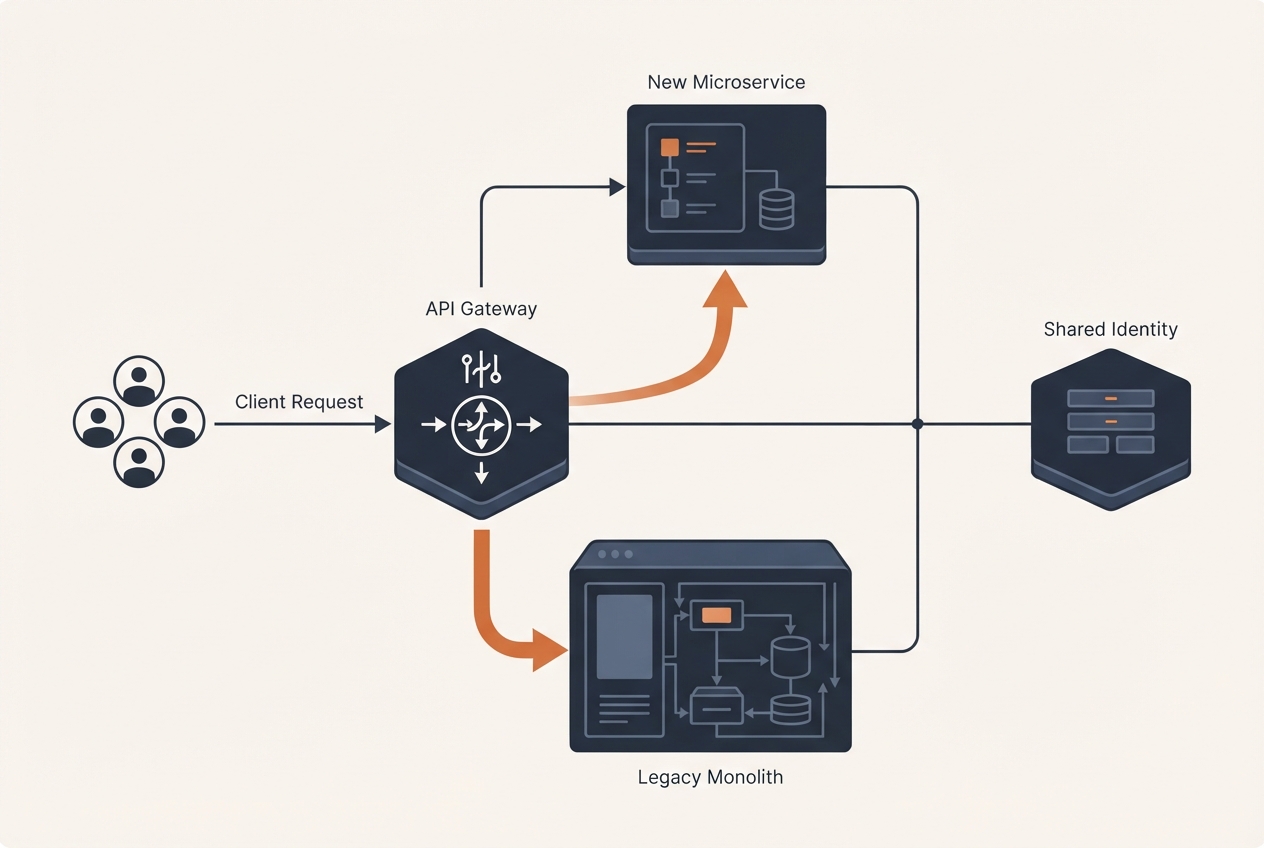
The Strangler Fig pattern represents the premier industry standard for dismantling legacy monoliths safely without incurring platform downtime. Named after tropical vines that germinate in the branches of host trees and gradually envelop them over time, this pattern places an interception layer around the monolithic application. Client requests are progressively rerouted away from legacy execution paths and directed toward newly engineered, self-contained microservices.
Rather than replacing the entire application at once, engineering teams identify a single bounded business capability, construct an independent service around it, and adjust routing rules at the perimeter gateway. The legacy system continues processing all other transactional workloads without disruption. As additional capabilities are sequentially extracted, the operational footprint of the legacy monolith diminishes until the remaining legacy code can be decommissioned permanently without risk.
- An API gateway intercepts inbound requests and directs traffic dynamically.
- Specific domain capabilities are extracted and deployed as autonomous services.
- Traffic allocation shifts incrementally until the legacy platform is safely retired.
Establishing Perimeter Interception Layers
Implementing the Strangler Fig pattern requires a high-performance perimeter proxy or API gateway positioned in front of existing infrastructure. This gateway acts as a facade, inspecting incoming client requests, handling token translation, and directing traffic transparently based on URL routes or request headers. External client applications communicate exclusively with this unified boundary, remaining entirely agnostic of whether underlying requests execute within legacy routines or modern microservices.
Engineering teams must ensure that their gateway enforces strict rate-limiting, comprehensive observability, and zero-trust authentication policies across modern and legacy destinations alike. For organizations planning comprehensive modernization roadmaps across distributed infrastructure, reviewing the official SnapKodex services catalog provides valuable architectural insight into structured delivery, governance, and cloud-native systems alignment.
How Do You Identify Service Boundaries Using Domain-Driven Design?
A critical failure mode during legacy modernization is the accidental creation of a distributed monolith. When software teams decompose an existing monolithic application based purely on folder structures, technical layers, or database tables, they introduce massive network latency and tight cross-service coupling without gaining any operational autonomy. Services that require lockstep deployments or share brittle internal dependencies negate the core architectural benefits of microservices entirely.
To establish resilient service boundaries, engineering organizations employ domain-driven design principles. Instead of organizing code around database tables or presentation layers, teams identify distinct bounded contexts representing autonomous business capabilities. For instance, customer identity, payment execution, product cataloging, and inventory management should each operate as isolated domains with explicit, well-defined data contracts that prevent leaky abstractions.
- Decomposing applications by technical tiers results in brittle distributed monoliths.
- Domain-driven design aligns service boundaries directly with business capabilities.
- Strict data contracts protect individual domains from unauthorized structural coupling.
Defining Bounded Contexts and Anti-Corruption Layers
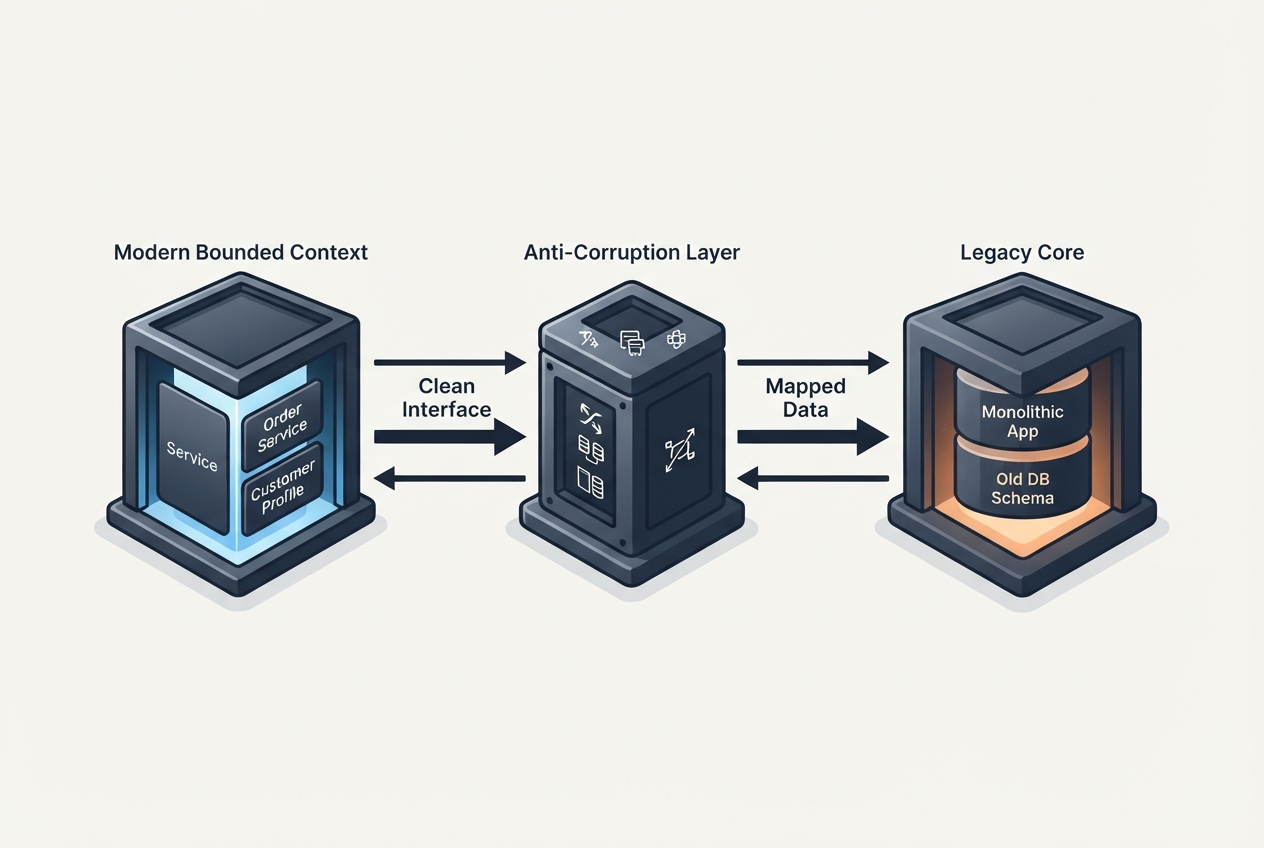
Within a legacy enterprise application, disparate concepts often share ambiguous terminology and tangled object models. A bounded context defines a contextual perimeter within which a specific business domain model applies exclusively. When a newly extracted microservice must exchange information with messy legacy data structures, architects construct an Anti-Corruption Layer to translate external payloads into clean internal domain language without contaminating modern services.
This decoupling mechanism ensures that legacy naming conventions, deprecated schemas, and inconsistent data models do not compromise modern cloud-native architectures. Engineering teams can visit the SnapKodex home platform to examine real-world architectural case studies, learn modern software delivery practices, and evaluate structural migration frameworks for complex enterprise application modernization.
How Can Engineering Teams Overcome Shared Database Coupling?
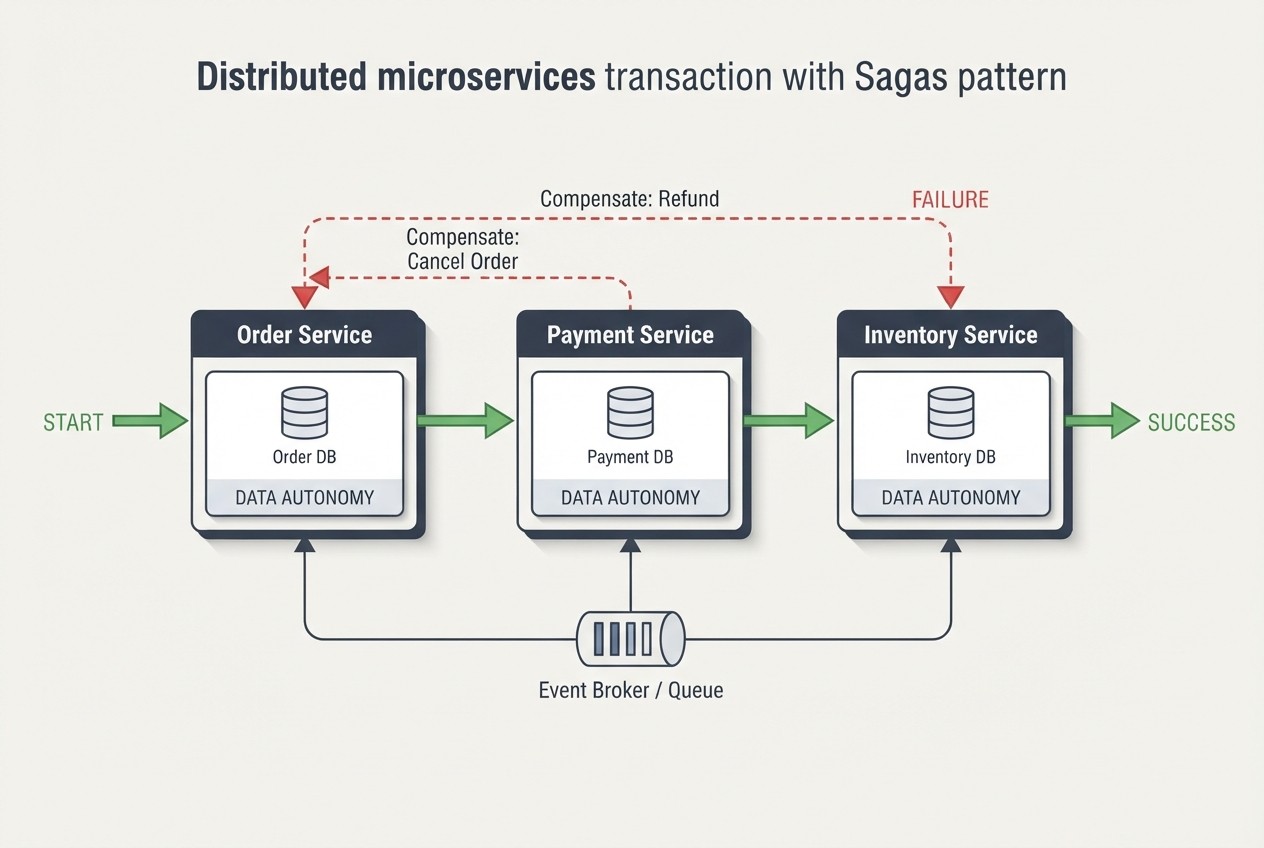
Disentangling a monolithic database represents the single most complex technical challenge encountered during architectural migrations. Legacy monoliths routinely rely on unified relational databases where foreign keys, database triggers, and complex multi-table SQL joins tightly bind unrelated business domains together. Attempting to deploy independent microservices that query a single shared database preserves critical architectural coupling and introduces severe deployment gridlocks.
Adopting a strict database-per-service pattern is essential for establishing genuine operational autonomy. Under this architectural paradigm, each microservice owns its private data persistence layer, completely preventing foreign services from accessing its tables directly. When external services require access to encapsulated data, they must request it through published application programming interfaces or consume real-time domain events broadcast over an enterprise message broker.
- A database-per-service design enforces genuine data ownership and autonomy.
- Eliminating cross-domain database joins prevents structural schema deadlocks.
- Asynchronous event streaming decouples data distribution across microservices.
Implementing Event-Driven Sagas for Distributed Consistency
Because individual microservices cannot rely on traditional atomic database transactions spanning multiple network boundaries, architects implement eventual consistency models using the Saga pattern. A saga organizes distributed transactions into a sequence of localized transactions executed across independent microservices. Each microservice updates its private datastore and publishes an event; subsequent services listen for this event and perform their designated localized transaction.
If any step within the sequence experiences a runtime error or business validation rejection, the saga coordinator publishes compensating events that systematically undo preceding transactions. For engineering teams producing detailed technical documentation, migration guidelines, or API references across complex systems, collaborating with https://snapkodex.com/services/seo-content helps articulate engineering achievements and ensure clear technical communication for all enterprise stakeholders.
- The Saga pattern coordinates complex business transactions across independent stores.
- Compensating transactions reverse partial operations when downstream steps encounter failure.
Monolithic Architecture Compared to Distributed Microservices
Understanding the core engineering, operational, and organizational trade-offs between monolithic legacy systems and modern microservice architectures.
| Operational Dimension | Monolithic Architecture | Modern Microservices |
|---|---|---|
| Deployment Independence | Single monolithic binary; all changes require complete application deployment. | Autonomous service deployments; independent release lifecycles and schedules. |
| Scalability Vector | Vertical scaling; entire application footprint must scale concurrently. | Horizontal scaling; individual high-traffic services scale independently. |
| Fault Isolation | Single runtime exceptions or memory leaks can crash the entire monolith. | Faults remain isolated within microservice boundaries, preserving system uptime. |
| Data Management | Single centralized database with tightly coupled multi-table SQL joins. | Database-per-service paradigm utilizing asynchronous event-driven consistency. |
| Team Autonomy | Large teams contend with merge conflicts and slow regression pipelines. | Small, cross-functional teams independently own and deploy distinct domains. |
Frequently asked questions
What is the Strangler Fig pattern in legacy migration?
The Strangler Fig pattern is an incremental architectural migration strategy where an API gateway intercepts incoming traffic, gradually rerouting requests from a legacy monolithic application to newly developed microservices until the legacy system can be safely decommissioned.
Why are big-bang software rewrites discouraged in enterprise environments?
Big-bang rewrites are discouraged because they require freezing feature delivery, underestimate undocumented legacy business rules, exceed budgetary boundaries, and frequently introduce severe regression defects that disrupt production operations.
How do microservices maintain data consistency without shared databases?
Microservices achieve data consistency by utilizing event-driven architectures and the Saga pattern, executing a series of localized transactions across services and applying automated compensating transactions if a failure occurs.
What is an Anti-Corruption Layer and when should it be implemented?
An Anti-Corruption Layer is a translation boundary that mediates communication between modern microservices and legacy monoliths, converting legacy schemas into clean domain models to prevent structural technical debt from polluting modern systems.